All posts by loristory

Unknown's avatar

About loristory

I am a mother, grandmother, and school psychologist/writer. I dabble in photography and music. I'm a big fan of Rosa Parks and Fred Rogers. I also like Steve Martin, Doc Martin, and my Martin guitar. I like binge-watching The West Wing, and eating chicken wings. I'm a little bit complicated.

So Many Questions

Dear Cheer Peppers,

What’s all this talk about Nano Poblano?

Why am I hearing about it just now?

Who are these peppers so chatty and cheerful?

Where do I upload my writing, and how?

One post a day for a month – are you crazy?

How can I manage to fit all that in?

What if I’m stranded on some desert island

Or dressing a turkey, or driving? What then?

Do I sound anxious? A bit apprehensive?

Am I afraid I’m not up to the task?

Yes, yes, and yes are my own honest answers

(To say otherwise would be too much to ask.)

Don’t get me wrong, I admire your focus

Your writing commitment is stunning and brave

But me, I’ll admit that I’m often quite scattered

Besides, I don’t think I have that much to say.

But hey, what the heck. I’m a sucker for challenge

Just dare me to do it and do it I’ll try

So I’m dipping my toe in the great Nano River

I’ll sink or I’ll swim but I won’t come out dry.

The water’s refreshing! I feel so much better!

Is that my reflection? And is that a smile?

I’m wading in now on the first of November

Please throw me a pencil; I’ll be here a while.

Badge 2017

Happy Nano Poblano Eve

Hello Halloween, goodbye sanity. Starting tomorrow, and for the next thirty days, I’ll be immersed in Nano Poblano. Wish me luck!

What is Nano Poblano, you ask? I asked myself the same question after stumbling upon it on the blogosphere about a month ago. Turns out, it’s a thing. A blogging thing. And it’s been going on for at least a few years. The short explanation is that bloggers challenge themselves to post every day during the month of November, instead of every once in a while when inspiration hits them. (The longer explanation by rarasaur, is here. It’s an interesting read.)

Nano Poblano is meant to help writers connect with other writers, hone their writing skills, and maybe — just maybe — attract a few interested readers who love reading their blog. That sounds good on paper, but writing thirty posts in thirty days may kill me (or destroy my marriage). I’m not sure I’ll be able to produce the goods. But, to quote Stuart Smalley (a.k.a. Senator Al Franken): “I’m good enough, I’m smart enough, and – gosh darn it – people like me!” At least that’s what my husband tells me. So If I’m still alive and married on November 30, I’ll just post a big smiley face on December 1.

What will YOU be doing in November?

Badge 2017

Your Sneak Preview

Go on … admit it. You’re curious about my new e-book, Standing in the Surf, available at Amazon.com. Well, look no further. What you see below is none other than the Introduction, in all its introductory glory! And just because you’re here, and I like you, from now until November 30 I’ll send you a link so you can view the entire book for FREE in the hopes that you’ll write a review. To get your free link, just fill out the contact form at the bottom of this post. And please don’t forget to leave a review on the Amazon page, here. THANKS!

AND NOW, WITHOUT FURTHER ADO … the INTRODUCTION:

Recently, I retired. Wanting to give my friends at work a parting gift, I wrote an amusing (to me) song called “Just Retired.” At my retirement luncheon, I handed out the lyrics and invited everyone to stand up and sing along with me. The melody was vaguely familiar — in fact, I might have stolen it — so my kind co-workers humored me by joining in. They even gave me a standing ovation, since they already were standing. (I recorded the song and put it on YouTube. You can listen to it right now.)

Did you like the part where I sang about how I’d soon be sleeping till nine or ten every day, and then I’d sit around like a lazy bum collecting Social Security? Well, I lied. I’m not one to sit around for very long. In fact, just one week after I retired, I became a traveling fool.

First, I visited my family in upstate New York, and then I flew to Seattle, where my husband Chuck was visiting his family. He’d rented a cabin on nearby Whidbey Island, in the area known as the Salish Sea. We thought it would be a great place to unwind. Ocean waves and hiking trails were just what I needed to get back in touch with life’s natural rhythms after years of Monday through Friday routines. We spent three weeks exploring the area. This book is my attempt to capture what I experienced at Whidbey Island, Camano Island, Stanley Park, and Vancouver Island during that time.

Speaking of rhythms, Chuck and I used to play music in a band called Pacific Buffalo. (You can read about us and hear our music at pacificbuffalo.com.) The reason I’m telling you about our band is so that I can explain how I came up with the title for this book.

“Standing in the Surf” is a combination of ”Standing Still” and “Old Man in the Surf,” two songs that Chuck wrote and that Pacific Buffalo recorded (as I’m sure you already know if you wisely decided to listen to our music). I was having a hard time creating a book title on my own. Since plagiarism had worked so well for me when I wrote my retirement song, I just borrowed a few words from Chuck’s song titles and told him about it later.

Although this book does contain actual photos of surf (most of which I took while standing), there are even more pictures of other things, like flowers, trees, people, and animals. To me, it’s all connected — just my way of expressing what it felt like, finally, to be free of the ringing alarm clock and to listen to nature’s heartbeat instead. It’s there in the pounding of the surf, but it’s also in the hiker’s footsteps, the squirrel’s chatter, and the petal’s unfolding.

This book can be read in either a standing, sitting, or lying down position. I don’t recommend reading it while surfing, though, unless you’re reading the e-book version and your device is waterproof.

Lori Bonati-Phillips, 2017

Go back

Your message has been sent

Warning
Warning
Warning
Warning

Warning.

Standing in the Surf

For those of you who stayed tuned from my previous post (Trials and Tribulations of an E-book Author), I’m here to tell you that I was finally successful in formatting my photo book (Standing in the Surf) and uploading it to Amazon as an e-book. It went up on their website two days ago as a pre-order option, and went “live” today. So far I have sold 3 copies, one of which I bought myself just to see if the system was working, and one was purchased by my husband. Whoever buyer number 3 is, I wish I could hug you and buy you dinner, but I don’t know who you are.

I’ll get this out of the way right now:

If you want to buy the book, click here!

The “Look Inside This Book” feature also went live today, but wasn’t formatted correctly for an iPad or iPhone. It did look okay on my desktop computer, though. As far as I can tell, there’s no way to disable that feature or fix it once it’s been added. I decided to just be thankful for the little progress I’ve made and move on.

Being the masochist that I am, though, moving on meant trying to make my e-book into a paperback. I’ll spare you the nightmarish details of what I’ve gone through today to make that happen. Fingers crossed, the paperback will be available soon!


Trials and Tribulations of an E-book Author

Have you ever tried to publish an e-book? Talk about frustrating. All morning, I’ve been on countless websites, digging through notes, and tearing my hair out trying to get a handle on this, without much progress. If I ever go totally insane and decide to write another e-book again, please talk me out of it, or just direct me to this post so I’ll reconsider.

Writing the book was the easy part. Shortly after returning from vacation, I’d decided that the pictures in my camera might be good enough for a photo book. It took me a few days to learn how to use Lightroom (my new photo editing software) so that I’d have images good enough to print, and then a couple of weeks to put them in some semblance of order and start writing witty yet meaningful text to accompany them. It was a logical, step-by-step process, one that left me feeling semi-talented and fulfilled at the end of each day. Not so with creating an e-book. All I feel is dumb and dumber.

Yesterday, I thought my work was done. The good thing about Lightroom is that, with one push of a button, you can send your finished photo book to Blurb.com to be published. The bad thing about Lightroom is that you’re locked into Blurb, and Blurb’s great mission seems to be making hardcover and paperback books. To convert your Blurb book to an e-book, you’re up the creek without a paddle, a life raft, or a canoe.

But I went ahead and uploaded the book to Blurb anyway, because I didn’t know how else to make a book. With Blurb, you have to order at least one book (hard cover or paperback). I had set it up as a hardcover and hesitated changing it to soft, for fear that it would mess up my margins, etc. So I went ahead and sprung for one hardcover copy, knowing that if it turned out shitty I’d just hide it in my closet.

All advice I’ve read stresses the importance of printing out a copy of your draft before ordering your book. I wanted to do that, but in order to print the draft, I had to convert the file to something called “pdf.” (Pretty Damn Funny?) I had no idea what might happen if I clicked on the little “convert to pdf” button in Lightroom, so I didn’t print a draft copy. I feared that my text and photos would disappear or be converted into some unrecognizable electronic version of themselves. It was safer to just send the damn thing to Blurb and let them take over. After all, I’d proofread my book a thousand times, hadn’t I?

So I sent the damn thing in to Blurb.

Once I uploaded the book and ordered my copy, I was so relieved. “That’s that! I’m done!” I thought. But I could not have been more wrong.

Within a few minutes, I received an email from Blurb saying that the “pdf” version of my book was available to download. Thinking I’d better take a look, I excitedly downloaded it onto my phone and started reading. All was well until I got to page 14. Where was the photo for that page? Somehow, I must have deleted it by mistake before I clicked “send.” Luckily, the email said that I could cancel my order within one hour. I ran to my computer and cancelled my order. OK, fine. Now to put that damn photo back in.

I searched and searched and finally found the photo in my computer’s hard drive. I guess it must have gotten deleted from Lightroom when I hit “undo” too many times. I put it back in place and resubmitted my book order. Then I looked at the next download. Uh-oh. One of my photos had gotten rotated. I still have no idea how that happened. To rotate a photo takes pressing two keys simultaneously. There’s no way I can be blamed for that. But it was an easy fix. I just cancelled my second order and started from scratch (again).

Photo rotated, I proceeded to give my book one last proofread, and decided to change a word or two while I was at it. (Editing never ends.)

Another upload, another problem. This time another photo had disappeared. I cancelled order #3, found the missing photo (somehow moving it from the desktop to the hard drive was enough to send Blurb into a tizzy), put the photo back into the book, and made my fourth and final order.

But now we come to the really frustrating part: converting my precious photo book to an e-book. First I tried Blurb, since they already had the damn book. But their conversion process changed the font so that nothing fit anymore. It would have taken me days to fix it.

I spent two hours Googling and trying various conversion programs. None of them solved the problem. For example:

Calibre — it messed up the formatting even worse than Blurb did. It cut off parts of photos, moved whole sentences around, and changed the font.

Ingram Spark — their website sounded good and I’d met one of their reps at a workshop once. I even have one of their t-shirts. I decided to go with them, and even paid $85 so they could give me an e-book ISBN number (needed in order to use their e-book service). But then I tried to upload my file to them and was blocked by a message saying that I had to convert the document to EPub. It said to “click here” to learn more. I’m sure I read somewhere that Ingram Spark will convert your file to EPub for you. When you click, you get information about what EPub is, and a warning that if you have someone else (a “third party”) convert the file for you, you should run it through Ingram Spark’s program to make sure it’s compatible. But nowhere could I find a link to Ingram Spark’s EPub file conversion service. I searched the FAQ and blog sites on their website to no avail. I sent them an email, but was too impatient to wait for a response. I called them and was on hold for ten minutes. The person who answered had to put me on hold again while he checked with his supervisor to see if they had an EPub converter. They did NOT. They recommended a program called InDesign. I already own InDesign, but, like me, it’s complicated and out of date. I was not about to buy it again. I asked if I could get my $85 back (the money I’d just spent on an ISBN number) and they said no, but I could cancel the ISBN number if I wanted to. I thanked them and hung up.

Somehow, through all the Googling I did right after that, I landed in Kindle Land. Kindle has something that apparently might work. Hooray!

I went ahead and took the Kindle plunge. I closed my eyes, clicked on “download pdf file” in Lightroom, and uploaded it to Kindle — and, lo and behold, it worked. Sort of. What I now had was a “kpf” version. (Kindle Pays Fine?) There were no changes to font, margins, layout, or anything, except for the cover, which I had to redesign using one of their templates. It wasn’t exactly the same as the one I’d designed in Lightroom, but it didn’t look too bad.

The next step in the Kindle process was something called “KDP pricing.” (Kindle Doesn’t Pay?) It has something to do with setting the price of your book, but it’s not self-explanatory. I even tried Googling it. It’s apparently an algorithm comparing your book with others like it. It sat there “analyzing historical data” for about 20 minutes. The little circle just kept spinning. I finally gave up and hit the back arrow, wondering if I’d lose my whole morning’s work. It kicked me out and I had to sign in again. Of course, that involved looking up my Amazon password, which I never can remember.

Miraculously, I was back on the page with KDP pricing. I clicked the box and the circle started spinning again, with no sign of ever stopping. I punched the back arrow (a little harder this time) and was asked to choose a “KDP Royalty Plan,” either 35% or 70%. What the hell does that mean? I Googled it and learned that you should choose 70% if your book is priced $2.99 to $9.99; otherwise you can only choose 35%. Why doesn’t Kindle automatically do that for you, or at least tell you which one means what? My book is only $2.99 so I chose 70% royalties. Does that mean I make 70% on my book? Who knows? Because here’s what the screen then told me:

Rate     Delivery     Royalty

35%     $0.00           $1.40

70%     $17.05         $0.00

Wait, what?

Determined to persevere, I ignored the above confusing numbers and clicked the “submit for pre-order” button. (I had been advised at a workshop to set the book up for pre-orders first, and change it later. I have no idea why.)

I’m pretty sure the e-book is now in process, but I’m so confused that I’ll have to check on that later. I do know that I also tried creating a softcover book with Kindle. First I tried uploading my text, but Kindle wanted me to upload something called a manuscript version, adding that I should, “click here for more information about what a manuscript version is.” I clicked and got a long set of instructions that I had to copy and paste into Word so that I could refer back to them. About the fifth step down it said to find and upload the “revised” manuscript file. Which one is that? I guessed the “kpf” version and I guessed wrong. They wanted the pdf version. OMG. But it started to upload. The next thing I saw was this very special message: “Congratulations, your manuscript has uploaded!” Halleluiah. I’m almost done.

Oh, the damn cover.

After an hour of struggling with Kindle’s limited softcover options, the text on the binding disappeared and there was apparently no way to add it back. I finally managed to complete a reasonable facsimile of my original cover, although there’s still no binding edge. Maybe the book’s too skinny for that? Oh well, I submitted it anyway.

And now Kindle wants a different ISBN number for the softcover book. I think Blurb may have given me one yesterday, but of course it’s nowhere to be found —  not in the notes I hastily scribbled while going through all of this with Blurb yesterday, and not on my Blurb account page, either. I searched for a way to call Blurb, but “Blurb is no longer taking calls.” You have to email them! So I did.

I’m waiting for Blurb to get back to me about my ISBN number. Kindle won’t let me preview the book until I give them that number, so I guess my work is done for today.

Stay tuned!


American Dreamer

Early this morning — around 3 a.m. in fact — I started my new job as a tax preparer. I went out into the busy waiting room and asked, “Who’s next?” A tall man in the front row eagerly raised his hand. It was Ronald Reagan.

I tried not to let my disappointment show on my face while racking my brain for a way out. I could pretend I hadn’t seen him. I could announce that we were closing for lunch. Or I could just quit. But in the end, I knew that I had no choice. I gave him a nod and we walked back to the cubicles.

I asked him if he’d like a more private office, and I was overcome with pangs of guilt for doing so. Why was I giving him royal treatment? I should just treat him like everyone else, I told myself. But it was too late. My co-workers had gotten wind of our special client, and they were hustling to vacate the director’s office so that we could use it. We entered the cushy room with its mahogany desk and velvet chairs, and sat down across from each other.

Suddenly, Reagan pulled out a ragged old newspaper with a shocking headline and risqué photograph of a woman. He thought it was hilarious. I told him that he was being inappropriate. Then I mustered up the courage to say that I really didn’t think I should be doing his taxes, because it was my first day on the job, and I’d never prepared anyone’s taxes before. “And besides,” I said, pausing for effect and looking him straight in the eye, “I’m not at all a Trump supporter!”

Reagan wasn’t fazed at all. He still wanted me to do his taxes, but first, we had to do his laundry. So down into the basement we went. I don’t even remember how we got there, but suddenly we were standing in front of an old washer and dryer in a dark, musty basement, filling up the tub with his dirty clothes. I turned on the machine and almost immediately flooded the basement. Realizing that we were standing in six inches of water, we abandoned our project and rushed toward the stairs. Once safe on the first floor, I pulled out my cell phone, called my mother, and asked her to help.

And then I woke up.

It’s only a dream, I thought with relief. And whatever you do, I told myself, do NOT close your eyes and go back to sleep!

Once fully awake, I tried to analyze the symbols in my dream. New Job. Taxes. Dirty Laundry. Flood. Ronald Reagan. What was my dream trying to tell me?

My first attempt at dream analysis resulted in the following possibilities:

  • New Job = I just started a new “career” (retirement).
  • Taxes = Identification with my father (who worked for the IRS).
  • Dirty Laundry = Scandals in the presidency.
  • Flood = Trickle-down economics.
  • Ronald Reagan = See Flood.

All of that made sense. But then it hit me. Last night, just before bed, I’d been practicing my guitar for the first time in a while. One of the songs I played was “American Dreamer,” something I wrote in 2009, right after the American housing bubble burst. (You can listen to it here.) The song tells the tale of someone who got in over his head because he believed what the banks and the real estate developers were telling him. He’d purchased a home with a balloon mortgage and then had lost his job and his home. People were blaming him for being greedy, but he says his mistake was following someone else’s dream.

So on a deeper level, my dream might symbolize what happens when you’ve gone along with the crowd and then are faced with a dilemma. Do you continue to follow the rules, despite your beliefs, or do you stand up to authority? Because if you don’t, you may find yourself in hot water. With Ronald Reagan.

I once dreamed that Bill Clinton kissed me on the cheek. Luckily, I did not have sexual relations with that man. I haven’t had any Obama dreams yet, although that would be nice. I wouldn’t even try to wake up!

An Improvised Life


     I recently watched the movie Don’t Think Twice for the second time. (Call me oppositional.) It’s a fictional, inside peek at what it’s like to be part of a group of friends that is also a struggling comedy improv troupe.

     One of the themes of the movie is “living in the moment,” — an important element when you’re on stage in front of a live audience, trying to be witty without a script. It made me think about how scripted my life has been up until now. In fact, a big part of my job for the past twenty years has been reading scripted test instructions to kids. The scriptedness of my career is one of the reasons I decided to retire this month. Whew! I’d had enough of that. But now what?

     I did make a sort of plan. The first two items on my list were to visit family 2,000 miles away and to be there for my grandson’s second birthday. I flew from Tucson to Montreal, just across the border from where my sister Sue lives. We spent the next three days practicing our French, eating pastries, and laughing it up in Vieux Montréal. I then traveled by train to Albany for a visit with Mom, sister Amy, and sister Lisa. Next on the agenda was renting a car and driving to Rochester for some quality time with daughters Erica and Katie, grandson Porter, and a few old friends. Mission accomplished, and still accomplishing, as I have about a week left here and am looking forward to a full day at the zoo or at the Museum of Play with Porter tomorrow.

     What I hadn’t planned on was that the Rochester Jazz Festival would be taking place simultaneously with my visit. This trip has turned into a wonderful chance for me to practice living in the moment, and what better way to do that than in the company of jazz, the ultimate medium of improvisation. I want to tell you about the show I heard last night.

     But first, to give you an idea of how my life has become sort of random lately (and I’m loving it), here’s what happened yesterday:

     -Woke up, decided to skip breakfast and dashed off to a yoga class.

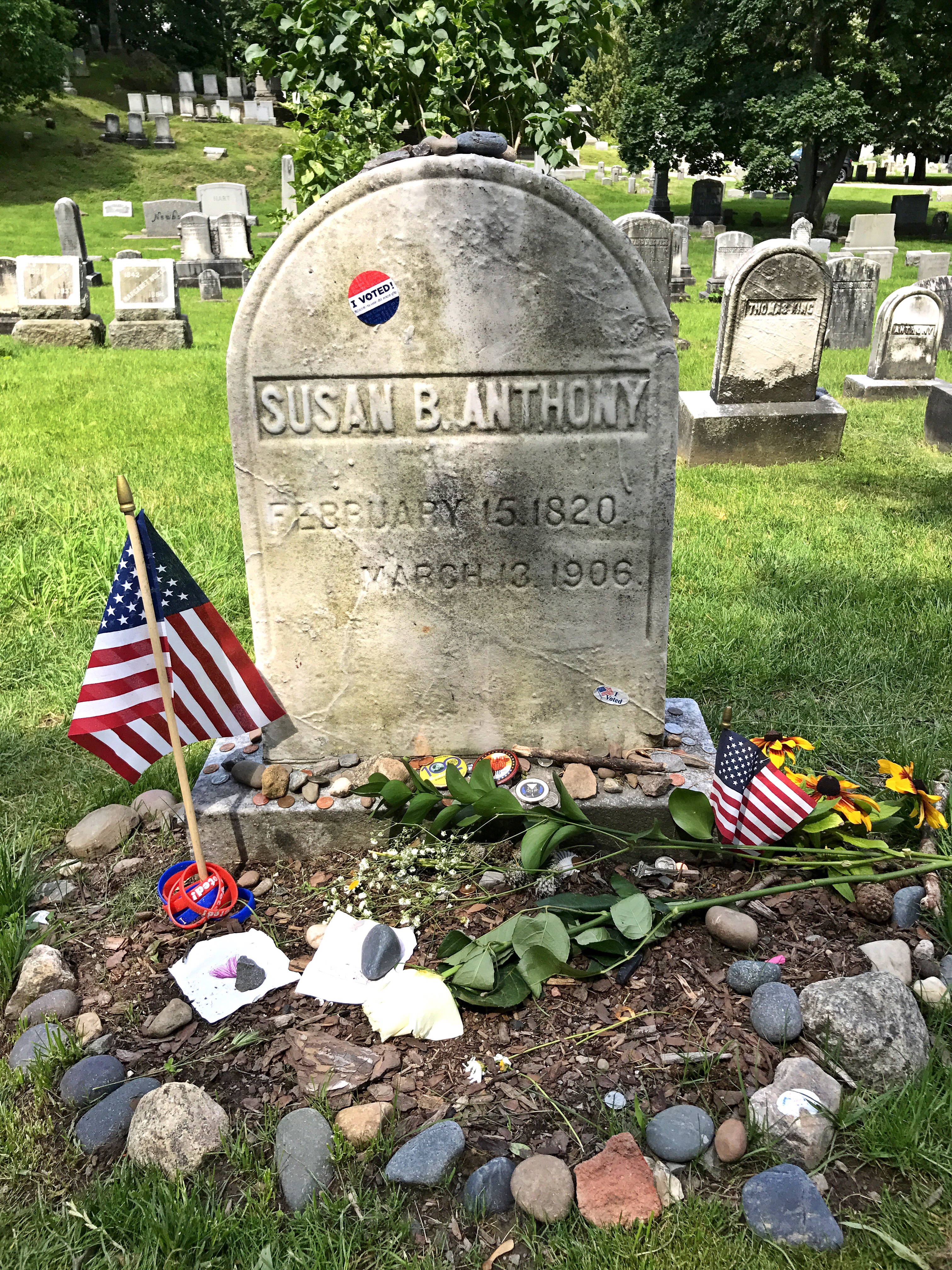
     – Made a split-second decision to go to Mt. Hope Cemetery to take a picture of Susan B. Anthony’s grave stone. Drove in without a map, headed for the older section. Couldn’t find the stone. Started driving out through the confusing web of winding roads in the old section, and by chance I took the very road that led to her grave. 

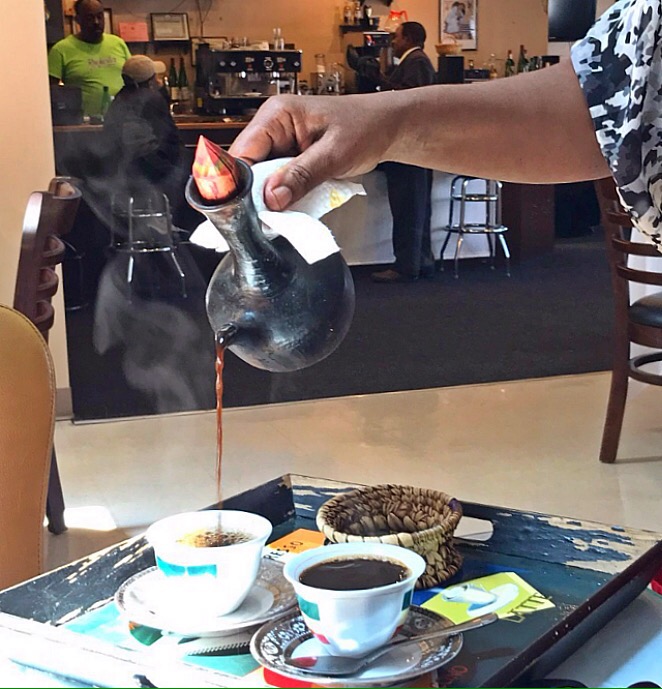
     – Met my good friend Alex for lunch, had Ethiopian food, which was about as spontaneous as lunch gets. There was one big platter of various unidentified foods, scooped up with torn pieces of spongy bread, and Ethiopian coffee brewed with beans that they had just roasted in their kitchen. We had decided against ordering the Ethiopian Coffee Ceremony, because it cost about $15. It was misspelled on the menu as Coffee Ceremoney — which we thought was hilarious.


     – Went shopping for Porter’s birthday gifts, and did some impulse spending on gifts for my daughters, too.

      – Treated myself to an unplanned cup of coffee and a slice of strawberry-rhubarb pie at my favorite little coffee shop in town (Canaltown Coffee Roasters).

     – While savoring my pie and caffeine (and maybe because of it), I decided to check out a jazz show that was happening — I thought — at Java Joe’s. After finding a decent place to park downtown and standing in line to pay for said parking, I walked the six blocks to Java Joe’s, only to discover that the show was at Joe Bean Coffee Roasters instead. I thought it was just a few doors down, but after consulting with Googlemaps (who needs the right side of your brain when you have Googlemaps?) I discovered that I’d be walking two miles to get there. So it was back to the paid parking lot, out of the parking lot, and on to Joe Bean.

     – I finally arrived at my destination, paid the $5 cover charge, sat down, and heard the last few notes of the band’s final song. The next group wouldn’t be on for another hour. Not a problem. I decided to stay for the second act, the Tyrone Allen II Quartet, about whom I knew nothing. But with my new, retired life ahead of me, I was starting to experience a wonderful sense of freedom. Why not stay? What else did I have to do?

     I ordered a glass of wine (not coffee!), and entertained myself with a crossword puzzle and an Italian grammar book (that’s a whole other story). While waiting, the strains of Herbie Hancock’s Maiden Voyage could be heard over the cafe’s sound system. How ironic, since I had just been reading about that song the previous night in a book I’d found in my rental house (How to Listen to Jazz by Jerry Coker).

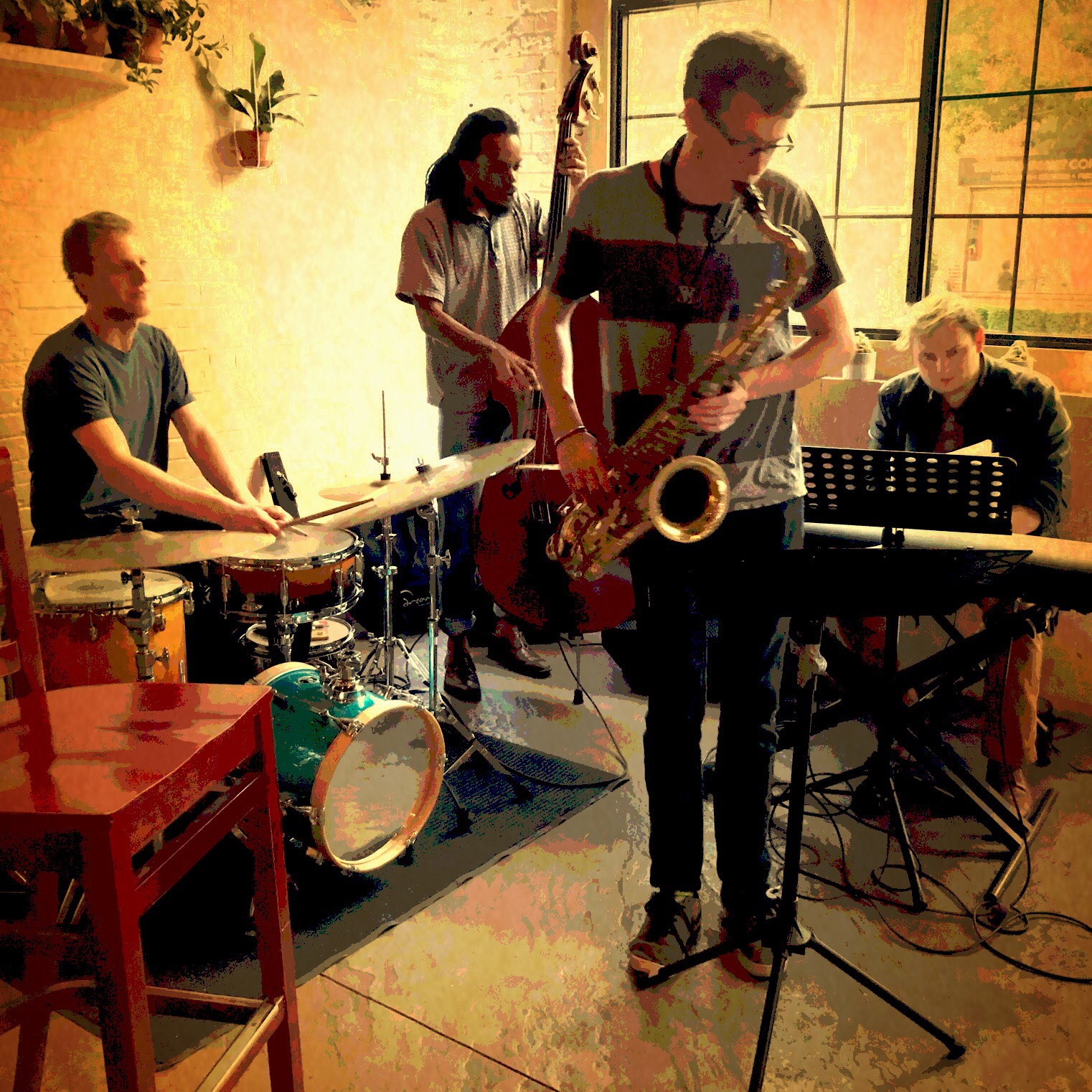
     The wait was well worth it. So worth it, in fact, that I’m having trouble finding the words to describe how good this group was. They were young — all recent graduates of the Eastman School of Music — but extremely talented. I was so blown away that it was probably noticeable. When I left, two folks in the crowd who appeared to be the bass player’s parents waved goodbye to me. I think they saw me picking my jaw up off of the floor during the performance. The bass player, Tyrone Allen II, was their modest leader who played several sensitive and interesting solos. The drummer, with the happy name Daniel Sunshine, was lively yet cool. On electric keyboards was Andrew Links, musical, experimental, out there, yet blending perfectly in the mix, and I loved watching his mouth move while he played. And out in front, on sax, was Rowan Wolf, who looks like he could still be in high school but plays like an old soul. And fast! His fingers were a blur at times. 

     If yesterday was any indication, I’ll be doing a lot of improvising myself from now on. And listening to last night’s free-form jazz was the right way to get started.


House Painting in America (With Apologies to Richard Brautigan)

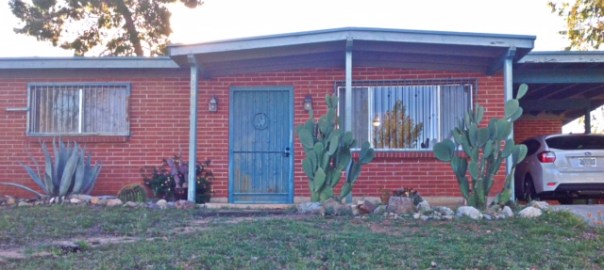
I live in a brick house. I know what song you’re probably humming in your head right now. But no, my house isn’t like that — not “mighty-mighty” at all. It’s just a modest, three-bedroom ranch on the outskirts of Tucson, a structurally solid little home à la The Three Little Pigs. But if I don’t slap some fresh paint on those peeling wooden posts and beams soon, I fear that a coyote might come along and blow the whole thing down.

I’ve lived in this home for almost twelve years, and up until now it hasn’t needed much. It looked just fine when I bought it, but the scorching desert sun, the monsoon rains, and the wind-blown dust have begun to take their toll. Just in case you don’t believe me about the sad state of my current abode, take another look at the above photo.

Can you see the faded color, the peeling paint, the rust on the metal doors and window bars? (For some reason, window bars were all the rage back in 1971, when the house was built.) I’m debating whether or not to get rid of those bars. All the experts (by experts I mean Google articles) say that removing the bars increases the home’s resale value. It’s good for curb appeal, they say, and it gives the impression of a safe neighborhood. But I say that removing the bars gives the impression of a house that can be broken into easily. I’m especially sensitive to that possibility. Burglars once let themselves in through the barred – but unlocked – back door, which I’d forgotten to lock when I went out to spend the day at a Blues Festival. How ironic is that? Blues all day, more blues when I got home. I should have sat down and written a blues song right then and there, but I couldn’t, because the thieves had stolen my guitar.

But when it came to painting my house, the dilemma about window bars turned out to be the least of my problems. Securing a painter was the hard part. Not knowing where to start searching, I posted a plea on Facebook. “Looking for a house painter in Tucson” yielded no comments at first. After my second post, though, I got a response. A friend recommended her house painter. Things were going well until he didn’t respond when I asked him to put his quote in writing. Needless to say, I decided not to go with him. After a second quote that was twice as high as the first, I finally found who I was looking for – a friend of a friend, a good quote, and a reliable response. I have to admit that I didn’t ask him to put his quote in writing (since he was a friend of a friend) and I hope I don’t live to regret that … but so far the work looks good and I’m not worried. If I have to write a blues song, though, I’m prepared this time. I have another guitar.

This painter is spraying my house with a garden hose as I type this. Should I ask him if he’s going to scrape? How does one oversee the painting of one’s house, when one does not know the first thing about painting a house?

Another dilemma has been choosing paint colors. As you can see from the “before” photo, the bricks are a reddish-orange, and the current trim is a dark teal, faded in most areas to a light teal. I like teal, but my absolute least favorite color is reddish-orange. Especially when combined with teal. Ugh! Orange and teal. I hate orange and teal! It reminds me of a football jersey. Maybe I’m thinking of the Miami Dolphins. I’m from Buffalo, and the Dolphins are the Bills’ arch nemesis, so maybe the hatred of orange and teal was ingrained in me at an early age. But I digress.

Reddish-orange is okay when paired with brown, gold, and green, though. I’m picturing autumn in upstate New York. Those beautiful golden colors that warm the heart just as the air is starting to feel frosty around the nose and ears. I guess I’ve come to peace with the reddish-orange bricks, as long as I surround them with a fall color, like brown.

But what to do about the front door? I’ve always liked the concept of making a bold statement, even if I’ve been too shy to make one myself. I’ve seen houses with red doors, black doors, wooden doors, doors that say, “I’m not shy and I’m inviting you in.” “Right this way to a dynamic life.” “This portal leads to treasure.” OK, now I’m exaggerating. But what if my heretofore drab little brick ranch had a black, gold, or red door? What would that say about me, the owner of such a grand portal? I decided to check with my good friend, Google.

According to Google, a door color is not something to be taken lightly. The correct door color will attract positive energy, or chi, into your home, and therefore is very important. Not wanting to take any chances with chi, I decided to let Google lead me further … right into the world of feng shui. Follow me.

Don’t worry, you won’t have to follow very far. I didn’t. I just read one or two articles and made up my mind. Green. According to feng shui, if your front door faces east, like mine does, you need to have a door that is the colors of the element of wood: either green or brown. You should never paint your door red, purple, white or gray. Voilà, problem solved. I consulted my paint brochure and there, on page two, was a combination I fell instantly in love with: Mayan Chocolate and Flagstone Quartzite. Flagstone Quartzite is just a fancy name for sage green. It’s an exact match to the prickly pear cactuses (yes, cactuses, not cacti) that stand a little too tall in front of my front picture window, and which I need to carefully trim. (Please note that the Desert Museum’s official word for the plural form of cactus is cactuses, because they claim that most people just don’t use those old Latin plurals like cacti and octopi anymore. I’d say they’ve got a point. Pun intended.)

But again, I digress. The color scheme of my house is now set. Chocolate for most of the trim, a lighter brown for certain other parts of the trim, including window bars, and that lovely sage green for the front door. I can’t wait to see how it all comes together, and I guess you could say I’m a little obsessed. Everywhere I go, I find myself checking out color schemes on houses, even if they’re nothing like my own. But then when I picture that brown/tan/sage/brick red combo in my head, I feel my whole body relax. Is there such a thing as color therapy? (Oh yes, there is. I wrote about it in a previous blog post.) But this is different. I’m coloring a picture that I’m going to have to live with for a long time. Every time I turn into my driveway, there it will be. I’m so glad I won’t have to see that red/teal combination ever again.

So, what does all of this have to do with Richard Brautigan? For some reason, I liked using the title “House Painting in America” for this blog post because it reminded me of Richard Brautigan’s 1967 novel, Trout Fishing in America. I probably read it in 1971, the year my house was built. (It was required reading in one of my college English classes.) I just Googled the book and there it was, its iconic cover with a bespectacled Richard Brautigan and his muse filling my computer screen. Startlingly, I realized that the cover of Trout Fishing in America just happens to be sort of a brick red color, with a brown and tan photo in the middle. Well. I’ll have to go down to the used bookstore and buy myself a copy. I’ll bet if I open it up, there’ll be a sage green door on page one.

Paying My Rent

Yesterday, I carried a sign and marched with 15,000 people through the streets of Tucson. We walked in solidarity with millions of others around the world as part of the Women’s March on Washington.

Although I have a lot to say about that march, I want to focus on some amazing connections that happened to me afterwards.

I returned home feeling tired yet energized. After posting photos on Facebook and Instagram, reading friends’ posts, and then their links, and then the links within those links, I finally settled down at my kitchen table with a carry-out dinner. My eyes fell upon the small neighborhood newspaper that had been in my mailbox when I got home. I opened it. The first thing that caught my eye was an unexpected article about the multinational biotech company, Monsanto.

Monsanto wants to buy 155 acres in Marana, a rural town adjacent to Tucson, so that it can build a 7-acre greenhouse focusing on corn and soybean seed research. Their proposed purchase of the land has been the subject of controversy in Marana (which gets its name from the Spanish maraña, or “tangled web”). Some of its residents see the move as an opportunity for jobs, while others are worried about the impact on the land, water, and surrounding crops. (Monsanto produces the herbicide Roundup. Roundup’s main ingredient — glyphosate — has been proven to be harmful to bees and is a possible human carcinogen.) But Monsanto argues that even though they’ll be using some GMO seeds and “limited” herbicides, neither will escape from their greenhouses. This has been viewed with suspicion by several Marana residents, who also are concerned about the effect that Monsanto’s presence could have on Tucson’s new reputation as an International City of Gastronomy. (Tucson prides itself on its rich cultural heritage, which includes indigenous crops, dry farming methods, and unique culinary offerings.) And they wonder what Monsanto will eventually be doing with the other 148 acres.

There already have been four town meetings to discuss the plan. Those meetings were filled with people who came there to listen, learn, and protest. From what I read, it sounded like Monsanto was given plenty of time to make its presentations. Then the residents got to ask questions and make comments. Some mentioned environmental concerns. Not to worry, responded Monsanto, because the greenhouse will be sealed up tight. The county administrator and the Tucson chamber of commerce president also noted that the project would bring jobs and increased tax revenue to Marana (despite negotiations to give Monsanto a two-thirds property tax incentive).

I got up from the table and started doing dishes. While washing plates, my thoughts started to take shape. I was getting a picture in my mind of an interconnected pattern, like a tree with many branches. I stopped in the middle of my chore, rinsed and dried off my hands, and almost ran to my computer. Once there, I closed my eyes and let my thoughts run down into my fingertips and onto the screen. I had to get that tangled web of words out before they disappeared like the water that had been running down my kitchen drain.

But, after typing my draft, and feeling a bit overwhelmed by all of those ideas swirling around in my head, I suddenly had another idea, one that would help me to sort things out. I would create an issues notebook.

I found an empty three-ring binder and filled it up with blank lined paper. I grabbed a pencil. But where to start? So many issues, so many facts to check (and also, so little time). I started by making sections, one for each major issue that I thought might need fixing. The first one I thought of was “Environment.” I decided to begin there.

I went back to the computer and googled Monsanto. That’s when the amazing interconnection began to reveal itself. The best way to describe it is like this:

  • I went to the women’s march
  • I came home and, by chance, I read the article about Monsanto
  • I began researching Monsanto
  • I needed a break and decided to do a crossword puzzle instead
  • I got stuck on some of the words. One was a five-letter word meaning “groups who share views” which probably ends with the letters “cs.”
  • I resumed my research about Monsanto
  • I learned that it was purchased by Bayer (pending approval)
  • I googled Bayer
  • I learned to my horror that Bayer used people in German concentration camps as slave labor and for their experiments (and that its parent company at the time, IG Farben, invented the gas used in those concentration camps)
  • I wanted to know who owns Bayer now
  • I found out that Bayer isn’t owned by anyone other than its stockholders, but it is one of many companies managed by the Capital Group investment firm
  • This led me to an article listing the four major investment firms in the world, which manage the trillions of dollars that exist in the world’s portfolio of investments
  • I read another article about the 147 companies that control 80% of the world’s economy
  • I decided to go to the original source of the article about the 147 companies (The network of global corporate control, 2011, by Vitali, Glattfelder, and Battiston)
  • I skimmed that article and learned about how interconnected those 147 companies are, and how unstable that makes the world economy (when one company falls, many others follow)
  • I read about how fund managers use something called “topology” to describe the mathematical interdependence of these companies visually
  • I was shocked when I saw that word, “topology,” because I’ve just finished reading a novel about a math genius whose field was “topology.” (The book is A Doubter’s Almanac, by Ethan Canin, and I had to look up “topology” while I was reading it.)
  • And then the final connection of all the dots (ta-da!): In the article was the word “blocs,” which may just be the answer to that crossword puzzle clue (“groups who share views” ending with the letters “cs.”).

Whew. A real maraña.

I’ve decided that I need to focus on one issue in my notebook at a time, and take action on that. Maybe I will choose The Environment (or maybe it has already chosen me).

That’s how I’ll start paying my rent for living on the planet.

Lost at Sea

Once upon a time there was a ship. It was a big, beautiful ship. The ship had many design flaws, but it managed to stay afloat. One of its brilliant features was the multitude of steering mechanisms that it had on board. It had four different steering wheels — one in the bow, one in the stern, one in the center, and one toward the southeast. It had rudders. It had sails. It even had a gasoline motor.

Every four years, the ship would have to be overhauled. Some people thought it would be wise to make the steering wheels in the center and the southeast a little stronger than the other wheels, because they couldn’t see ahead as well as the other wheels, and that this would give the ship balance. And so it was done.

One morning, a bright, shiny rock appeared in front of the ship. It was so enormous, so tremendous, that it didn’t even look real. It swayed this way and that, hypnotizing some of the wheels on the ship. At times it seemed to mock the ship, but then it would promise the ship great things, and the ship listened.

‘We need to get to that rock!” the center wheel said. “Yes!” the southeast wheel agreed. “No, no,” said the wheels in the stern and the bow. But the central and southeastern wheels were stronger because of the way they were weighted. They pulled the ship along, right toward that bright, shiny rock, until it was too late. The ship shook and shuddered, and slowly sank to the bottom of the ocean.

The waves and the fishes saw what had happened to the ship. Some of the waves left as quickly as they could. Other waves decided to hurl themselves against the rock. It would take some time, but they knew they could eventually wear the rock down. The fishes just didn’t know what to do. Some of them went low, others went high, jumping right out of the water into the pure, pure air. And some (the ones who had been to school) pooled their efforts and pulled that ship back up to the surface.

(I wrote this shortly after waking up this morning. I’m not sure if I’m one of the fish that went to school, or a wave. Right now I just feel like I want a time machine.)