Schooled in Spain (Part 2)

In my previous post, Schooled in Spain (Part 1), I wrote about the beginning of my 8-day trip to southern Spain. That post covered the minor trials and tribulations on day 1, the recovery on day 2, and the market, winery, and tour of Cómpeta on day 3.

Part 2 continues with days 4 through 8, and I’ve added many more photos of Spain to my Photos page.

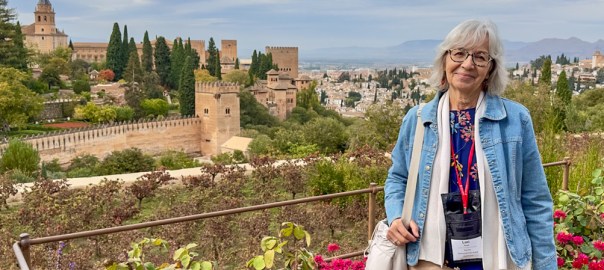
Day 4: Granada and the Alhambra: Thanks to the advance reading list from Road Scholar, I’d read about the Alhambra, but nothing could have adequately prepared me for touring the “Eighth Wonder of the World.” Although we had a tour guide, his words just swirled around me like a fog while I tried to take everything in. There were imposing walls with minimal windows (to ensure privacy), diagonal entryways (again, for privacy), courtyards within buildings, carvings mimicking stalactites, gardens, a reflecting pool, and thousands, perhaps millions, of intricate patterns, texts, and other inscriptions that, in keeping with Islamic requirements, never depicted the human form. I stood in the very room where Christopher Columbus received verbal approval from Queen Isabella to forge ahead with his plan to sail to India (and we all know how that turned out).

I found Granada to be a fascinating city of contrasts, with its ornate ancient architecture alongside fashionable storefronts and glittery Christmas decorations. While there, we visited a huge market, the Cathedral of Granada, and the Royal Chapel (where Queen Isabella and King Ferdinand rest … perhaps not in peace ). I got to see the queen’s robe, crown, scepter, and mirror (!) as well as the king’s sword. Side note: Besides funding Columbus in 1492, the king and queen horribly banished all Jews from Spain that same year and forced Spanish Muslims to convert to Catholicism).

Day 5: Flamenco and Frigiliana: In the morning, we enjoyed a Flamenco demonstration, where I learned that the foot-stomping of the genre is an imitation of the sound of tools striking hot metal in forges where many Romani worked in the past. (It’s considered more correct nowadays to say “Romani” instead of “gypsy,” although our guide and even the Flamenco dancers themselves used the word “gypsy” repeatedly.) Fun fact I learned on this trip: The Romani people originally came from India.

After Flamenco, we had a free afternoon. My choice was to explore a picturesque little village nearby called Frigiliana, only 5 minutes away by taxi. Three of my new friends on the tour joined me, and we had quite an adventure, especially when it came time to return home and we had no idea how to call a cab for the return trip. We’d assumed we’d just call the driver who’d brought us there, until we discovered that Nerja cabs only make the trip one way (from Nerja to Frigiliana, but not the other way around). Luckily, I’d seen a tourist info office a few blocks away, and with their help we managed to make it back to our hotel. It wouldn’t have been so bad being stranded in Frigiliana, though, since the place was absolutely crawling with tapas bars! (It was quite touristy.)

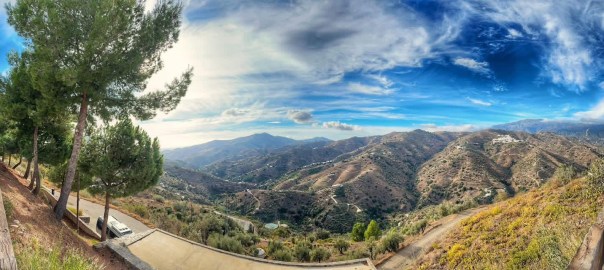
Day 6: I’ve been quite wordy so far in this post, so I’ll cut right to the chase. We visited an olive oil factory, tasted several different olive oils, and were served a delicious lunch in a local home. I even got to practice my Spanish with our host. The scenery there and back was breathtaking, too. I’ve never seen so many olive trees in my life!

Day 7: Again, I’ll be brief. Málaga was interesting and beautiful, and the Picasso Museum was outstanding. Every single piece in the museum is from Picasso’s own personal collection in his home!

Day 8: On this day, I rose early (4:30 am) and shared a cab to the Málaga airport with someone who, like my daughter, loves Brandi Carlile. Over coffee and pastries, we had a long and enjoyable conversation about music while waiting for our gates to open. Then I managed to find my way through both the Málaga and Madrid airports by following signs, arrows, and the sometimes LOUD, even YELLING voices of people directing travelers here and there, mostly in Spanish. I guess they figured if they yelled loudly enough, they’d be understood by everyone. Luckily, I knew enough Spanish to get in the right lines and into my airplane seat on time.

I’m really glad I had the chance to visit southern Spain and to learn about its history and blend of cultures. Thanks for coming on this journey with me, and don’t forget to check out my Photos!

Schooled in Spain (Part 1)

I recently took an 8-day Road Scholar trip to Andalucía, a small slice of Spain on the Mediterranean coast. The area can be quite touristy, but in November, not so much. The trip was stimulating and relaxing … and educational, too.

For a glimpse of my activities during the trip, see my Photos page (with captions). I’ve included photos from days 1-3 today. My next post will include more.

For now, let me just say that what I saw of Spain was a feast for all the senses. From my first sight of Nerja, the beach town where I stayed, to the crowded food markets, to the whitewashed villages, tasty tapas, fiery flamenco dancers, historic buildings, and sublime sunsets, the trip was a delight–not to mention my wonderful tour guides and travel-mates,  none of whom I knew in advance.

Here’s my itinerary and highlights for the first 3 days (the other days will follow in Part 2, still to be written):

Days 1 and 2: Travel from home (Rochester, NY) to Nerja, Spain. Connecting flights: Charlotte, NC, Madrid, and Málaga, followed by an airport taxi from Málaga to Nerja. Total travel time: about 15 hours. Complications:

(1) How many people do you know who’ve checked their baggage and immediately realized they had to get it back? Well, now you know one, because, after checking my suitcase, I realized I’d left a spare camera battery in it! I immediately told someone at the desk, who called the baggage department. As I rushed to the baggage claim area to retrieve my battery, the woman smiled and commented, “A woman on a mission!” I had been slightly panicked thinking I might miss my flight because of this dumb mistake on my part, but her smile reassured me. As it turned out, retrieving the battery only took 10 minutes (possibly due to the fact that my new suitcase was easy to identify by its lovely spring green color); When I returned to my gate, I still had 30 minutes left before boarding time.

(2) We landed a full hour early in Madrid, and since Customs didn’t open until 5 am, we had to wait on the plane for almost an hour before disembarking.

(3) It then took another full hour to make my way to the next gate! It wasn’t real obvious how to get there. When I asked for directions (in Spanish) from the person at the information desk, his information wasn’t very informative: he just sort of pointed down a set of stairs. I took the stairs which ended at a train station with trains going only one way. Signs in Spanish and English were confusing. They seemed to say the trains went to several terminals, none of which were mine. However, I boarded the next train that came along, because everyone else was getting on it. Turns out it took me to the correct terminal and close to my departure gate. Whew!

After landing in Málaga, the rest was smooth sailing. My transport taxi was waiting for me with my name on a sign, just like in the movies. I felt sort of famous. (Not really. But I would have felt famous if I actually was famous for something!) One hour later, I arrived at my hotel with a serious case of jet lag. It was 10 am in Nerja, but 4 am back home, and I’d only slept an hour on the plane.

My hotel room wasn’t going to be ready until 12 noon. What was I going to do with myself for the next 2 hours? What would you do? Probably what I did …

I headed out to the pool area and ordered a bowl of olives and a Margarita. Then I settled myself down in a deck chair, sat back, and gazed out at the blue, blue Mediterranean Sea.

“It’s strong,” the bartender had warned me when she handed over my drink. After my long journey and lack of sleep, I must have looked like someone who couldn’t handle their alcohol.

And boy, was she right. It was super-strong, but I was careful to only take small sips. After drinking half of it, I chucked the other half and made my way to the lobby, where I fell into a stupor (not a drunken one! how dare you think that!). Actually, I fell asleep sitting up. Finally, at noon, my room was ready, and after freshening up, I ventured down to the buffet and then took a 2-hour nap. Feeling somewhat refreshed, I made it to my tour group orientation at 6 pm and met my wonderful tour guide and fellow travelers.

Day 3:

After an introductory lecture on the history of Andalucía (which included its Muslim, Christian, Jewish, and Romani influences), we visited a weekly market in Nerja, followed by a motorcoach trip to a winery nestled in the mountains, a tour of the winery, a gourmet lunch and wine tasting, and a walk through the cobblestone streets of Cómpeta.

And now, it’s time for me to edit more photos. See you next time for a summary of Days 4 and beyond!

Sketches of Spain, and Sweetness

This post is about a part of Spain I’d never heard of … and it’s about my grandsons, too.

Yesterday, while listening to a local radio program about world reggae music, I was surprised to hear a reggae song described as Spanish, Celtic, and Galician. I’d never heard the terms “Spanish” and “Celtic” together in the same sentence. To me, Celtic meant Irish, Welsh, and Scottish. I couldn’t imagine a Spanish reggae song with a Celtic flair.

What’s more, I didn’t have the slightest idea what “Galician” meant. Curious, I Googled it and found a reference to a Galicia in eastern Europe. I thought I’d misheard the radio host and thought nothing more about it.

But then, later that evening, while reading a book about Spain (because I’m planning a trip there soon), I stumbled upon a map showing another Galicia – this one a region in the northwestern portion of the country … and the book said that Galicia’s language has Celtic roots.

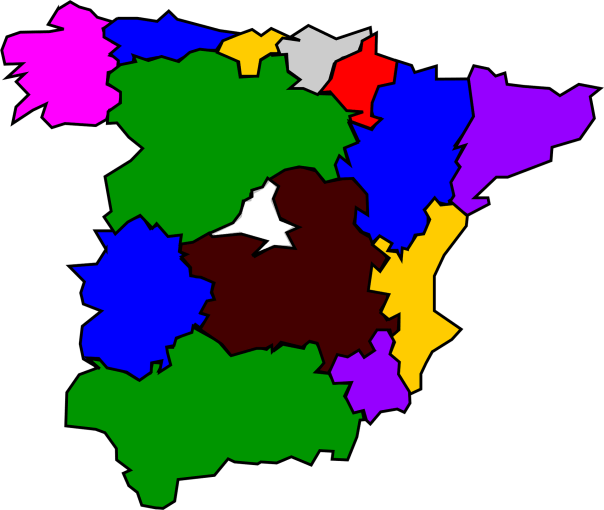
Galicia is the bright pink region on this map, in the northwest corner of Spain.

Wow! I’d just learned something new about music, language, AND geography. I like learning new things. But today, in the car, when I asked my 10-year-old grandson Porter (who loves maps and history) if he’d ever heard of Galicia, the one in Spain, I learned even more.

Yes, he knew exactly where it was. He even expressed the opinion that the map of Spain would look much better if Galicia were part of Portugal!

He also already knew about Galicia’s Celtic ties, and when I wondered aloud how many languages were spoken in Spain, he mentioned not just Spanish, but Basque and Catalan, too.

After I told him I’d be visiting southern Spain soon, he said he thought there’d be a lot of history there because it was probably the oldest part of Spain. This led to a lively tutorial (by that I mean he tutored me) about Spain’s history, including key points like Charlemagne’s invasion and several Spanish conquests (Mexico, southwestern US, the Philippines, Cuba, and Equatorial Guinea). That’s right. My grandson knows something about the history of Equatorial Guinea, a small country in Africa.

Did I mention that he’s only 10 years old?

Meanwhile, his 6-year-old brother Elliot was quietly absorbing every word, and during a break in the conversation, he sweetly offered his own opinion:

“Grandma, when you come back from Spain, maybe you can tell us all about it … and if you get us anything while you’re there, you can give it to us then.”

Up until today, my main goals in traveling to Spain had been (1) brushing up on my Spanish conversational skills, (2) taking lots of awesome photos, and (3) steeping myself in Andalusian culture. But now, I have a much more important goal: finding a couple of really cool souvenirs for my grandsons.

Apples, Autumn, and Angles

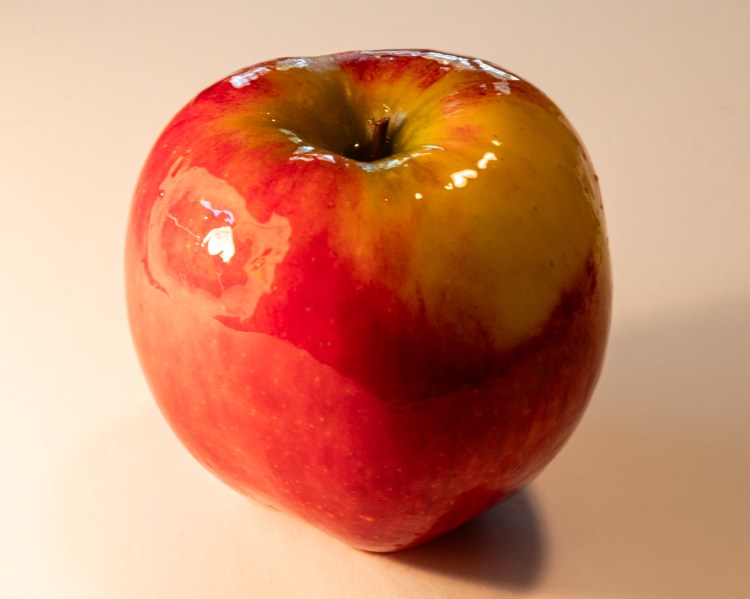
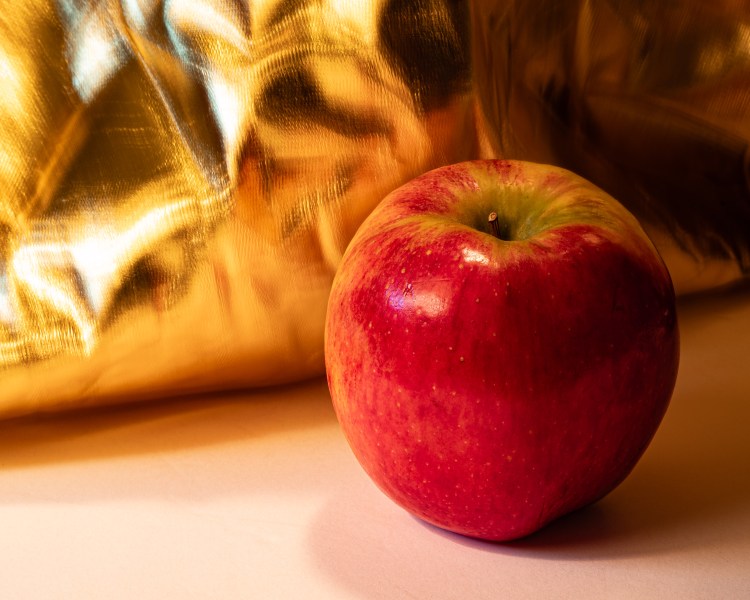
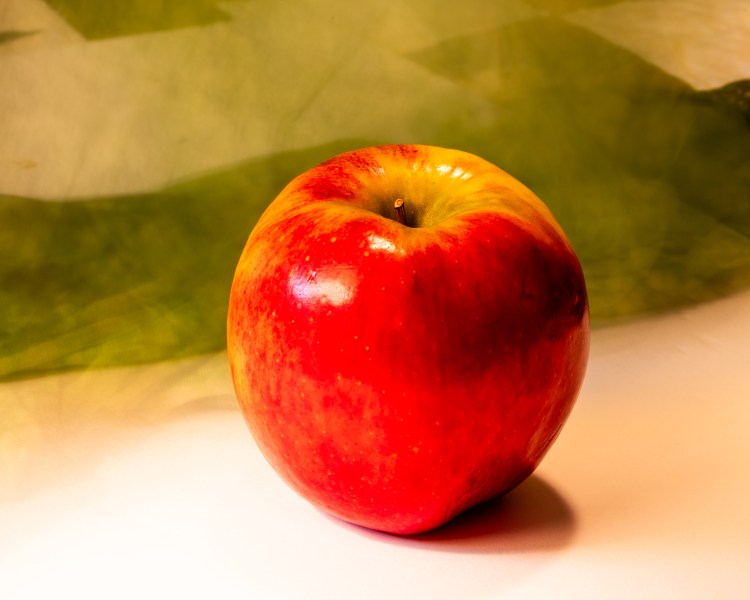
My photography group assignment for September was “Composition.” We were told to photograph a small object in at least 10 different ways, experimenting with angle, distance, etc., and then to choose the 2 to 4 we liked best, which would be presented to the group and critiqued at our next meeting.

We could define “small” in any way we wished. We had to keep the object in a consistent environment, but we could alter its appearance by doing things like spraying it with water, immersing it in water, or cutting it in half. I’m sure that last suggestion applied only to inanimate objects!

Aside from trying to decide how I’d alter the poor object, the hard part for me (and for many of the rest of us, I’ve heard) was settling on a subject to photograph. I wanted to choose something interesting or unique. But then it dawned on me that I was in the group to learn, not to try and impress anyone. And the best way for me to learn composition, I figured, was to keep it simple. I chose an apple as my model.

After selecting the prettiest apple in my fruit bin, I hauled out my camera, two lenses, a tripod, a shiny background, a scarf, a lamp, and a flashlight. I piled everything on my bed and proceeded to set up various scenes using the apple as the star of my production.

I set the apple on a white board. I placed a black box behind it. I nestled it in a colorful scarf. I experimented with various shutter speeds and apertures. I waved the scarf behind it. I sprayed the apple with water and coated it in olive oil. I spent at least 4 hours taking photos of the damned apple.

Then I spent another hour or so editing my photos. But after all of that, I was unsatisfied. I felt like I hadn’t done a very good job on the assignment, and I was embarrassed to show my photos to the group. Even worse, I hadn’t learned anything about composition.

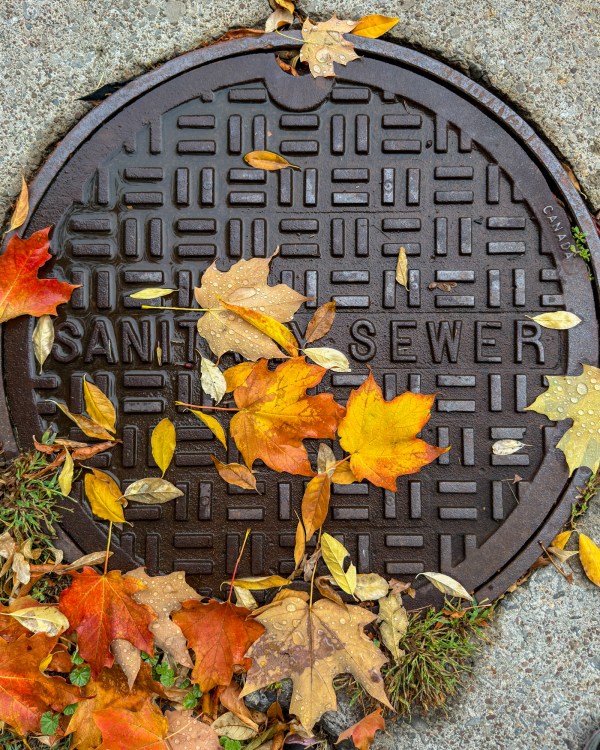
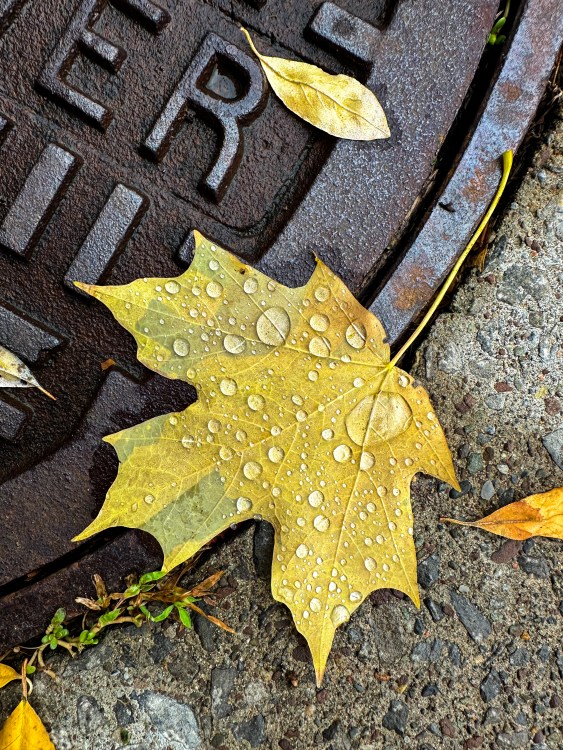
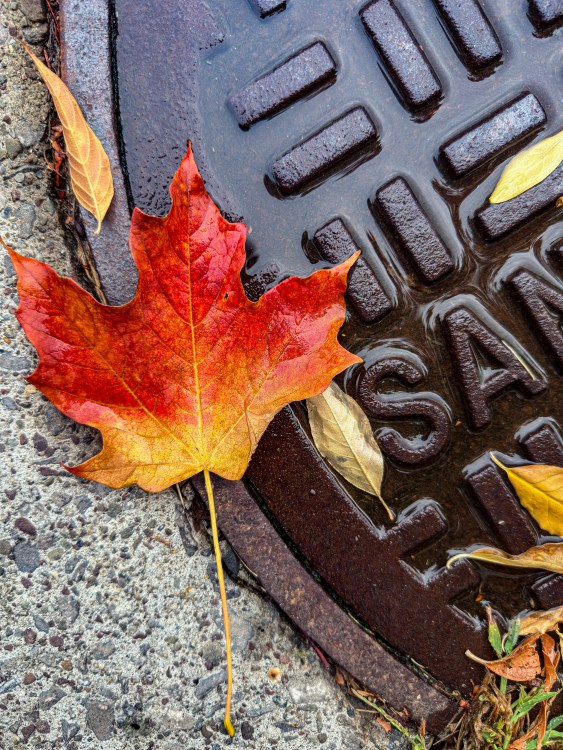
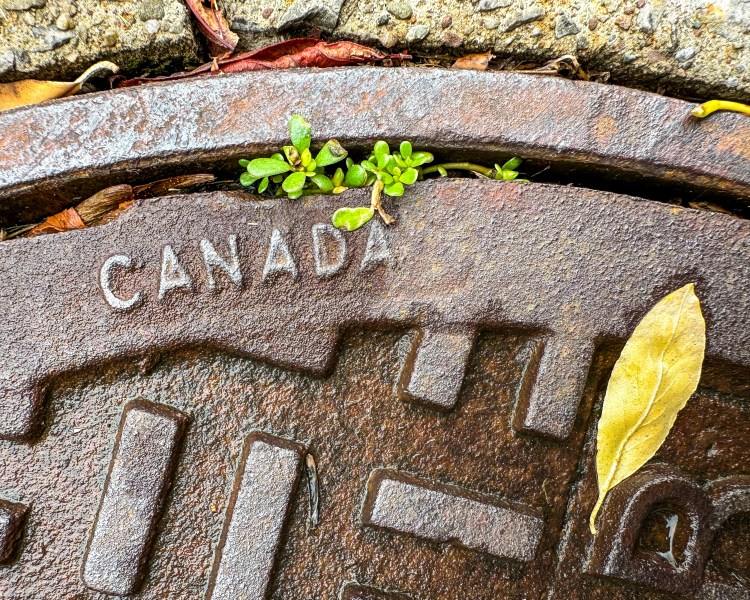
Then yesterday I went for a walk, and what did I see? Hundreds of small, rain-splashed autumn leaves glittering in the sun. Some had landed on top of a sewer cover. There was a strange beauty in all of that. Unfortunately, all I had with me was my iPhone, and there was someone walking behind me. Nervous about stopping, squatting down, and taking pictures with someone watching, I kept walking.

But after they passed me, I turned around. Sure, traffic was zooming by, and I’d be noticed by everyone in their cars as I crouched down, held that position for far too long, and then struggled to get up again (that did happen!), but so what? If a good picture is worth 1,000 words, it’s also worth a little embarrassment and creaky knees. I got to work.

After about 5 minutes, I had 30 pictures of leaves! And my knees survived! I couldn’t wait to get home and edit the pictures. I hadn’t used any fancy equipment. I didn’t have special lighting or backgrounds to play with. But instead, I decided to do what our mentor had said … notice something, stop, walk around it, and take pictures from different angles.

What do you think of the results? Which photos do you like best?

Did I learn something? Yes. I learned that beautiful objects can be found anywhere, even at the most unexpected times and in the most unexpected places … and that it pays to consider all the “angles.”

Capturing Summer

It’s the last day of August – but even without looking at the calendar I already know that summer’s end is fast approaching. The days are shorter, the nights cooler, and hundreds of sad, brown leaves have suddenly appeared on lawns and sidewalks in my neighborhood. I try not to notice them, but they lay there, taunting me. Some even have the audacity to crunch.

My sandals must be feeling neglected. Cool, damp mornings have sent me scrambling for my socks and sneakers – which is probably a good thing, since my summer pedicure (raspberry red polish this year) has seen better days.

My grandsons have gotten their back-to-school haircuts, too: another sure sign that the lazy, hazy, long-haired days of summer are over. You can see the boys’ smiling end-of-summer faces and new haircuts on my Photos page.

I used to dread this time of year, partly because I worked for a school district and had summers off, but mainly because I love summer and hate to see it come to an end. As someone with a June birthday, I like to imagine that my first impression of the world was a sunny and glorious one, filled with birds singing, kids splashing, and tons of ice cream. Yes, my love affair with June, July, and August goes way back.

But this year, rather than getting downhearted about the changing seasons, I’m trying to focus on the positive. I DID have a good summer. A pretty great one, in fact. The weather was good, especially for cloudy Rochester. I gardened. I walked. I mowed my lawn. I wrote and sang and played and took pictures. I visited family and friends. Family and friends visited me. And if all of that isn’t great, I don’t know what is.

Yes, the world is a mess right now. Some days I wonder how I can find joy in my surroundings when there are so many terrible things happening, but then I somehow manage to separate out the good from the bad. Getting outside in summer helps me with that. I go out and drink in the sunshine, and breathe in the warm air. I look around at all the living, thriving things, like trees, flowers, animals. I try and capture light and hold on to it for as long as I can.

Here is some light that I captured this summer, little moments that I enjoyed while being out and about with my camera. I’ll probably look at them again through the winter. I think that will be a little bit like sitting outside with the sun on my shoulders.

For more pictures of my summer (with captions so you’ll know what you’re looking at), visit my Photos page.

How was YOUR summer?

Brant Lake, Adirondacks, New York. I’ve always wanted to own a cabin there. I think I’ll have to settle for just driving around the lake and taking pictures.

Hopkins Sunflower Farm, Pittsford, New York.

Cardinal (male), Wild Wings walking trail, Honeoye Falls, New York. Wild Wings is a not-for-profit educational group that cares for permanently injured birds and has walking trails surrounding its facilities.

Don’t forget to check out my other photos, comment, and follow this blog (if you haven’t already) by hitting the Subscribe button! Thanks!

A Tale of Two Websites

Note: The following post is a copy of what now appears on this site’s Welcome page. I’m posting it here as well, so you’ll be aware that I’ve recently merged my two author websites. From now on, this site is the only one you’ll need in order to access all of my past and present blog posts, etc. I hope that simplifies your life. I know it will simplify mine!

“Words, words, words.” —”Hamlet,” Act 2, Scene 2.

I’ve always been in love with words.

As a child, I was an avid reader, but it wasn’t until high school (many decades ago) that I wrote my first piece, a one-act play about Cinderella set in modern times. I still have a copy of it!

After a long hiatus involving college and parenthood, I started writing again, and now I can’t seem to stop.

In fact, I’ve been writing so much that I recently found myself with not one but TWO writing websites. This was confusing for my readers, as well as for myself, so I’ve just merged the two sites. Now, whether you use the old url (loristory.wordpress.com) or the newer one (loribonati.com), you’ll end up here.

In addition to still being able to read all of my old WordPress blog posts dating back to 2016 (lucky you, especially if you have insomnia!) you’ll now have access to a few I’ve never posted here before, as well as all of my future blog posts. For example, you’ll see:

  • An account of my experiences when I was Teaching Kids About Poetry.
  • A five-part series that’s guaranteed to keep you on the edge of your seat, or at least in your seat. It’s about my move from Arizona to New York, and it’s called (I’ve Got A) New Latitude.
  • A mini-series about a not-so-comfortable-but-I’d-do-it-again three-day cross-country train trip, Train Tracker. (P.S. Hyphens are my friends.)

You’ll still be able to view my Photos, and you’ll find a few new tabs (Books, Honors, News, and Services.

As always, thanks so much for subscribing and reading my “words, words, words.”

Poem on the Spot

d ellis phelps, a blogger,

invited me to jot

some jaunty little verses,

a poem on the spot.

The subject of the poem

should be what I am doing

at right this very minute;

a practice worth pursuing.

I turned to my computer

and I began to write

a poem on the topic.

I tried to keep it light.

But here’s what I’d been doing,

yes, here is my conclusion …

I was learning from a podcast

called “Manifest Delusion.”

It isn’t very jaunty,

in fact, it’s quite severe –

the story of an empire

that trashed our hemisphere.

If anyone has interest,

just Google it for free;

it’s on a site called Substack

the link’s below, you see:

https://drstaceypatton1865.substack.com/p/todays-the-day-manifest-delusion

Inspired by a prompt posted by d ellis phelps at:

https://formidablewoman.org/2025/06/20/poem-on-the-spot/

Large cardboard figure reading a book to a smaller cardboard figure

So Little Cardboard

Recently, I attended a protest rally and took pictures of some clever and inspiring signs. One of my favorites was:

The word “Cardboard” was squeezed tightly into a corner at the bottom of the sign, to emphasize the fact that there just wasn’t enough room on that small placard to list every important grievance against our government.

The sentiment struck me as true not only politically, but “writerly,” too. You see, besides feeling swamped by political issues (and I’ll get to that later), I also seem to have too many ideas for writing projects swirling around in my head. Some are already written, some are nearing completion, and one I started yesterday. This morning, I even wrote two haikus before I got out of bed. Each one of these projects is clamoring for its moment in the spotlight (or at least a “like” by an agent).

But I feel like I’m running out of cardboard.

Cardboard: That space in my brain where I churn out half-baked writing ideas that sometimes bear fruit, and other times fade into obscurity. That flimsy container that can feel sharp and in focus one day, and waterlogged or empty the next. That hourglass that seems to be flowing in a downward direction, faster and faster every day.

It would be wonderful if my cardboard would suddenly turn into a bright, flashing neon sign, like the kind on Broadway, one that speaks boldly and proudly that “we have a winner!” “a smash hit!” “a must-read!” 

It would be great if that cardboard would become a billboard that agents would notice as they speed by on the literary highway, taking note of the contact information, and later that night, sending an email asking for a full manuscript.

It would be reassuring if that cardboard were to be waved like a flag by a reader who was moved by it.

It sure would be nice to have an unlimited supply of cardboard, but my brain matter is finite. My cardboard will never stretch. In fact, it can only shrink. So now I know what I need to do:

I need to write smaller!

Yes, I need to choose just one, or possibly two, of my books, and focus on getting them published.

And also, does anyone know where I can find MORE CARDBOARD?

Note: See my PHOTOS link in the Menu for signs – cardboard and otherwise – from the 50501 (50 protests, 50 states, 1 day) rally in Rochester, NY, 4/19/25. 

P.S. Speaking of politics, I’ve found it helpful in this political climate to keep a second piece of cardboard in my brain just for politics, and to put only one issue on it for now: the environment. That way maybe I can focus my energy and hopefully be effective. The job I’ve assigned myself is to read up on the science behind climate change, and to report out to my group (a subcommittee of Indivisible) on local environmental actions. Reading and writing … I can’t seem to get away from either one.

Thanks to Rick Steves for his thoughtful and honest post about authoritarianism yesterday, which inspired me to veer into the political realm today. I urge you all to read it.

Featured image by ColiN00B at Pixabay.com

Share this post:

Empathy and Creativity

My current writing project is a book about music. In mining the internet for information, I’ve sometimes unearthed facts that feel like sparkly gems – ones that light up my brain with ideas I wasn’t expecting. Here’s an example:

I’ve just learned that Leon Russell, a prolific musician who wrote and recorded one of my favorite songs, “A Song for You,” was mute as a young child. When he finally did speak, his first words were a complete sentence. He’d been watching a group of birds who were having some issues, and he asked:

     “What’s the matter, little birdie, you cry?” 

My daughter Erica once asked a similar question. At age three, while examining the magnetic letter Q stuck on our refrigerator, she wondered aloud:

     “What’s the matter, O, are you crying?”

I was pleased to learn that my daughter and a famous musician had so much in common, and I couldn’t stop thinking about how similar their reactions had been.

Was it unusual for young Erica and young Leon to care about another’s feelings? I don’t think so. I believe all humans are born with the capacity for empathy. It’s probably helpful to our survival. If you’re more likely to care about your fellow creatures, they’re probably more likely to return the favor.

But there are other aspects of their responses that impressed me, and that I think are related to creativity:

1. Imagination

Both children demonstrated vivid imaginations. They didn’t see actual tears, but they imagined them, and their imaginations would bear fruit later in life. Leon would grow up to teach himself to play piano, despite having a congenitally weak right hand, because he could imagine himself being able to do so. Erica would eventually create her own art business without having formal art or business training at the time, because she could visualize her goal.

2. Confidence

Rather than asking IF something was the matter, both kids asked WHAT was the matter, indicating they were sure something was amiss. They had confidence in the conclusions they’d come to about what they’d observed.

3. Inquiring Minds

Both children were inquisitive. They didn’t hesitate to ask questions about something that concerned them.

4. Respect

Neither child asked “WHY are you crying?” Instead, they wanted to know “ARE you crying?” This showed a healthy respect for the right to acknowledge and name our own emotions. Maybe I’m going into it too deeply here, but I think it’s an important distinction. 

5. Social Interaction

Rather than just filing their observations away, Erica and Leon communicated their concerns. I think this comes from a desire for social interaction, and from a place of caring. This outward stance might be a factor in creativity. Does this mean you have to be outgoing to be creative? Not necessarily, but I think maybe it helps to want to reach out and share your thoughts, concerns, and creations with others, and to help them, too.

I’ve certainly done a lot of thinking today about empathy and creativity, and all while sitting in a room by myself, working on a book … a book I hope someday will be shared with others … so I guess I’m reaching out, too. 

And to borrow a phrase from a child I know (and one I don’t): “What’s the matter” with that?

Note: This post also appears on my new website, loribonati.com. It would be wonderful if you’d follow me there! I also have a new social media site at bluesky. (I’ve deleted my Twitter account.) My bluesky account is: @loribuffalo.bsky.social. I’d love to follow you back. Thanks!

Teaching Kids About Poetry

“What does an iguana have to do with poetry?”

That’s a question I recently asked some 5th grade boys, right before launching into my school presentation about poetry, which included a reading of my book, “Iguana in the Road.”

As a member of a local writer’s group, I’d been invited to participate in a literacy program for city youth. I was excited to be around students again, after having been retired from school psychology for 4 years.

I arrived early, hoping to set up my presentation before the students arrived. Unfortunately, I soon learned that there would be a substitute teacher that day. 

Then I was informed by the Literacy Specialist that it was a “tough class.”

I knew I could handle that, but what ruffled me a bit was when my PowerPoint presentation wasn’t immediately recognized by the smart board in the classroom.

It was 8:00 a.m. on a Friday before a long weekend, and I’d been hoping my bright, colorful PowerPoint slides would wake the kids (and me) up, and keep us awake throughout the presentation.

I had a Plan B: I’d brought notes. But luckily, I didn’t have to use them! After about 5 minutes, a helpful staff member got the technology working, and my PowerPoint was up on the big screen. Yay! Now all I had to do was inspire a bunch of young boys to write poetry.

I began by holding up a cute stuffed iguana and asking, “What does an iguana have to do with poetry?” Admittedly, it wasn’t a fair question. They couldn’t possibly have known what I was leading up to. But one brave soul raised his hand.

“Eat,” he said.

“Eat?” I asked. He nodded.

“Okay … they both eat?” He nodded again. What could he have meant?

Maybe I misheard him, and what he really said was “neat” (as in “I like both”) or “feet” (as in the rhythmic pattern of poetry). In either case, maybe he should have been teaching the class instead of me.

I decided to move on quickly – and to keep the presentation lively. (A teacher friend of mine once told me that teaching is something like acting.) I believe my strategy worked, because the boys paid attention and were respectful and engaged throughout the entire hour.

I think having props like my cuddly stuffed iguana helped. I also had brought lots of books. I began by showing them a picture book about Gwendolyn Brooks, the first Black person to ever win a Pulitzer Prize. She won the prize for poetry, I informed them, and she wrote her first poem when she was seven years old. They seemed surprised by that.

Next, I read short quotes about poetry from three famous poets: Amanda Gorman, William Shakespeare, and Kwame Alexander. They’d never heard of Amanda or Kwame, but one boy not only recognized the Bard, but knew his name.

William Shakespeare
William Shakespeare

I animatedly read a page from Kwame Alexander’s novel-in-verse, “The Crossover.” When I mentioned that the book is about twin brothers who play basketball, one boy raised his hand. “I’m a twin!” he said. When I said that the main character in the book is named Josh, he grinned. “I’m Josh!” he exclaimed. I was glad I’d chosen “The Crossover” to include in my talk. (P.S. I love that book!)

Kwame Alexander
Kwame Alexander

I then listed the main ingredients in a poem (rhyme, rhythm, and repetition), read a poem as an example of rhyme, showed a photo of my dog (because kids like dogs, right?), and read a poem I’d written about my dog that used repetition.

I added other ingredients, such as comparison (simile and metaphor), and I read a poem my own daughter had written in 4th grade – one that used a metaphor. I wanted them to know as much about poetry as I could squeeze into an hour, without boring them to death.

I also stressed that a poem does not need to be long. As an example, I put Muhammad Ali’s famous poem (“Me. Whee!”) up on the board.

Then I dramatically announced that there were NO RULES! in poetry. I wanted them to relax and feel free to write whatever was in their hearts.

After that, I invited them to think of a topic and brainstorm a few words that could eventually become a poem. Classroom helpers passed out paper and pencils that had been provided by a grant from a local organization.

Several students asked for help with spelling. As I spelled out a word for one boy, he wrote it from right to left, each letter reversed. Some kids didn’t write at all. One child kept his head down on his desk most of the time. I knew from experience that could mean he hadn’t slept the night before, was hungry, or maybe was just trying to keep his emotions together. Whether they wrote or not wasn’t important to me. I was just glad they were listening, because I was hoping to plant some poetry seeds that day.

In the 5 minutes they had to think of topics and write, the majority of kids did write. I’m not sure I could have done that! Their rough drafts ranged from just a few words to whole paragraphs. Several volunteered to stand and read their works-in-progress to the class.

They wrote about football (one poem was a play-by-play description of a game), and about their pets. One of my favorite creations was this one:

Chocolate, dog, no, no, no.”

Good use of repetition! And it says so much in just five words. After reading his poem aloud, the author explained what he meant (that dogs shouldn’t eat chocolate). This is a clear, concise, rhythmic poem, written in just a few minutes by someone who might never have written a poem before in his life. Bravo!

I concluded my presentation with a reading of “Iguana in the Road,” and moved on to my next assignment, a bilingual 5th grade class down the hall. (The school I visited is the largest bilingual elementary school in my city.) 

Right away, I noticed a difference. The students seemed older, taller, quieter. They didn’t raise their hands or respond to my questions … not right away, at least.

But by the end of the presentation? Wow. Not only were they participating, but they were actively encouraging each other to participate, chanting their friends’ names to get them to stand on the “stage” (the front of the room) and to share their poems.

While they wrote, I offered assistance. As with the former class, many asked for help with spelling. One girl asked if it was okay to write in Spanish, or if she had to write in English. I told her it was fine to write in Spanish, and then I mentioned that to the rest of the class. As a result, several kids wrote poems in Spanish.

Since many were reluctant to read aloud, I offered to read their poems for them, including the ones in Spanish. At least ten children handed me poems to read, about half of them in Spanish. I think they were pleasantly surprised that I could read and understand them!

Thanks to the community grant, each child in the participating elementary schools received a free book that day! I was so grateful for the privilege of being part of this program and being among so many creative, talented, and helpful people.