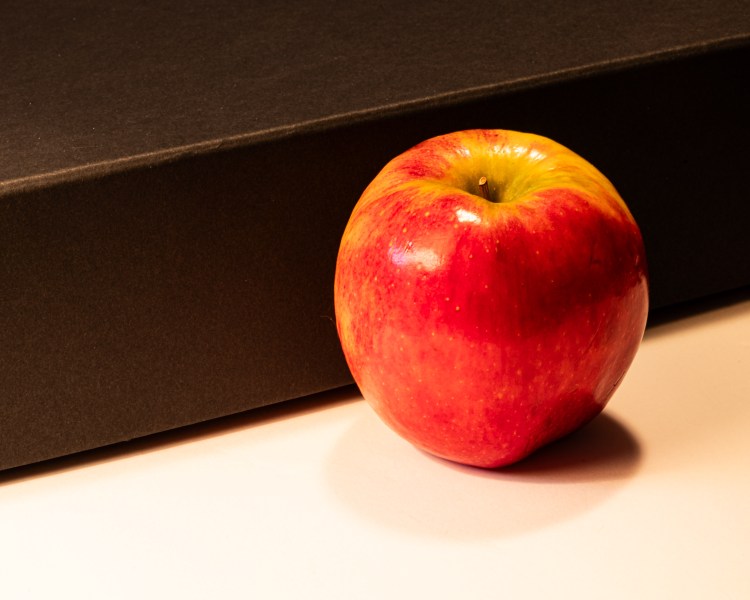
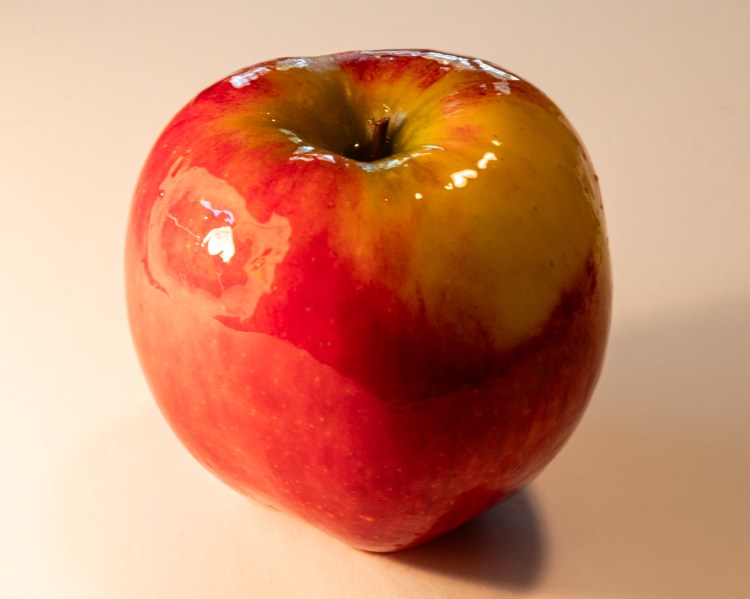
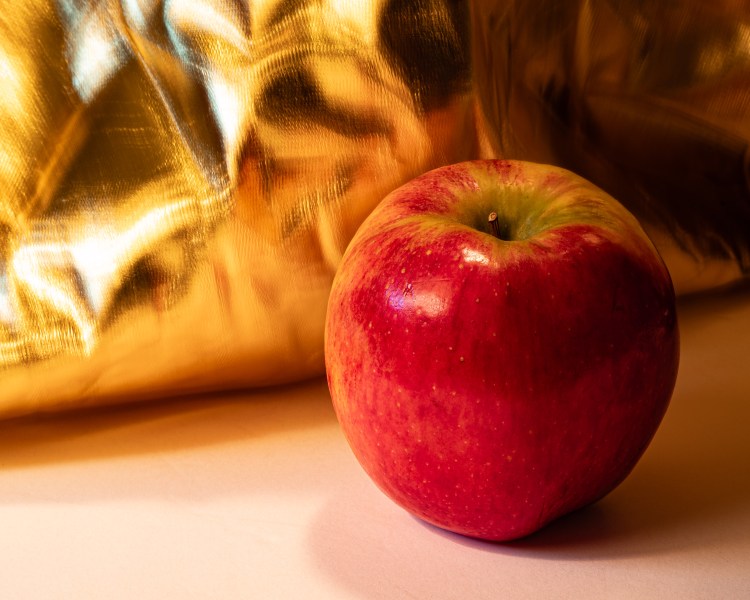
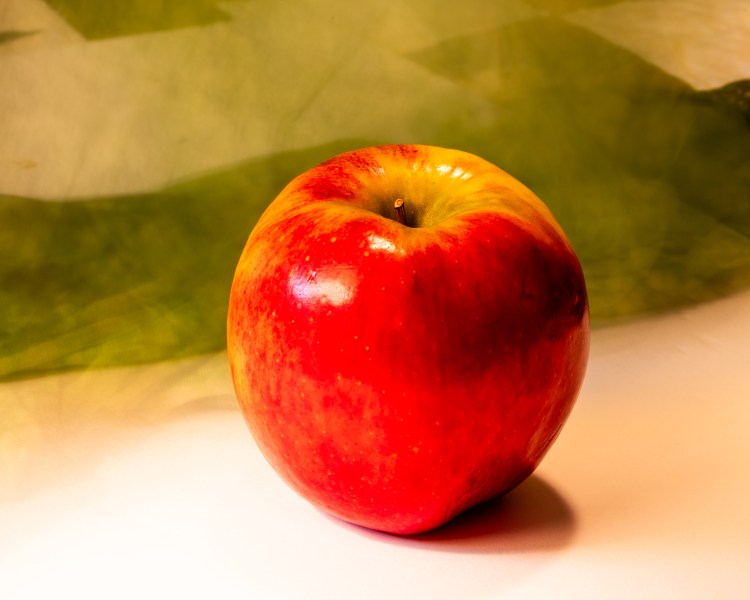
My photography group assignment for September was “Composition.” We were told to photograph a small object in at least 10 different ways, experimenting with angle, distance, etc., and then to choose the 2 to 4 we liked best, which would be presented to the group and critiqued at our next meeting.
We could define “small” in any way we wished. We had to keep the object in a consistent environment, but we could alter its appearance by doing things like spraying it with water, immersing it in water, or cutting it in half. I’m sure that last suggestion applied only to inanimate objects!
Aside from trying to decide how I’d alter the poor object, the hard part for me (and for many of the rest of us, I’ve heard) was settling on a subject to photograph. I wanted to choose something interesting or unique. But then it dawned on me that I was in the group to learn, not to try and impress anyone. And the best way for me to learn composition, I figured, was to keep it simple. I chose an apple as my model.
After selecting the prettiest apple in my fruit bin, I hauled out my camera, two lenses, a tripod, a shiny background, a scarf, a lamp, and a flashlight. I piled everything on my bed and proceeded to set up various scenes using the apple as the star of my production.
I set the apple on a white board. I placed a black box behind it. I nestled it in a colorful scarf. I experimented with various shutter speeds and apertures. I waved the scarf behind it. I sprayed the apple with water and coated it in olive oil. I spent at least 4 hours taking photos of the damned apple.
Then I spent another hour or so editing my photos. But after all of that, I was unsatisfied. I felt like I hadn’t done a very good job on the assignment, and I was embarrassed to show my photos to the group. Even worse, I hadn’t learned anything about composition.
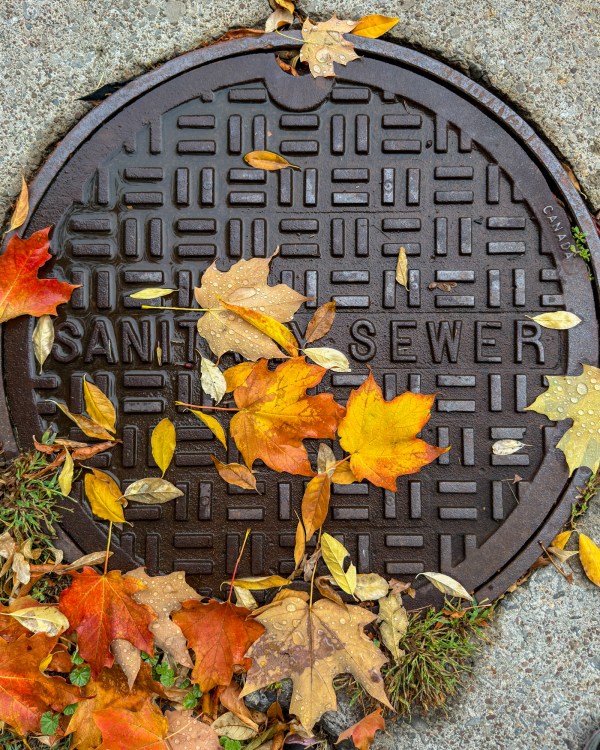
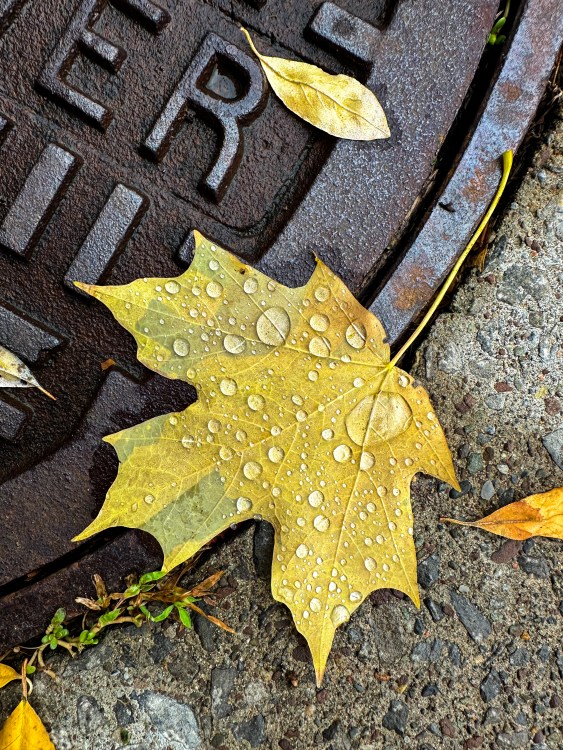
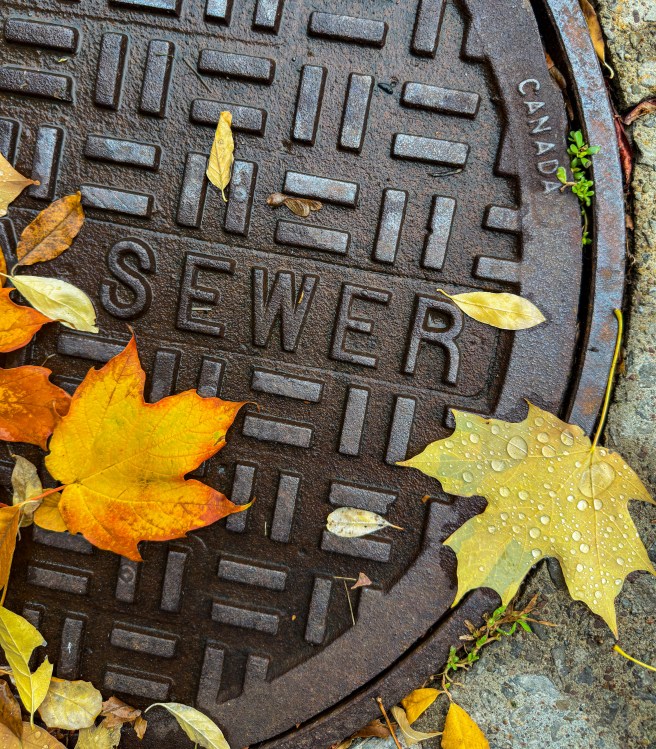
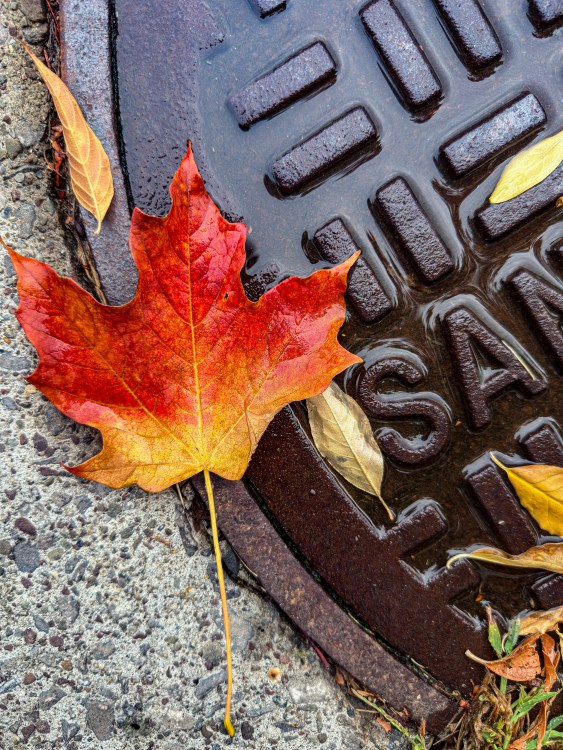
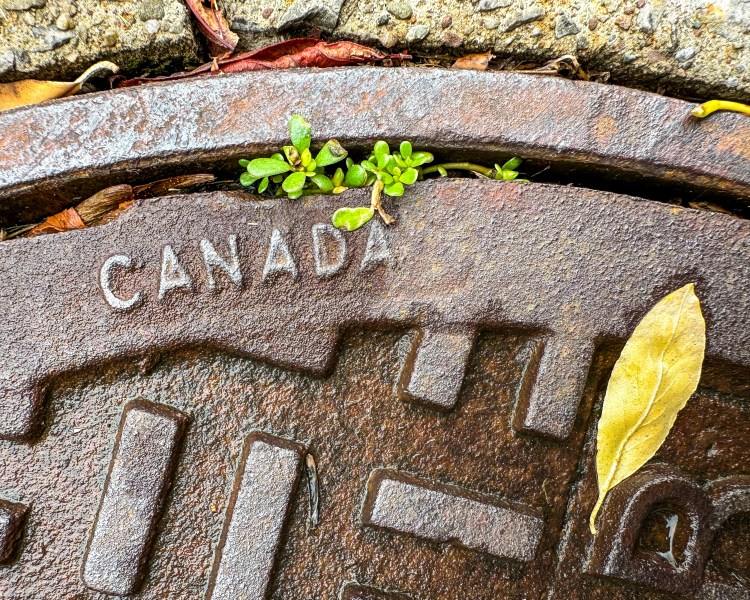
Then yesterday I went for a walk, and what did I see? Hundreds of small, rain-splashed autumn leaves glittering in the sun. Some had landed on top of a sewer cover. There was a strange beauty in all of that. Unfortunately, all I had with me was my iPhone, and there was someone walking behind me. Nervous about stopping, squatting down, and taking pictures with someone watching, I kept walking.
But after they passed me, I turned around. Sure, traffic was zooming by, and I’d be noticed by everyone in their cars as I crouched down, held that position for far too long, and then struggled to get up again (that did happen!), but so what? If a good picture is worth 1,000 words, it’s also worth a little embarrassment and creaky knees. I got to work.
After about 5 minutes, I had 30 pictures of leaves! And my knees survived! I couldn’t wait to get home and edit the pictures. I hadn’t used any fancy equipment. I didn’t have special lighting or backgrounds to play with. But instead, I decided to do what our mentor had said … notice something, stop, walk around it, and take pictures from different angles.
What do you think of the results? Which photos do you like best?
Did I learn something? Yes. I learned that beautiful objects can be found anywhere, even at the most unexpected times and in the most unexpected places … and that it pays to consider all the “angles.”
It’s the last day of August – but even without looking at the calendar I already know that summer’s end is fast approaching. The days are shorter, the nights cooler, and hundreds of sad, brown leaves have suddenly appeared on lawns and sidewalks in my neighborhood. I try not to notice them, but they lay there, taunting me. Some even have the audacity to crunch.
My sandals must be feeling neglected. Cool, damp mornings have sent me scrambling for my socks and sneakers – which is probably a good thing, since my summer pedicure (raspberry red polish this year) has seen better days.
My grandsons have gotten their back-to-school haircuts, too: another sure sign that the lazy, hazy, long-haired days of summer are over. You can see the boys’ smiling end-of-summer faces and new haircuts on my Photos page.
I used to dread this time of year, partly because I worked for a school district and had summers off, but mainly because I love summer and hate to see it come to an end. As someone with a June birthday, I like to imagine that my first impression of the world was a sunny and glorious one, filled with birds singing, kids splashing, and tons of ice cream. Yes, my love affair with June, July, and August goes way back.
But this year, rather than getting downhearted about the changing seasons, I’m trying to focus on the positive. I DID have a good summer. A pretty great one, in fact. The weather was good, especially for cloudy Rochester. I gardened. I walked. I mowed my lawn. I wrote and sang and played and took pictures. I visited family and friends. Family and friends visited me. And if all of that isn’t great, I don’t know what is.
Yes, the world is a mess right now. Some days I wonder how I can find joy in my surroundings when there are so many terrible things happening, but then I somehow manage to separate out the good from the bad. Getting outside in summer helps me with that. I go out and drink in the sunshine, and breathe in the warm air. I look around at all the living, thriving things, like trees, flowers, animals. I try and capture light and hold on to it for as long as I can.
Here is some light that I captured this summer, little moments that I enjoyed while being out and about with my camera. I’ll probably look at them again through the winter. I think that will be a little bit like sitting outside with the sun on my shoulders.
For more pictures of my summer (with captions so you’ll know what you’re looking at), visit my Photos page.
How was YOUR summer?
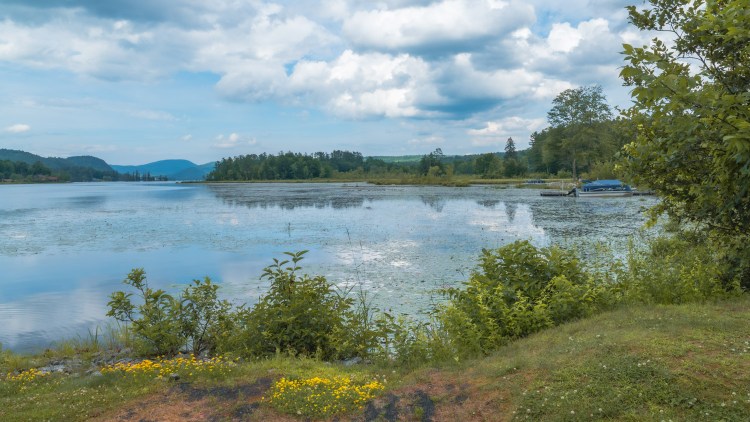
Brant Lake, Adirondacks, New York. I’ve always wanted to own a cabin there. I think I’ll have to settle for just driving around the lake and taking pictures.
Hopkins Sunflower Farm, Pittsford, New York.
Cardinal (male), Wild Wings walking trail, Honeoye Falls, New York. Wild Wings is a not-for-profit educational group that cares for permanently injured birds and has walking trails surrounding its facilities.
Don’t forget to check out my other photos, comment, and follow this blog (if you haven’t already) by hitting the Subscribe button! Thanks!
That’s a question I recently asked some 5th grade boys, right before launching into my school presentation about poetry, which included a reading of my book, “Iguana in the Road.”
As a member of a local writer’s group, I’d been invited to participate in a literacy program for city youth. I was excited to be around students again, after having been retired from school psychology for 4 years.
I arrived early, hoping to set up my presentation before the students arrived. Unfortunately, I soon learned that there would be a substitute teacher that day.
Then I was informed by the Literacy Specialist that it was a “tough class.”
I knew I could handle that, but what ruffled me a bit was when my PowerPoint presentation wasn’t immediately recognized by the smart board in the classroom.
It was 8:00 a.m. on a Friday before a long weekend, and I’d been hoping my bright, colorful PowerPoint slides would wake the kids (and me) up, and keep us awake throughout the presentation.
I had a Plan B: I’d brought notes. But luckily, I didn’t have to use them! After about 5 minutes, a helpful staff member got the technology working, and my PowerPoint was up on the big screen. Yay! Now all I had to do was inspire a bunch of young boys to write poetry.
I began by holding up a cute stuffed iguana and asking, “What does an iguana have to do with poetry?” Admittedly, it wasn’t a fair question. They couldn’t possibly have known what I was leading up to. But one brave soul raised his hand.
“Eat,” he said.
“Eat?” I asked. He nodded.
“Okay … they both eat?” He nodded again. What could he have meant?
Maybe I misheard him, and what he really said was “neat” (as in “I like both”) or “feet” (as in the rhythmic pattern of poetry). In either case, maybe he should have been teaching the class instead of me.
I decided to move on quickly – and to keep the presentation lively. (A teacher friend of mine once told me that teaching is something like acting.) I believe my strategy worked, because the boys paid attention and were respectful and engaged throughout the entire hour.
I think having props like my cuddly stuffed iguana helped. I also had brought lots of books. I began by showing them a picture book about Gwendolyn Brooks, the first Black person to ever win a Pulitzer Prize. She won the prize for poetry, I informed them, and she wrote her first poem when she was seven years old. They seemed surprised by that.
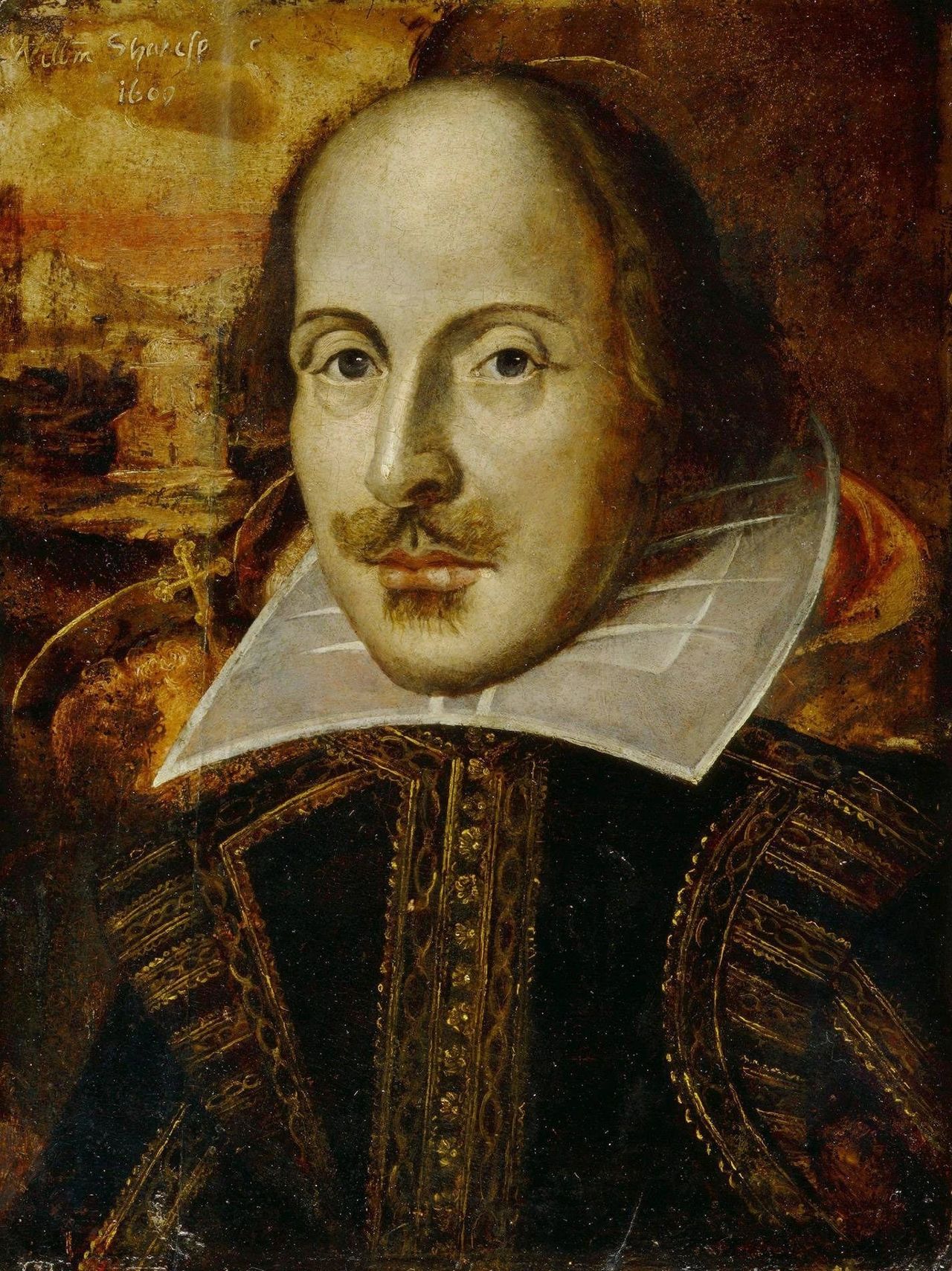
Next, I read short quotes about poetry from three famous poets: Amanda Gorman, William Shakespeare, and Kwame Alexander. They’d never heard of Amanda or Kwame, but one boy not only recognized the Bard, but knew his name.
William Shakespeare
I animatedly read a page from Kwame Alexander’s novel-in-verse, “The Crossover.” When I mentioned that the book is about twin brothers who play basketball, one boy raised his hand. “I’m a twin!” he said. When I said that the main character in the book is named Josh, he grinned. “I’m Josh!” he exclaimed. I was glad I’d chosen “The Crossover” to include in my talk. (P.S. I love that book!)
Kwame Alexander
I then listed the main ingredients in a poem (rhyme, rhythm, and repetition), read a poem as an example of rhyme, showed a photo of my dog (because kids like dogs, right?), and read a poem I’d written about my dog that used repetition.
I added other ingredients, such as comparison (simile and metaphor), and I read a poem my own daughter had written in 4th grade – one that used a metaphor. I wanted them to know as much about poetry as I could squeeze into an hour, without boring them to death.
I also stressed that a poem does not need to be long. As an example, I put Muhammad Ali’s famous poem (“Me. Whee!”) up on the board.
Then I dramatically announced that there were NO RULES! in poetry. I wanted them to relax and feel free to write whatever was in their hearts.
After that, I invited them to think of a topic and brainstorm a few words that could eventually become a poem. Classroom helpers passed out paper and pencils that had been provided by a grant from a local organization.
Several students asked for help with spelling. As I spelled out a word for one boy, he wrote it from right to left, each letter reversed. Some kids didn’t write at all. One child kept his head down on his desk most of the time. I knew from experience that could mean he hadn’t slept the night before, was hungry, or maybe was just trying to keep his emotions together. Whether they wrote or not wasn’t important to me. I was just glad they were listening, because I was hoping to plant some poetry seeds that day.
In the 5 minutes they had to think of topics and write, the majority of kids did write. I’m not sure I could have done that! Their rough drafts ranged from just a few words to whole paragraphs. Several volunteered to stand and read their works-in-progress to the class.
They wrote about football (one poem was a play-by-play description of a game), and about their pets. One of my favorite creations was this one:
“Chocolate, dog, no, no, no.”
Good use of repetition! And it says so much in just five words. After reading his poem aloud, the author explained what he meant (that dogs shouldn’t eat chocolate). This is a clear, concise, rhythmic poem, written in just a few minutes by someone who might never have written a poem before in his life. Bravo!
I concluded my presentation with a reading of “Iguana in the Road,” and moved on to my next assignment, a bilingual 5th grade class down the hall. (The school I visited is the largest bilingual elementary school in my city.)
Right away, I noticed a difference. The students seemed older, taller, quieter. They didn’t raise their hands or respond to my questions … not right away, at least.
But by the end of the presentation? Wow. Not only were they participating, but they were actively encouraging each other to participate, chanting their friends’ names to get them to stand on the “stage” (the front of the room) and to share their poems.
While they wrote, I offered assistance. As with the former class, many asked for help with spelling. One girl asked if it was okay to write in Spanish, or if she had to write in English. I told her it was fine to write in Spanish, and then I mentioned that to the rest of the class. As a result, several kids wrote poems in Spanish.
Since many were reluctant to read aloud, I offered to read their poems for them, including the ones in Spanish. At least ten children handed me poems to read, about half of them in Spanish. I think they were pleasantly surprised that I could read and understand them!
Thanks to the community grant, each child in the participating elementary schools received a free book that day! I was so grateful for the privilege of being part of this program and being among so many creative, talented, and helpful people.
I think there must be something in the air. Maybe it’s autumn. Or aliens. Or the fact that I haven’t had to mow my lawn in three weeks. Whatever it is, it’s causing me to throw myself into certain indoor projects with a vengeance. And while that means I’m getting things done, and enjoying all this work, it also means I’m staying up late and not getting enough sleep.
Maya has no trouble sleeping.
In the coming weeks, I’ll be blogging about what’s been keeping me so busy (for example, reading, writing, cooking, and packing for a trip to California where I’ll attend a writing workshop), but today I’m excited to tell you about my newest music project, the YouTube song video IF TIME CAN BEND.
If Time Can Bend began its life as a poem several years ago. It’s about astrophysics, and therefore it touches on relativity, planets, time travel, and string theory. Do I sound like I know what I’m talking about? If so, my effort to pull the wool over your eyes has been a complete success!
Seriously, though, I know just enough about these topics to be dangerous, so I recklessly decided to turn my pseudoscientific poem into a song. Then, even more recklessly, I boldly asked keyboardist Chuck Phillips to help me record it, and the rest is history. Or is it? Maybe it hasn’t been recorded yet? Aha! Now you’re starting to see what the song is about.
Here’s how I describe it on YouTube:
“This lush song based on Lori’s original poem about time will have your head spinning and your heart swooning. Physics never sounded so good! Original music & lyrics by Lori Bonati, with Lori on vocals & midi instruments, and Chuck Phillips on piano and bass.”
I’m not going to apologize for tooting my own horn in that description. First of all, there are absolutely NO HORNS in this song. And also, I’m kind of proud of it, to tell you the truth!
Okay, enough talking. Maybe you should just go check it out here: IF TIME CAN BEND. A big thank you to those of you who do.
By the way, you can like and comment on the video directly on YouTube, or you can just leave a comment below.
So, that’s one song video down, a few more to go, and then I might just sit back and relax for a while. Or not! I’ve got all those books to finish writing … oh well, as Governor Tim Walz says, “We’ll sleep when we’re dead!”
How many books can you read in a week? A month? A year? I’m asking for a friend.
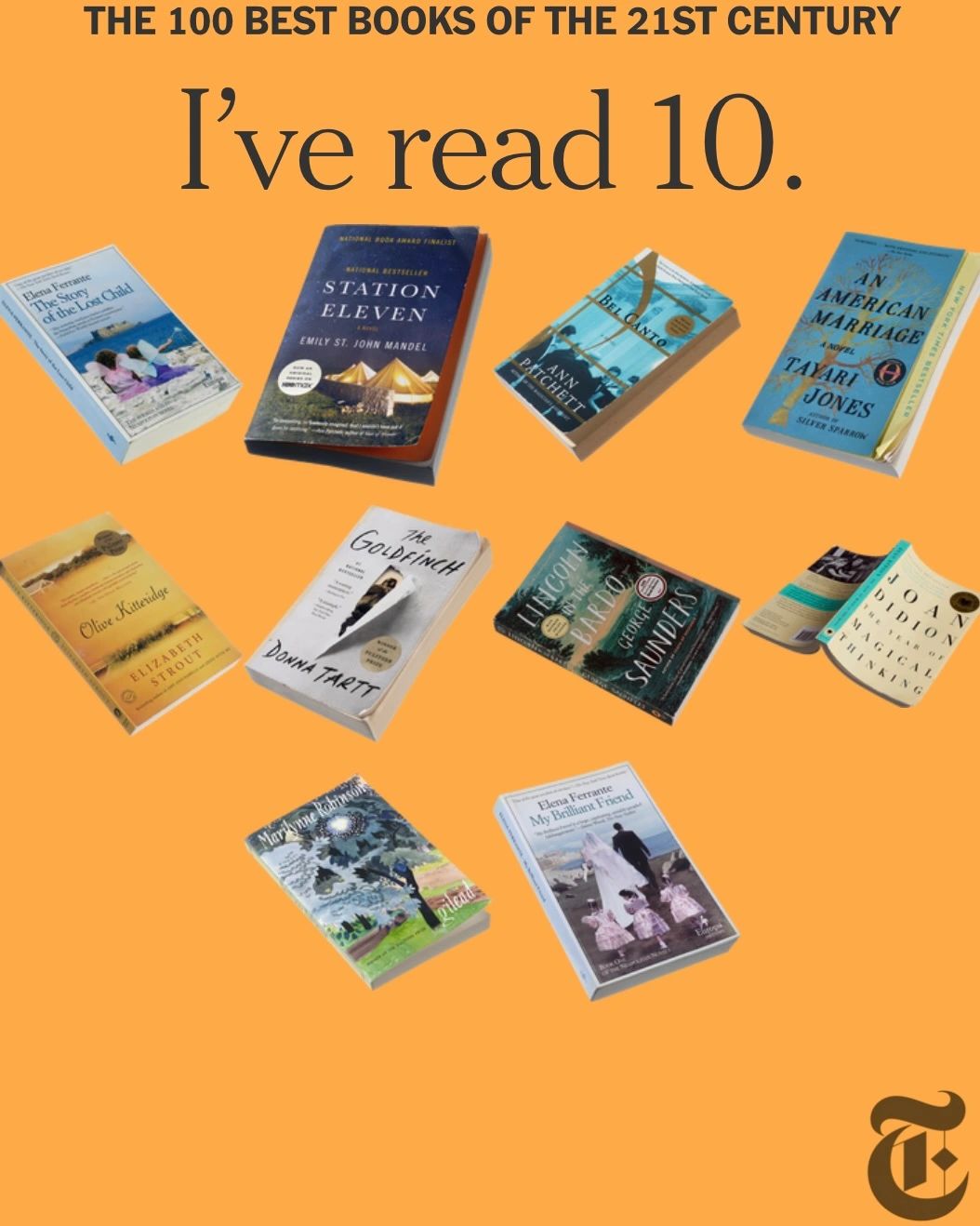
Actually, my friend is me. I’m on a mission to read every one of “The 100 Best Books of the 21st Century,” but at the rate I’m going, I’m afraid I’ll never accomplish my bucket list task before I actually kick said bucket.
The esteemed list (of which I’ve read only 10) was compiled by The New York Times using input from over 500 hand-picked writers, editors, librarians, and other literary types. Here are the ones I’ve read:
The Story of the Lost Child (Elena Ferrante)
Station Eleven (Emily St. John Mandel)
Bel Canto (Ann Patchett)
An American Marriage (Tayari Jones)
Olive Kitteridge (Elizabeth Strout)
The Goldfinch (Donna Tartt)
Lincoln in the Bardo (George Saunders) … well, most of it, anyway
The Year of Magical Thinking (Joan Didion)
Gilead (Marilynne Robinson)
My Brilliant Friend (Elena Ferrante)
(My review: I’m wild about the Ferrante, St. John Mandel, and Strout books, and I liked the others, except for Lincoln in the Bardo, which I just didn’t get.)
Yikes! With 90 more books to go, I’ll have to hustle like crazy. But luckily for me, The New York Times has just come up with another “100 Best Books” list, because the original list was pooh-poohed by some picky Times readers. After receiving numerous complaints, the publication succumbed to the pressure, polled their regular readers, and assembled a second collection of titles: the “Readers Pick Their 100 Best Books of the 21st Century” list. I like this list better.
In fact, I was happy to discover that I’ve read 16 books on this new list, including 9 from the old list, plus:
All the Light We Cannot See (Anthony Doerr)
Lessons in Chemistry (Bonnie Garmus)
Gone Girl (Gillian Flynn)
Caste: The Origins of Our Discontents (Isabel Wilkerson)
Braiding Sweetgrass (Robin Wall Kimmerer) … skimmed parts of it
Where the Crawdads Sing (Delia Owens)
The Dutch House (Ann Patchett)
(My review: I absolutely loved the books by Doerr, Garmus, and Flynn, appreciated and learned much from Wilkerson and Kimmerer, and thought the Patchett was pretty good. I was disappointed in Crawdads, however.)
I’m not all that fond of “best” lists. In fact, “best” is a word I don’t often use. For me, it’s difficult to select just one song, movie, or even friend as “the best,” and the same holds true for books. I’ve read several great ones, and others that were less than great but that I’ve thoroughly enjoyed nonetheless.
That said, I’ll take a recommended reading list any day of the week. In fact, I’ll take it all the way to my local library or indie bookstore. Book lists are helpful. But I’m sad that there are SO MANY great ones out there that didn’t make either one of the “Best Of” lists.
I’m thinking, off the top of my head, of this highly subjective list of my favorite 21st century books (and I’m sure I’ve left out many deserving ones):
Where’d You Go Bernadette (Maria Semple)
Mr. Penumbra’s 24-Hour Bookstore (Robin Sloan)
The Lacuna (Barbara Kingsolver)
Less (Andrew Sean Greer)
Bridge of Sighs (Richard Russo)
The History of Love (Nicole Krauss)
The Guernsey Literary and Potato Peel Pie Society (Mary Ann Shaffer and Annie Barrows)
State of Wonder (Ann Patchett)
How to Be an Antiracist (Ibram X. Kendi)
Turtles All the Way Down (John Green)
Unsheltered (Barbara Kingsolver)
Miracle and Wonder: Conversations with Paul Simon (Malcolm Gladwell)
The Farmer and the Clown (Marla Frazee)*
A Wish in the Dark (Christina Soontornvat)**
The List of Things that Will Not Change (Rebecca Stead)**
* Picture book with no words.
** Middle grade novels.
I’ll keep you posted on my progress toward my goal of reading 100 21st century books. Meanwhile, please leave me a comment about your favorite books, ones you’re currently reading, or anything else!
And be sure to check out the photos that I keep adding to my Photos page. I’ve neglected to blog about what I’ve been up to this summer, so I’m hoping that these pictures (and their captions) will catch you up.
I love coincidences – apparently unrelated events that become connected, otherwise known as synchronicity. Well, this morning a coincidence popped up, and it was perfectly in sync with my day.
Let me set the stage.
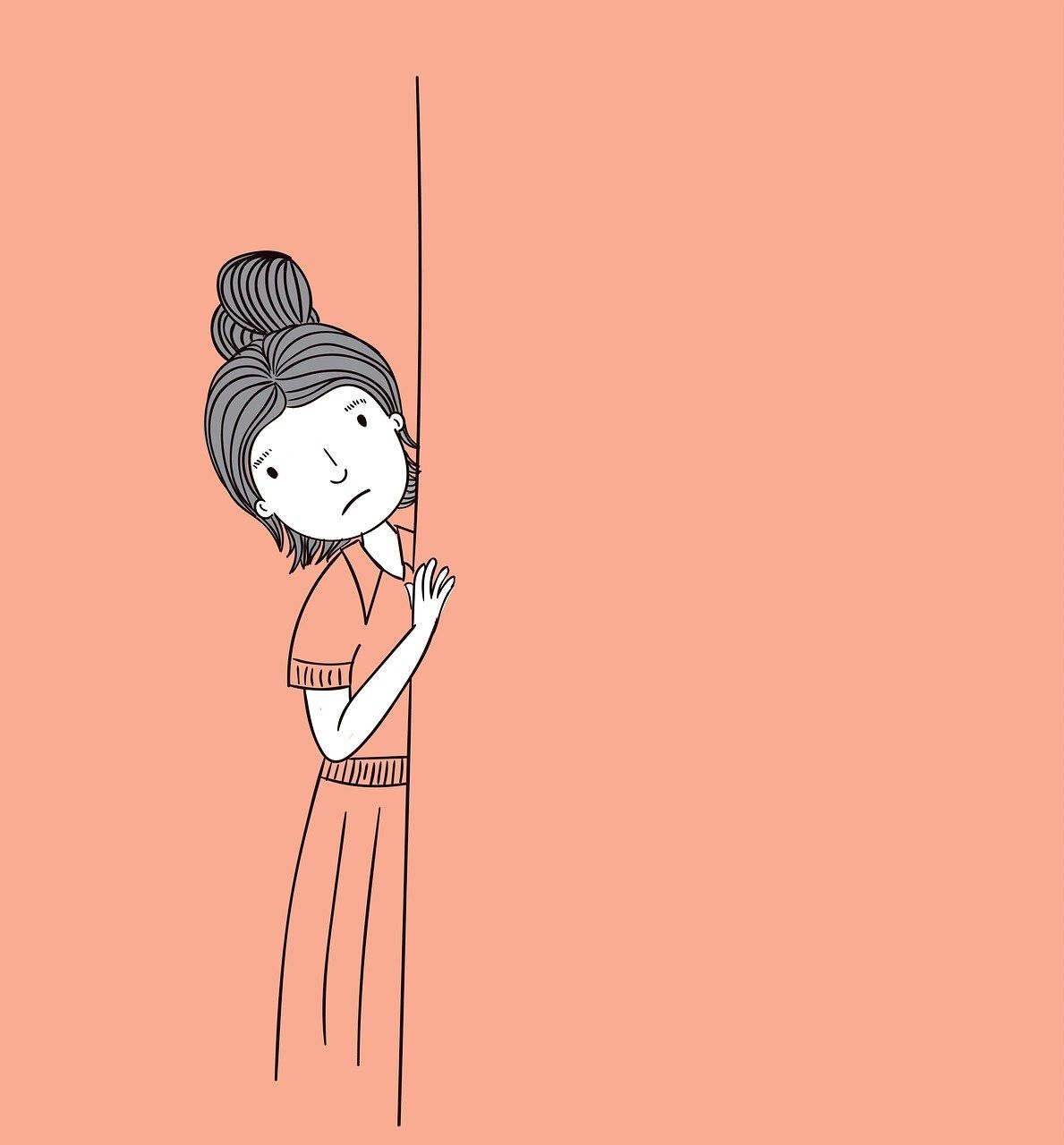
It’s 10:30 on a Sunday morning. I’m still in my fuzzy pink bathrobe. My hair’s a mess. I have raccoon eyes, probably, although I haven’t checked myself in the mirror yet. I’m hiding behind an open door.
Image by Piyapong Saydaung @ Pixabay
What could possibly explain my situation, and my unkempt appearance?
It’s simply this: I was up late last night. I couldn’t help it. I’d spent hours reading. Playing guitar. Watching TV.
Doing a crossword puzzle, browsing YouTube, researching a literary agent online.
Cutting my hair.
Combing through my possessions for doodads to enhance my vendor table at a book fair next weekend.
And cleaning out two closets that suddenly seemed to be jam-packed with clothes I couldn’t believe I’d actually spent good money on, and never wear anymore.
Just an average Saturday night.
Is it any surprise, then, to find me cowering behind my back door late Sunday morning, with one extended hand on my dog’s leash, the other on the doorknob, awaiting the moment we were both safely back inside the house? I wasn’t hung over, just hung UP on one horrifying thought: What if my neighbors see me?
I knew if that happened, and if they asked if I was okay, I probably shouldn’t dive into the litany of activities I’ve just revealed to you: the playing, watching, puzzling, researching, cutting, combing and cleaning I’d spent hours on the night before. Better to just utter a simple excuse before ducking back inside my house. But what could I say? The words “I’m an artist” suddenly sprang to mind. After all, artists are allowed to stay up late and sleep in the next day.
But is that true? I asked myself. AM I an artist? No, absolutely not. Not really. Well, maybe. I just wasn’t sure.
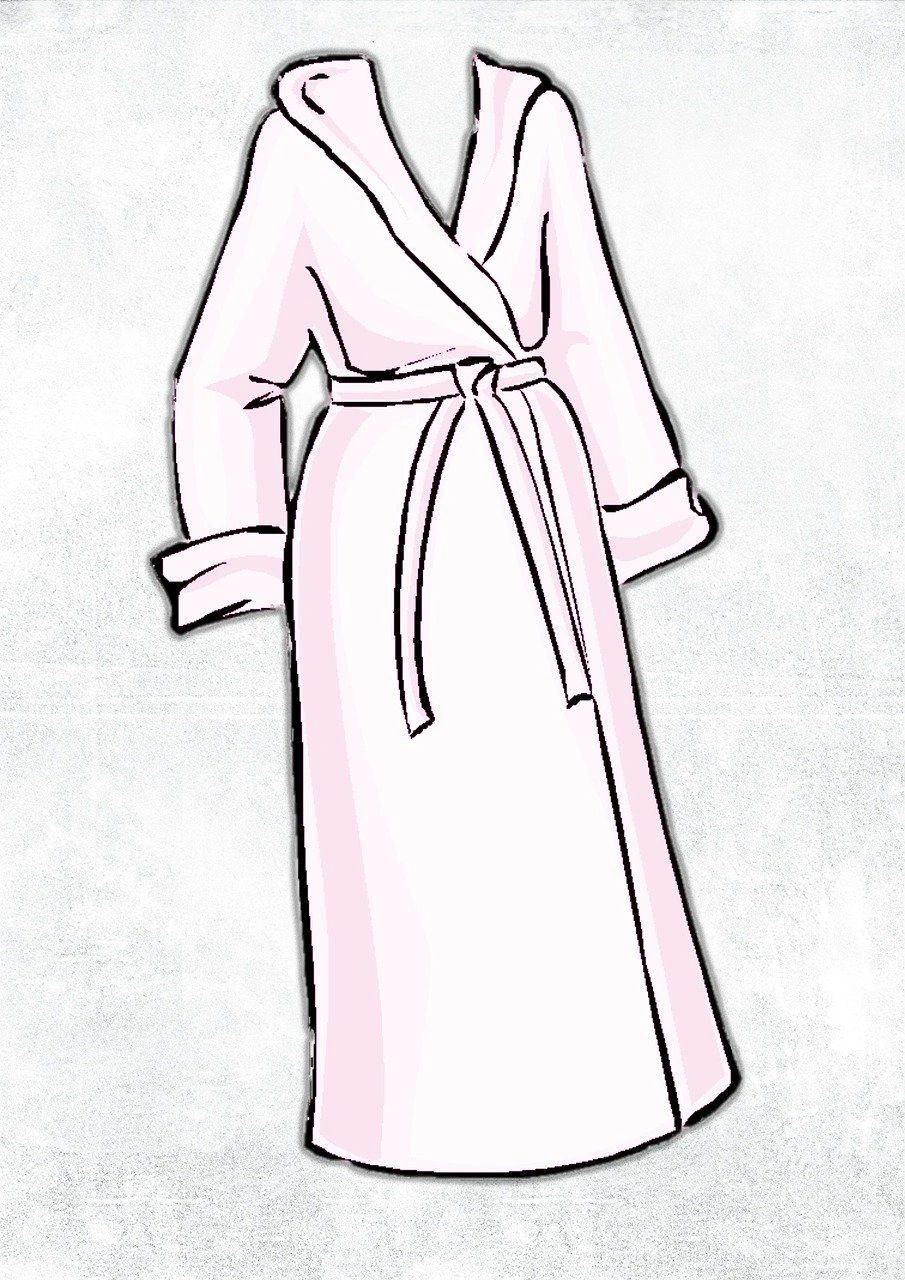
Image by ArtsyBee @ Pixabay
Do artists cower behind doors, dressed in fuzzy pink bathrobes?
Why yes, I suddenly remembered, they do! I’d seen Michael Douglas do just that in Wonder Boys, where he plays an English teacher trying to write a novel. His bathrobe was fuzzy! And pink! (I think it was his wife’s, but that’s beside the point.) Hmm. The idea of calling myself an artist was starting to seem more plausible.
I ate a big breakfast, still ensconced in my robe, after which I listened to the audiobook I’d begun recently: Miracle and Wonder, by Malcolm Gladwell – an extended interview with musician Paul Simon.
When I came to the part where Simon was asked about his motivation to experiment with music, I was stopped in my tracks by his response:
I really didn’t like being called an artist. Until I was in my 40s, I didn’t accept that. I just felt like, no, I’m not an artist. And when I was in my 40s, I took courses around the time of Graceland … I said, well, actually, I AM an artist. It doesn’t mean I’m a GOOD artist, it’s just a personality type. Some people make up stuff all the time, they can’t help it, they make it up. But, you know, it doesn’t mean you’re a … you could be a bad artist, you could be a great artist! But it’s a kind of a type of person. – Paul Simon
I laughed out loud when I heard that! There’s your answer, I told myself. Paul Simon just spoke to you! Paul Simon had imposter syndrome, and he overcame it. And you should, too. You ARE an artist!
I’m no longer going to hide behind a figurative door, fearing to call myself an artist. No, I’m going to wave my fuzzy pink flag proudly. My art might not be great, or even good, but I AM making stuff up (and enjoying the process).
By now you’re probably wondering what selection of songs, TV shows, and books could possibly have kept me up and interested until the wee hours of Sunday morning. Well, here they are, in no particular order:
TV: The final episode of the Netflix series, All the Light We Cannot See. It’s just beautiful, all the way through. Great acting within a story that’s simultaneously deep, dark, and uplifting, based on Anthony Doerr’s lyrical, Pulitzer prize-winning novel by the same name. The blind woman who plays the part of Marie beat out thousands of sight-impaired actors for the role, despite the fact that she’d had no previous acting experience or training. And it was her first audition! Now that’s an artist!
Hardcover book: The List of Things that Never Change, by Rebecca Stead. It’s a wonderful book written for middle grade kids, about a girl with two dads who sees a shrink, wishes she had a sister, and never gets 10 out of 10 on a spelling test (and therefore never gets to eat lunch with her teacher on Fridays). That’s all I know about it so far, and it’s so good I had a hard time putting it down last night.
Audiobook: Miracle and Wonder, by Malcolm Gladwell. I highly recommend it for anyone who’s interested in music, creativity, songwriting, or Paul Simon.
Songs: The songs I practiced on my guitar (26 altogether) before watching TV included ones written by Gordon Lightfoot, Paul Simon, Steve Goodman, Neil Young, Bob Dylan, The Beatles, Jill Sobule, and me. I spent a significant portion of the time listening to recordings of Paul Simon playing Homeward Bound and Still Crazy, trying to copy his fingerings (but not succeeding too well). Nonetheless, the act of listening to the chords and trying to break them down into individual notes is, for me, both fascinating and rewarding.
Crossword Puzzle: The Sunday New York Times. It was around 12:05 a.m., and technically Sunday morning, when I started it. I finished it today during breakfast.
YouTube: After searching “how to set up book festival vendor table,” I watched How to Create the Best Vendor Booth for a Pop-Up Shop by Monica Razak, and it inspired me to run around the house searching for props for displaying my books, crafts, business cards, etc. This somehow led to the cleaning out of closets. I’m not sure why. An artist works in mysterious ways.
As midnight approaches on the 16th day of National Blog Posting Month, I find I’m at a loss for words. I’m likely to do something wild and unpredictable.
Well, this blog is supposed to be inspired by my camera, and I do have a photo or two in my collection. Let’s see what I can come up with.
(Pause while I pull up my photo app …)
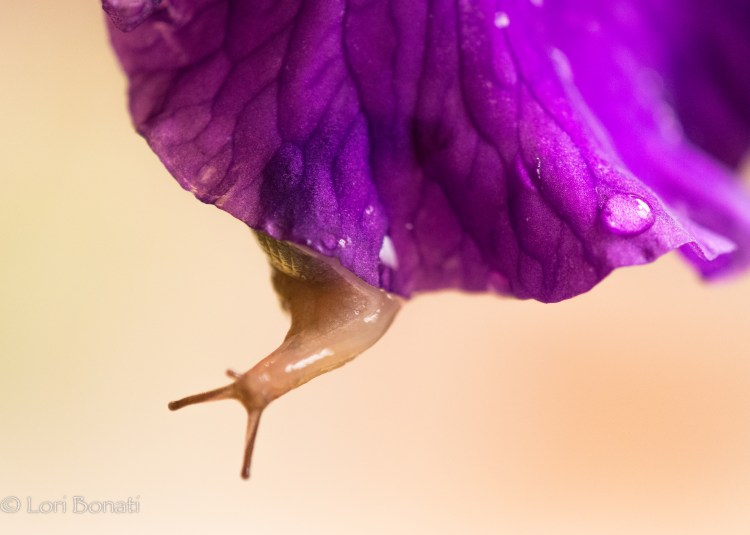
Ahh. Okay. Fortunately, I’ve found something: a portrait in vibrant purples and golds. It shimmers. It moves. It practically jumps off the page! The model reminds me of a graceful Flamenco dancer. Her dress is as soft as a petal.
Unfortunately for you, the model is a slug. A literal slug.
Introducing: Señorita Iris Maria Ariana Slug! (I.M.A. Slug, for short)!
I told you I was likely to do something wild and unpredictable. And I did!
~ ~ ~ ~ ~
This is post #16 of the month-long challenge known as #NaBloPoMo or #NanoPoblano. To follow my blog, please click below where it says “Follow loristory.”
And, to read more of the NanoPoblano posts written by the supportive blogging group “Cheer Peppers,” click the image below.
My photography critique group’s assignment last month was to submit three photos inspired by song or book titles. I’ve already shared one of those photos in my post, “Secrets Revealed” — the one called “Chelsea Morning,” which was inspired by a song by Joni Mitchell. Today I’ll show you my photo titled “Souvenirs,” inspired by the song and cd by John Prine.
If you’ve never heard of John Prine, I highly suggest you listen to him singing “Hello in There,” and then listen to Brandi Carlile sing it, too (with an amazing introduction by Stephen Colbert). Don’t be put off by Prine’s voice, which I’ll admit isn’t the best. It’s his honest, down-to-earth persona and absolutely devastating lyrics that get me.
Here’s what Wikipedia has to say about him:
John Edward Prine … was an American singer-songwriter of country-folk music. He was active as a composer, recording artist, live performer, and occasional actor from the early 1970s until his death. He was known for an often humorous style of original music that has elements of protest and social commentary.
… Widely cited as one of the most influential songwriters of his generation, Prine was known for humorous lyrics about love, life, and current events, as well as serious songs with social commentary and songs that recollect sometimes melancholy tales from his life.”
Wikipedia, Nov. 9, 2022
Sadly, I never got to see him perform live. He passed away from COVID-19 on April 7, 2020. But before he died, I’d listened to his “Souvenirs” cd many times. I’d sung along to it in the car so often that I’d memorized all of the lyrics and most of the little inflections in his voice.
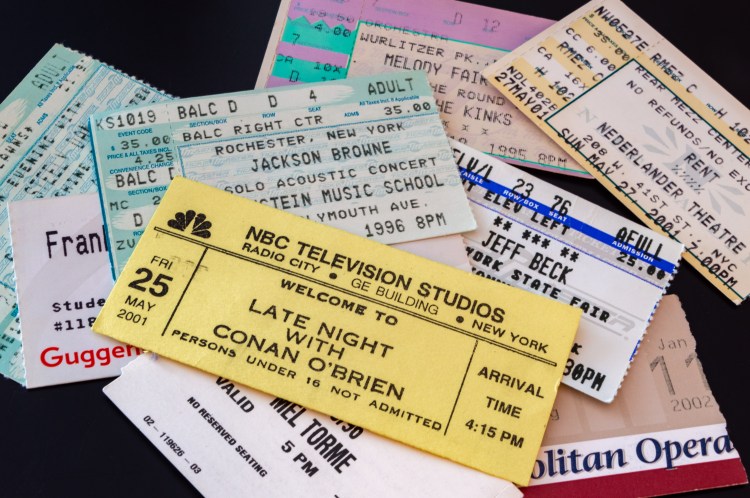
I decided to use the song, “Souvenirs,” for my photo assignment. I knew I had a stash of memorabilia in my guest room closet (I’d recently been in there looking for something), so I went back in and retrieved a handful of ticket stubs. Here are just a few of them:
These ticket stubs really brought back some good memories. For example:
The Kinks at Melody Fair, 1995
I remember Ray Davies entering the stage wrapped in a British flag, and the excitement of hearing him and, I believe, his brother Dave, performing all their greatest hits from the 60s. I particularly remember his energy. And now, every time I listen to “The Kinks Choral Collection,” an album of Kinks songs Ray sings with a symphonic orchestra and full chorus of backup singers, I feel that energy.
No, not that kind of chorus.
It’s this kind of chorus:
And, believe it or not, they blow the roof off of “All Day and All of the Night” and “You Really Got Me.”
Rent, Nederlander Theatre, NYC Theater District, May 27, 2001
In 2001, my daughters (ages 17 and 21 at the time) and I took an all-girls vacation to New York City. I’m not from the BIG city, so it’s always a thrill for me to go there. We had fun and saw lots of Big Yellow Taxis, the kind Joni Mitchell wrote about.
It was my 17-year-old who suggested we see the musical “Rent,” and we managed to nab cheap tickets that very day. The production was great. My favorite song was “Seasons of Love” (“525,600 Minutes”). Seeing “Rent” had a major impact on my daughter’s decision to become a social worker, which she still is to this day.
In the next installment of “Souvenirs,” I’ll share more memories jarred loose by seeing these ticket stubs. Which ones do you want to hear about next?
~ ~ ~ ~ ~
This is post #9 of the month-long challenge known as #NaBloPoMo or #NanoPoblano. To follow my blog, please click below where it says “Follow loristory.”
And, to read more of the NanoPoblano posts written by the supportive blogging group “Cheer Peppers,” click the image below.
In my Nov. 2 post, Secrets Revealed!, I shared the story of how I came to write a little ditty called “Home Alone.” Today, I’d like to talk about another song I’ve written for my new songwriting club.
Our prompt for this song was “inspiration.” We were supposed to try and write songs having to do with a quote that means something to us. I bent the rules a bit and used the title of one of my photos for inspiration. Here’s the photo, which also can be seen in my Nov. 1 post:
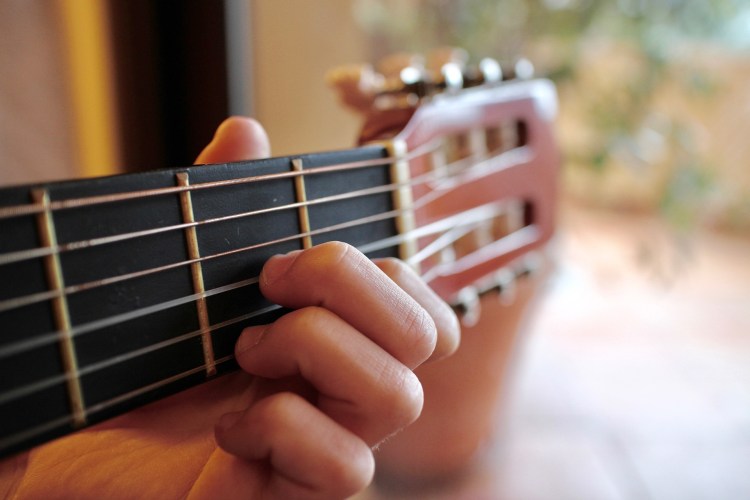
The stillness and vulnerability of the trees, and the way they seemed to be listening to and supporting each other, made me want to write something quiet and reflective to support them, something that would say “I hear you.” I grabbed my guitar and played one of my favorite chords, A-major-seventh (Amaj7). Here’s a photo of an Amaj7 chord that I found online. It’s one of the easier chords to make!
Photo by sweetlouise at pixabay.com
Major chords, or major triads, are often described as happy. The notes are bright and positive-sounding. Minor chords can be described as sad. The second note of the triad (third note of the scale) is dropped by a half-step (one fret on the guitar). For some reason, this brings out sad emotions. But major SEVENTH chords are really different. They add an unexpected fourth note – a half-step below the octave – and the result is a little bit dissonant and melancholy, but at the same time warm, sweet, and hopeful. At least that’s how I hear major seventh chords.
After I played that Amaj7 on the guitar, my hands drifted up the neck a bit and sort of accidentally landed on the strings in places that, when strummed, sounded good to my ear. Turns out it was a chord called Cadd9. (I had to look it up.)
My new song, “Listen to the Trees,” ended up with ten different chords altogether, and it all started with that Amaj7. It has a bossa nova beat which makes me think of the great Brazilian jazz composer Antonio Carlos Jobim, who used a lot of major seventh chords in his own songs.
Here are the lyrics to my song:
LISTEN TO THE TREES

Whispers in the forest, carried on a breeze

hear the quiet chorus of the trees

branches are bending, roots move underground

messages that barely make a sound.

Telling their troubles, each in their own way

helping each other through the day

around them only silence, actions too few –

and the trees, they know this is true.

     Take the time to listen, listen to the trees

     know what they are saying, get down on our knees

     tell them we hear them, do what they need

     and give a word of thanks to the trees.

Inhale the essence of treasures we can lose

be mindful of the things we choose

learn nature’s lessons from branches above

wrap our arms around the ones we love.
I’ll try to record it and post a link, if I can remember how to use Garage Band. That could take me until next November, though!
Have you ever written a song, poem, or story about trees? Post a link in the comments below if you have!
~ ~ ~ ~ ~ ~ ~ ~
This is post #5 of the month-long challenge known as #NaBloPoMo or #NanoPoblano. To follow my blog, please click below where it says “Follow loristory.”
And, to read more of the NanoPoblano posts written by the supportive blogging group “Cheer Peppers,” click the image below.
Featured image at top of post by Gordon Johnson at pixabay.com
My sister Lisa recently suggested I join her songwriting club. The group is given a prompt and then meets once a month to perform their new songs for each other (followed by polite applause and short critiques). Even though I get nervous performing in public, I decided to give it a whirl.
What’s the worst that can happen, I asked myself. I’ll be on Zoom, and if I can tell by their faces that my song really sucks, I’ll just mute myself and blame it on my computer!
This month’s prompt is Home. That’s a pretty broad topic. Maybe a little too broad, I thought. And for an entire day or two, I wracked my brain trying to come up with a clever idea. I even made this list of phrases using the word “home,” hoping it would lead me somewhere:
But that list just led me in circles. In desperation, I sat down at my piano keyboard. Now, mind you, my piano skills are somewhere between beginner and advanced beginner. But sometimes my fingers accidentally land on notes that lead me to a song idea. This time, it worked.
I played a couple of simple chords, and – lo and behold – some words popped into my head. I hate to admit it, though: they were pretty dumb words. The words were:
“Since my baby left me.”
Yeah, I know, that’s been done before (in the song “Heartbreak Hotel”). But what good is a good song lyric if you can’t steal it, I asked myself.
Just so I wouldn’t be sued by the estate of Thomas Durden, who wrote Heartbreak Hotel, I decided to give my song a more positive twist. Somehow, I’d turn heartbreak into happiness.
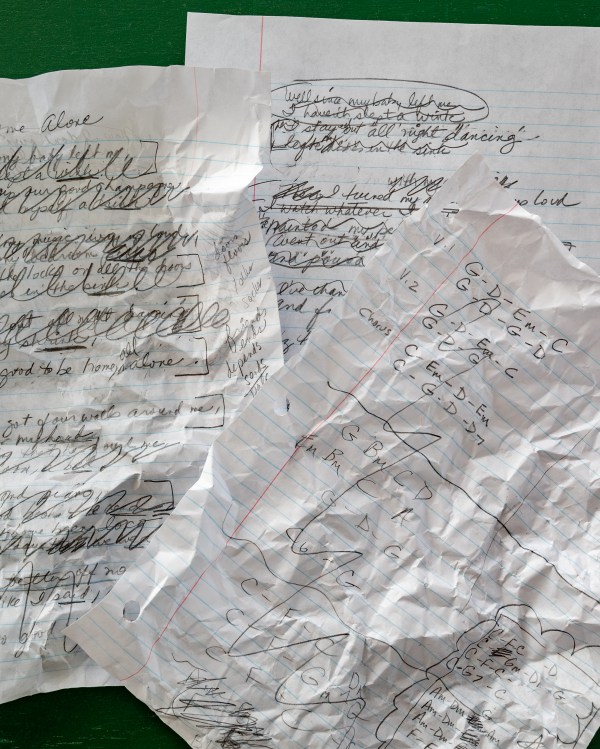
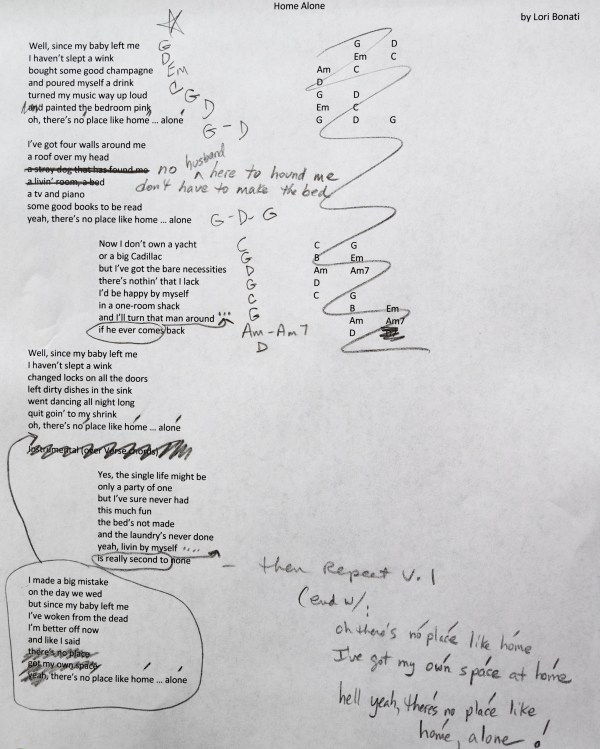
Writing a song about heartbreak turned on its head was difficult. The struggle was real, as these pictures will demonstrate:
In the end, I DID manage to come up with something positive, and, I think, positively funny. Here’s what I’ve got so far for my new song, “Home Alone”:
So now you know a few of my songwriting secrets, and also what happened “since my baby left me.”
P.S. The song above is a work of FICTION. My baby didn’t leave me, and I don’t like being home alone!
This is post #3 in this year’s #NaBloPoMo challenge, a.k.a. #NanoPoblano. To follow my blog, just click below where it says “Follow loristory.”