Category Archives: Language

Sketches of Spain, and Sweetness

This post is about a part of Spain I’d never heard of … and it’s about my grandsons, too.

Yesterday, while listening to a local radio program about world reggae music, I was surprised to hear a reggae song described as Spanish, Celtic, and Galician. I’d never heard the terms “Spanish” and “Celtic” together in the same sentence. To me, Celtic meant Irish, Welsh, and Scottish. I couldn’t imagine a Spanish reggae song with a Celtic flair.

What’s more, I didn’t have the slightest idea what “Galician” meant. Curious, I Googled it and found a reference to a Galicia in eastern Europe. I thought I’d misheard the radio host and thought nothing more about it.

But then, later that evening, while reading a book about Spain (because I’m planning a trip there soon), I stumbled upon a map showing another Galicia – this one a region in the northwestern portion of the country … and the book said that Galicia’s language has Celtic roots.
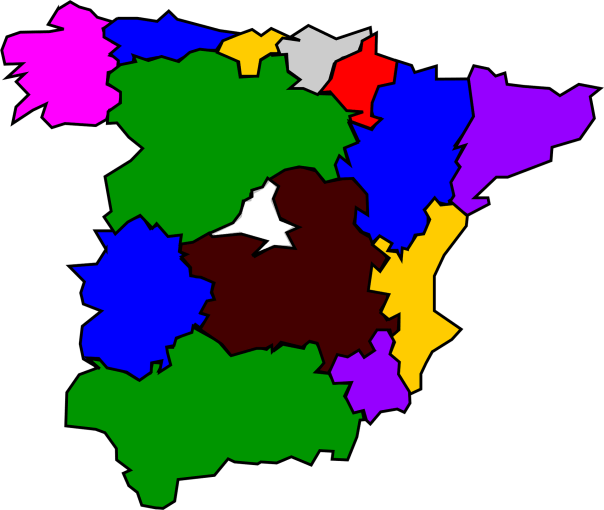
Galicia is the bright pink region on this map, in the northwest corner of Spain.

Wow! I’d just learned something new about music, language, AND geography. I like learning new things. But today, in the car, when I asked my 10-year-old grandson Porter (who loves maps and history) if he’d ever heard of Galicia, the one in Spain, I learned even more.

Yes, he knew exactly where it was. He even expressed the opinion that the map of Spain would look much better if Galicia were part of Portugal!

He also already knew about Galicia’s Celtic ties, and when I wondered aloud how many languages were spoken in Spain, he mentioned not just Spanish, but Basque and Catalan, too.

After I told him I’d be visiting southern Spain soon, he said he thought there’d be a lot of history there because it was probably the oldest part of Spain. This led to a lively tutorial (by that I mean he tutored me) about Spain’s history, including key points like Charlemagne’s invasion and several Spanish conquests (Mexico, southwestern US, the Philippines, Cuba, and Equatorial Guinea). That’s right. My grandson knows something about the history of Equatorial Guinea, a small country in Africa.

Did I mention that he’s only 10 years old?

Meanwhile, his 6-year-old brother Elliot was quietly absorbing every word, and during a break in the conversation, he sweetly offered his own opinion:

“Grandma, when you come back from Spain, maybe you can tell us all about it … and if you get us anything while you’re there, you can give it to us then.”

Up until today, my main goals in traveling to Spain had been (1) brushing up on my Spanish conversational skills, (2) taking lots of awesome photos, and (3) steeping myself in Andalusian culture. But now, I have a much more important goal: finding a couple of really cool souvenirs for my grandsons.

The Circle of Swag

I’ve just had a “full circle” moment.

It began yesterday, when I met with Rory Fitzpatrick (Irondequoit, NY Town Supervisor) and Shannon Grieve (Irondequoit Recreation Department Director) for a congratulatory event. I was being recognized for having come up with the name for my town’s new quarterly Activity Guide/Newsletter.

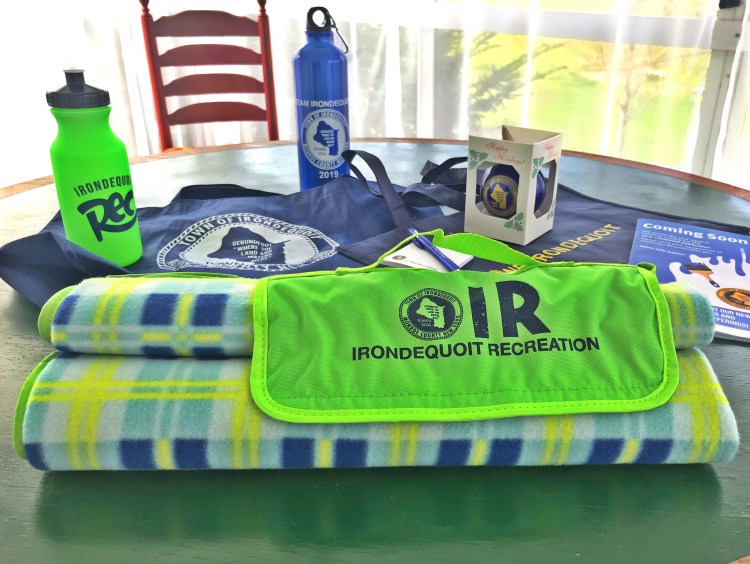
I even had my picture taken, and I received a sweet “swag bag,” too, complete with a blanket, pad, pen, holiday ornament, extra bag, and not one but two water bottles. I felt like a celebrity.

The word “Irondequoit” derives from the Iroquois word “gerundegut,”
which in English means “where the land and waters meet.”

The name I’d submitted for the publication, “Eye on Irondequoit,” was one of 25 entries, and Shannon said mine was the clear winner. The town even designed a new newsletter logo to go with the name: a round lens looking out toward the Rochester Harbor Light, a local landmark where Irondequoit Bay meets Lake Ontario.

After taking my swag out of my swag bag, and reading the origin of the word “Irondequoit” that was written on the outside of the bag, I got to wondering about the origin of the word “swag.” And my search for the answer to this question eventually led me full circle, as you will see.

I found as many definitions of swag as there were items in my swag bag (seven). According to the internet, “swag” can mean:

  • the act of swaying or lurching,
  • self-confidence,
  • a style of drapery,
  • money,
  • stolen goods,
  • the shape of one’s stomach,
  • or free promotional items.

In fact, the Merriam-Webster Dictionary hails the word “swag” as one of the most “polysemous” words in the English language. I had to look up “polysemous.” It’s just another way of saying “having multiple meanings.”

To make things even more confusing, there are several different explanations for the origin of the word “swag.” It might come from:

  • Old Norse sveggja (to swing or sway);
  • Old English swingan (to swing)
  • Middle English swaggen, swagen, swoggen (probably from Old Norse — see above)
  • Norwegian svaga (to sway, swing, stagger)
  • 18th century British thieves’ slang

It might even be related to the root word swage, which had to do with the bending of cold metal, which in turn came from the French suer (to sweat).

According to the fact-checking website Snopes, the word swag has been falsely rumored to be an acronym for phrases such as:

  • Stuff We All Get
  • Stuff We Ain’t Got
  • Scientific Wild Arsed Guess
  • Souvenirs, Wearables, And Gifts
  • Sold Without A Guarantee
  • Secretly We Are Gay

Snopes also tells us that, in Australia, a swag can be a bundle of belongings, and, in addition, a large quantity of something.

I’ve read that the first written use of the word “swagger” wasn’t until the late 16th century:

Puck: “What hempen home-spuns have we swaggering here, so near the cradle of the fairy queen?”

WILLIAM SHAKESPEARE, “A MIDSUMMER NIGHT’S DREAM”

And, last but not least, the word “swag” has been referred to as the 2011 Hip-Hop Word of the Year.

But MY first encounter with the word “swag” was on the TV show Parks and Recreation, where my favorite character, Tom Haverford, created a business called “Rent-A-Swag.”

And as I was writing that last paragraph, I realized I’ve come full circle, because I began with my meeting with the Recreation Department Director — my own town’s version of Leslie Knope. (Parks and Recreation fans will know who she is.)

Don’t you just love it when things come full circle? And now I think I’ll go and fill up my Irondequoit Rec water bottle, grab my Irondequoit Rec blanket, and go to the park. Either that, or I’ll take my swag bag into the living room, park myself in front of the TV, and watch an old episode of Parks and Recreation.

Seven Ways to Say “Curly”

I am the child of a father with thick, curly black hair and a mother with fine, straight brown hair. So what did I end up with? A head full of not-quite-curly, not-quite straight, fine hair. Thanks, genes! Actually, a better way to describe my hair is “a collection of limp, uncooperative cowlicks that behave badly in public.”

The only time my hair looks good is right after a new haircut. Here’s me straight from the hairdresser’s about a month ago:

lori-selfie-032019.jpeg

and here’s me today:

edward-lear-1823617_1280

But last week I bought some pomade that smells like limes and makes my wavy, unruly hair calm down and behave. I looked like this for about one day:

IMG_4787

As long as my hair stays exactly this length, I’m happy. I like the simplicity of my current morning routine: shampoo, apply goo, scrunch, and go.

But I know in about two days my hair will reach that stage again where I debate the pros and cons of yanking it back into a pony tail, getting it all cut off, or both.

The reason I’m discussing my hair has nothing to do with vanity, and everything to do with linguistics. You see, the little label that came with my pomade was translated into seven languages, none of which were English or Spanish.

I wondered why the company selected the languages they did (French, German, Swedish, Russian, Italian, Dutch, and Portuguese) and why they omitted English and Spanish. But I was glad to see the less well-known languages included for a change.

Being a language nerd, I decided to take up the challenge of trying to read the label. I still remember some of my high school French, which gave me a head start. The label began with a brief product description, saying it would lend control and shine to curly hair. It talked about how to apply the stuff.

For each language, there was a warning included, which said:

Precautions: Follow instructions. Avoid all contact with eyes. KEEP AWAY FROM CHILDREN.

After studying the label, I’ve come to the conclusion that there are seven different ways to think of “curly,” depending on where you live.

The French phrase for curly hair is “cheveux bouclés,” which actually means “loopy hair.” If you’ve ever seen a jacket made from bouclé fabric, you know the look. It’s kind of tousled and wild, something like fleece. I like the idea of appearing tousled and wild, so from now on I’m going to ask my hairdresser to give me a “bouclé.” I just hope she doesn’t think it means “blue hair.”

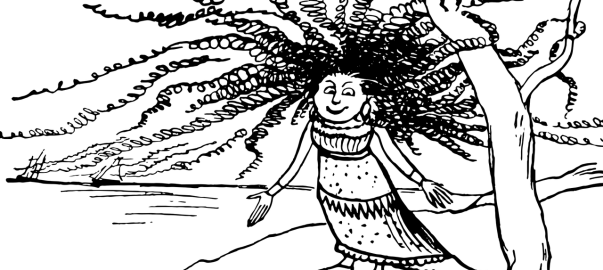
The German phrase for curly hair is “lockige Haare.” That may be where we get the word “Goldilocks” from. And I learned from reading the label and using Google that the German way of saying “control hair” uses the word “geeignet,” which means to make something acceptable. I guess I’d better not visit Germany looking like picture #2 above.

The Swedes refer to curly locks as “lockigt har/god til krollet har.” That means curly/crinkly hair, I think. I found it interesting that the English words for “medium” and “formula” are the same in Swedish, at least on this product label.

Then I came to Russian, a language that completely baffles me. Not only do most letters appear as upper-case, but some like R and N are mirror images of their English versions, and others look more like hieroglyphics. I had no idea which of the Russian words was the one for hair.

However, I did manage to figure out which one meant “Precautions,” since I’d already identified it in the French version (“Précautions”) and it was the only word followed by a colon. So I THINK that the Russian word for “Precautions” is something like this: Cnoco6 npNMeHehNR. I wonder if Donald Trump took Cnoco6 npNMeHehNR when he visited Russia.

Now for Italian. In Italian, curly hair is translated as “capelli ricci.” Rich hair! It makes sense that Italians would think of curly hair as “rich.”

The Dutch translation of curly hair is “krullend haar.” But before you start thinking that Dutch is just a slightly modified version of English, consider that the Dutch word for instructions is “gebruiksaanwijzing.” (It was on the label and I looked it up.)

The last language on the label is Portuguese. The Portuguese translation of curly hair is “cabelo encaracolado,” which almost literally means “hair like a snail shell.” What a great description of my hair! (See picture #2 above.)

The very last portion of the label was a long list of ingredients, and, for some reason, it was in English only. Maybe they didn’t want their readers to understand it. I understood only too well that I’ve been putting something on my hair that’s made with citronella, and is practically radioactive. But it smells good, and it probably will keep the mosquitoes away this summer.