Tag Archives: activism

Large cardboard figure reading a book to a smaller cardboard figure

So Little Cardboard

Recently, I attended a protest rally and took pictures of some clever and inspiring signs. One of my favorites was:

The word “Cardboard” was squeezed tightly into a corner at the bottom of the sign, to emphasize the fact that there just wasn’t enough room on that small placard to list every important grievance against our government.

The sentiment struck me as true not only politically, but “writerly,” too. You see, besides feeling swamped by political issues (and I’ll get to that later), I also seem to have too many ideas for writing projects swirling around in my head. Some are already written, some are nearing completion, and one I started yesterday. This morning, I even wrote two haikus before I got out of bed. Each one of these projects is clamoring for its moment in the spotlight (or at least a “like” by an agent).

But I feel like I’m running out of cardboard.

Cardboard: That space in my brain where I churn out half-baked writing ideas that sometimes bear fruit, and other times fade into obscurity. That flimsy container that can feel sharp and in focus one day, and waterlogged or empty the next. That hourglass that seems to be flowing in a downward direction, faster and faster every day.

It would be wonderful if my cardboard would suddenly turn into a bright, flashing neon sign, like the kind on Broadway, one that speaks boldly and proudly that “we have a winner!” “a smash hit!” “a must-read!” 

It would be great if that cardboard would become a billboard that agents would notice as they speed by on the literary highway, taking note of the contact information, and later that night, sending an email asking for a full manuscript.

It would be reassuring if that cardboard were to be waved like a flag by a reader who was moved by it.

It sure would be nice to have an unlimited supply of cardboard, but my brain matter is finite. My cardboard will never stretch. In fact, it can only shrink. So now I know what I need to do:

I need to write smaller!

Yes, I need to choose just one, or possibly two, of my books, and focus on getting them published.

And also, does anyone know where I can find MORE CARDBOARD?

Note: See my PHOTOS link in the Menu for signs – cardboard and otherwise – from the 50501 (50 protests, 50 states, 1 day) rally in Rochester, NY, 4/19/25. 

P.S. Speaking of politics, I’ve found it helpful in this political climate to keep a second piece of cardboard in my brain just for politics, and to put only one issue on it for now: the environment. That way maybe I can focus my energy and hopefully be effective. The job I’ve assigned myself is to read up on the science behind climate change, and to report out to my group (a subcommittee of Indivisible) on local environmental actions. Reading and writing … I can’t seem to get away from either one.

Thanks to Rick Steves for his thoughtful and honest post about authoritarianism yesterday, which inspired me to veer into the political realm today. I urge you all to read it.

Featured image by ColiN00B at Pixabay.com

Share this post:

Do Something

There should be stricter gun laws severely restricting the rights of those who have made or professed threats against others. The Buffalo, New York murders could have been prevented.

The killer believed in a right-wing, extremist, racist theory promoted by selfish, small-minded, greedy individuals. He then wrote a 180-page hate-filled screed and posted it on social media.

He also made a threat, in writing, against his own high school. This was known to the state police before his attack on innocent people.

And yet he was permitted, by New York State law, to purchase an assault-style weapon.

Why was this allowed? And how long before history repeats itself? We must act now to outlaw the promotion of violent propaganda and fear-mongering. We must also outlaw availability of assault-style weapons to those with any history of violent or threatening behavior.

Further, we must vote right-wingers out of office. If I had my way, we’d vote ALL Republicans out, just because they haven’t dissociated themselves from the party led by Donald Trump.

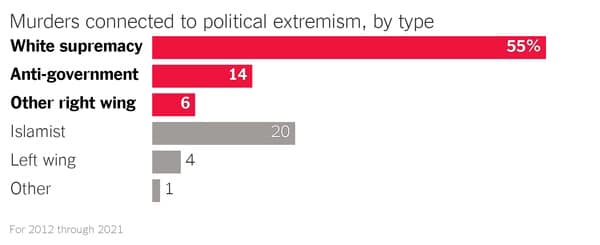
Here’s data reported today in the NYT:

“Over the past decade, the Anti-Defamation League has counted about 450 U.S. murders committed by political extremists.

“Of these 450 killings, right-wing extremists committed about 75 percent. Islamic extremists were responsible for about 20 percent, and left-wing extremists were responsible for 4 percent.

“Nearly half of the murders were specifically tied to white supremacists.” [See Anti-Defamation League graph below]

“As this data shows, the American political right has a violence problem that has no equivalent on the left. And the 10 victims in Buffalo this past weekend are now part of this toll. ‘Right-wing extremist violence is our biggest threat,’ Jonathan Greenblatt, the head of the ADL, has written. ‘The numbers don’t lie.’ …

“The pattern extends to violence less severe than murder, like the Jan. 6 attack on Congress. It also extends to the language from some Republican politicians — including Donald Trump — and conservative media figures that treats violence as a legitimate form of political expression.”
—-

The killer’s plan, after completing his mission in Buffalo, was to come to the city where I live, to a corner where I once worked, and continue the bloodshed. He has no remorse. He did not deserve the benefit of the doubt, or his so-called right to bear arms.

Regardless of where he was planning his next attack, good people were going about their daily business on a sunny day in Buffalo and were brutally murdered simply because of the color of their skin. I’m mad as hell. I hope you are, too. And I hope we all finally do something about it.

Paying My Rent

Yesterday, I carried a sign and marched with 15,000 people through the streets of Tucson. We walked in solidarity with millions of others around the world as part of the Women’s March on Washington.

Although I have a lot to say about that march, I want to focus on some amazing connections that happened to me afterwards.

I returned home feeling tired yet energized. After posting photos on Facebook and Instagram, reading friends’ posts, and then their links, and then the links within those links, I finally settled down at my kitchen table with a carry-out dinner. My eyes fell upon the small neighborhood newspaper that had been in my mailbox when I got home. I opened it. The first thing that caught my eye was an unexpected article about the multinational biotech company, Monsanto.

Monsanto wants to buy 155 acres in Marana, a rural town adjacent to Tucson, so that it can build a 7-acre greenhouse focusing on corn and soybean seed research. Their proposed purchase of the land has been the subject of controversy in Marana (which gets its name from the Spanish maraña, or “tangled web”). Some of its residents see the move as an opportunity for jobs, while others are worried about the impact on the land, water, and surrounding crops. (Monsanto produces the herbicide Roundup. Roundup’s main ingredient — glyphosate — has been proven to be harmful to bees and is a possible human carcinogen.) But Monsanto argues that even though they’ll be using some GMO seeds and “limited” herbicides, neither will escape from their greenhouses. This has been viewed with suspicion by several Marana residents, who also are concerned about the effect that Monsanto’s presence could have on Tucson’s new reputation as an International City of Gastronomy. (Tucson prides itself on its rich cultural heritage, which includes indigenous crops, dry farming methods, and unique culinary offerings.) And they wonder what Monsanto will eventually be doing with the other 148 acres.

There already have been four town meetings to discuss the plan. Those meetings were filled with people who came there to listen, learn, and protest. From what I read, it sounded like Monsanto was given plenty of time to make its presentations. Then the residents got to ask questions and make comments. Some mentioned environmental concerns. Not to worry, responded Monsanto, because the greenhouse will be sealed up tight. The county administrator and the Tucson chamber of commerce president also noted that the project would bring jobs and increased tax revenue to Marana (despite negotiations to give Monsanto a two-thirds property tax incentive).

I got up from the table and started doing dishes. While washing plates, my thoughts started to take shape. I was getting a picture in my mind of an interconnected pattern, like a tree with many branches. I stopped in the middle of my chore, rinsed and dried off my hands, and almost ran to my computer. Once there, I closed my eyes and let my thoughts run down into my fingertips and onto the screen. I had to get that tangled web of words out before they disappeared like the water that had been running down my kitchen drain.

But, after typing my draft, and feeling a bit overwhelmed by all of those ideas swirling around in my head, I suddenly had another idea, one that would help me to sort things out. I would create an issues notebook.

I found an empty three-ring binder and filled it up with blank lined paper. I grabbed a pencil. But where to start? So many issues, so many facts to check (and also, so little time). I started by making sections, one for each major issue that I thought might need fixing. The first one I thought of was “Environment.” I decided to begin there.

I went back to the computer and googled Monsanto. That’s when the amazing interconnection began to reveal itself. The best way to describe it is like this:

  • I went to the women’s march
  • I came home and, by chance, I read the article about Monsanto
  • I began researching Monsanto
  • I needed a break and decided to do a crossword puzzle instead
  • I got stuck on some of the words. One was a five-letter word meaning “groups who share views” which probably ends with the letters “cs.”
  • I resumed my research about Monsanto
  • I learned that it was purchased by Bayer (pending approval)
  • I googled Bayer
  • I learned to my horror that Bayer used people in German concentration camps as slave labor and for their experiments (and that its parent company at the time, IG Farben, invented the gas used in those concentration camps)
  • I wanted to know who owns Bayer now
  • I found out that Bayer isn’t owned by anyone other than its stockholders, but it is one of many companies managed by the Capital Group investment firm
  • This led me to an article listing the four major investment firms in the world, which manage the trillions of dollars that exist in the world’s portfolio of investments
  • I read another article about the 147 companies that control 80% of the world’s economy
  • I decided to go to the original source of the article about the 147 companies (The network of global corporate control, 2011, by Vitali, Glattfelder, and Battiston)
  • I skimmed that article and learned about how interconnected those 147 companies are, and how unstable that makes the world economy (when one company falls, many others follow)
  • I read about how fund managers use something called “topology” to describe the mathematical interdependence of these companies visually
  • I was shocked when I saw that word, “topology,” because I’ve just finished reading a novel about a math genius whose field was “topology.” (The book is A Doubter’s Almanac, by Ethan Canin, and I had to look up “topology” while I was reading it.)
  • And then the final connection of all the dots (ta-da!): In the article was the word “blocs,” which may just be the answer to that crossword puzzle clue (“groups who share views” ending with the letters “cs.”).

Whew. A real maraña.

I’ve decided that I need to focus on one issue in my notebook at a time, and take action on that. Maybe I will choose The Environment (or maybe it has already chosen me).

That’s how I’ll start paying my rent for living on the planet.