Tag Archives: apples

Apples, Autumn, and Angles

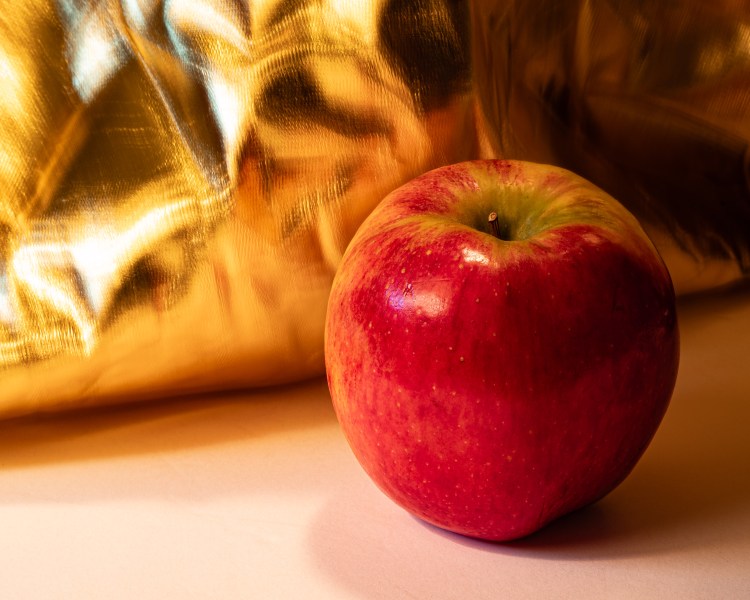
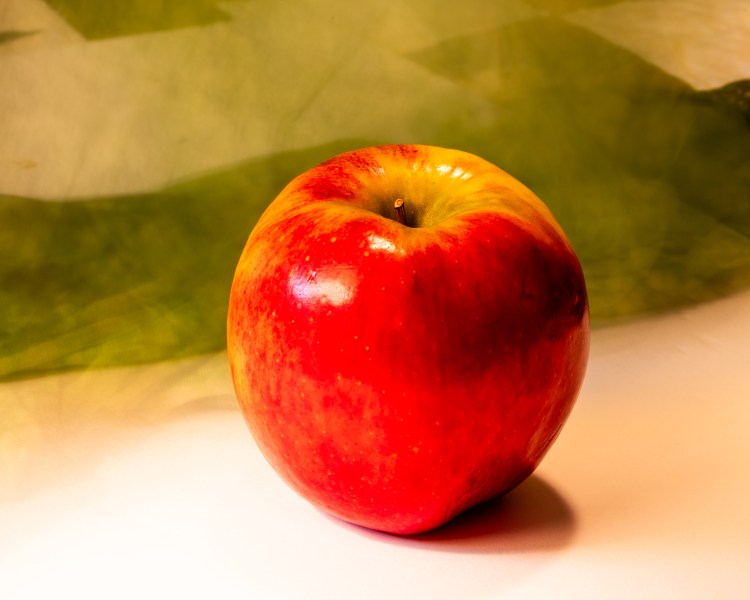
My photography group assignment for September was “Composition.” We were told to photograph a small object in at least 10 different ways, experimenting with angle, distance, etc., and then to choose the 2 to 4 we liked best, which would be presented to the group and critiqued at our next meeting.

We could define “small” in any way we wished. We had to keep the object in a consistent environment, but we could alter its appearance by doing things like spraying it with water, immersing it in water, or cutting it in half. I’m sure that last suggestion applied only to inanimate objects!

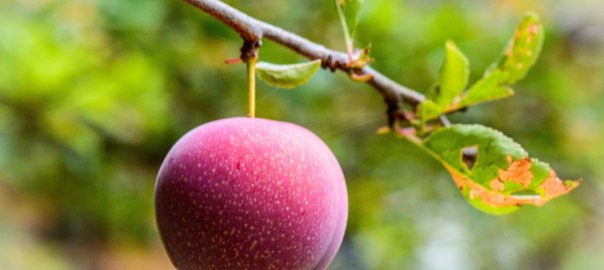
Aside from trying to decide how I’d alter the poor object, the hard part for me (and for many of the rest of us, I’ve heard) was settling on a subject to photograph. I wanted to choose something interesting or unique. But then it dawned on me that I was in the group to learn, not to try and impress anyone. And the best way for me to learn composition, I figured, was to keep it simple. I chose an apple as my model.

After selecting the prettiest apple in my fruit bin, I hauled out my camera, two lenses, a tripod, a shiny background, a scarf, a lamp, and a flashlight. I piled everything on my bed and proceeded to set up various scenes using the apple as the star of my production.

I set the apple on a white board. I placed a black box behind it. I nestled it in a colorful scarf. I experimented with various shutter speeds and apertures. I waved the scarf behind it. I sprayed the apple with water and coated it in olive oil. I spent at least 4 hours taking photos of the damned apple.

Then I spent another hour or so editing my photos. But after all of that, I was unsatisfied. I felt like I hadn’t done a very good job on the assignment, and I was embarrassed to show my photos to the group. Even worse, I hadn’t learned anything about composition.

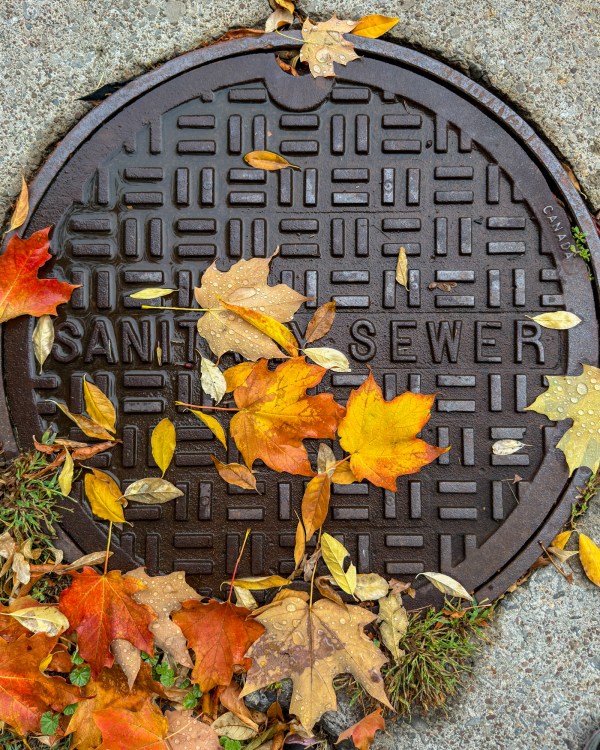
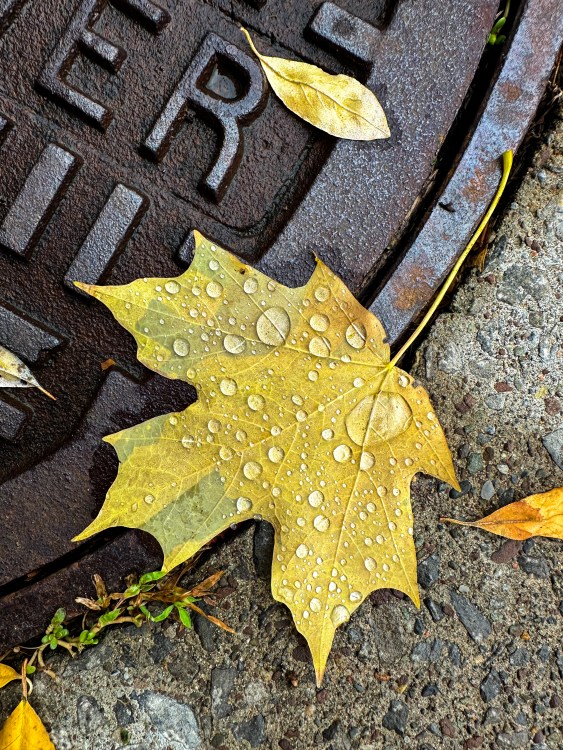
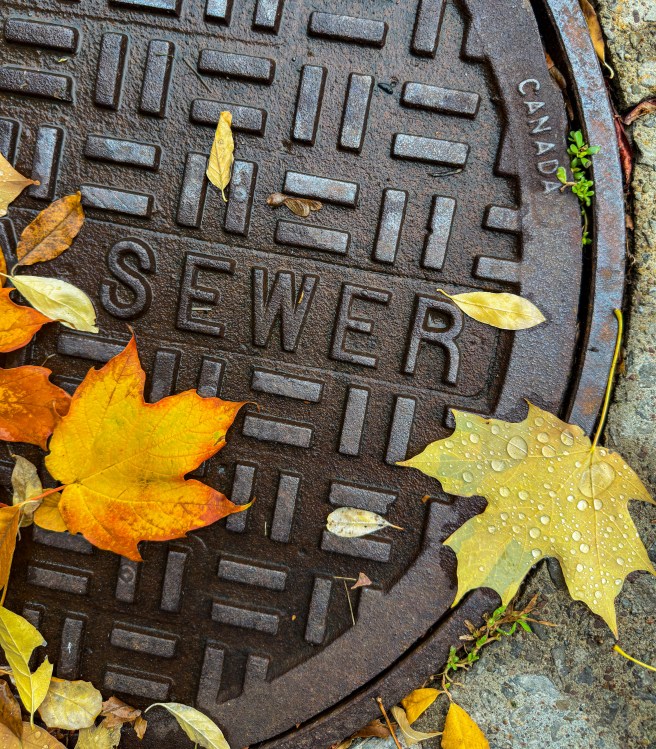
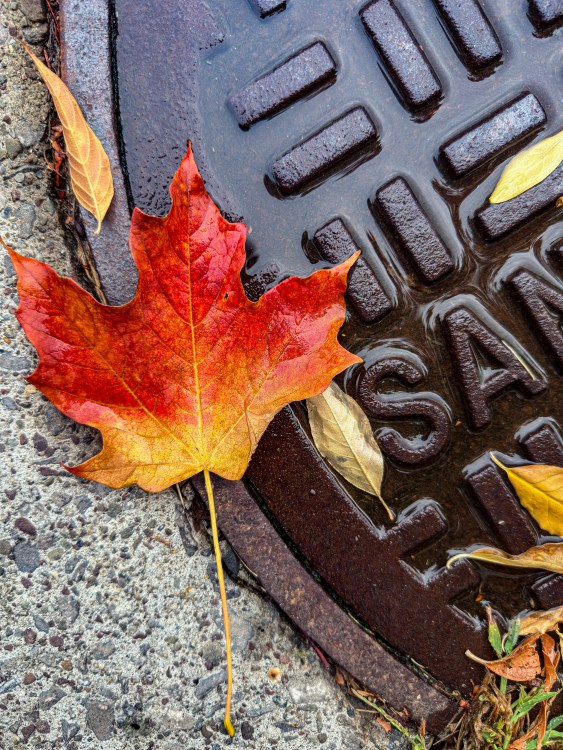
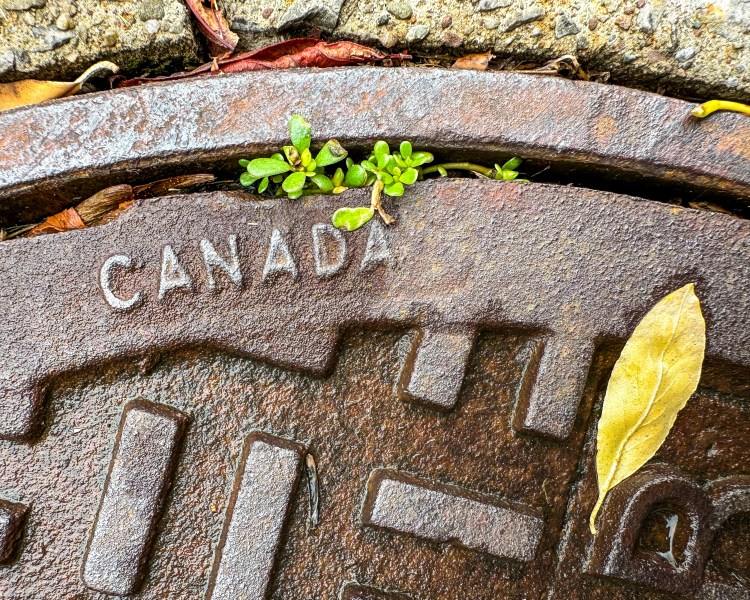
Then yesterday I went for a walk, and what did I see? Hundreds of small, rain-splashed autumn leaves glittering in the sun. Some had landed on top of a sewer cover. There was a strange beauty in all of that. Unfortunately, all I had with me was my iPhone, and there was someone walking behind me. Nervous about stopping, squatting down, and taking pictures with someone watching, I kept walking.

But after they passed me, I turned around. Sure, traffic was zooming by, and I’d be noticed by everyone in their cars as I crouched down, held that position for far too long, and then struggled to get up again (that did happen!), but so what? If a good picture is worth 1,000 words, it’s also worth a little embarrassment and creaky knees. I got to work.

After about 5 minutes, I had 30 pictures of leaves! And my knees survived! I couldn’t wait to get home and edit the pictures. I hadn’t used any fancy equipment. I didn’t have special lighting or backgrounds to play with. But instead, I decided to do what our mentor had said … notice something, stop, walk around it, and take pictures from different angles.

What do you think of the results? Which photos do you like best?

Did I learn something? Yes. I learned that beautiful objects can be found anywhere, even at the most unexpected times and in the most unexpected places … and that it pays to consider all the “angles.”
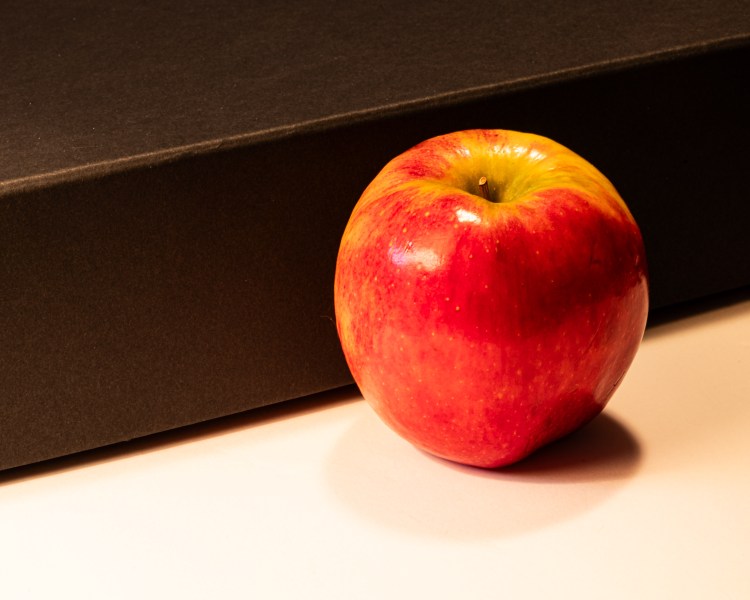
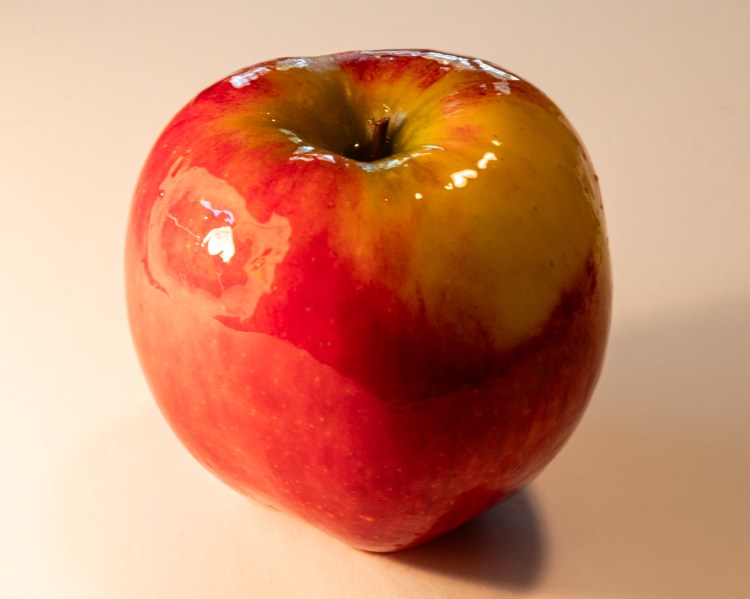
All That and Apples, Too

(This post is in response to a writing prompt from Lorna over at Gin & Lemonade. The prompt was “A Fall/Autumnal Food Memory.” Here’s mine — an adventure I’ve never shared in print before. And once again, thanks to Lorna for jogging my memory.)


For most young people, autumn signifies a return to school. But for me, in September of 1971, the cooler temperatures and colorful foliage of upstate New York were telling me to leave college, spend $90 (in other words, half my life savings) on a train ticket, and make my way west to California.

I had a little adventure with apples along the way.

In 1971, American kids were dropping out of college in droves. They’d read On the Road; they’d listened to California Dreamin’. They wanted to get back to the land and find themselves. So did I.

I’d planned to take a train from Toronto to Vancouver, and then a bus south to Santa Cruz, where my friend Sharon lived. I was sure I could find some sort of job (or perhaps gold) once I got to California.

At the train station, I met two women who also were heading west. We boarded the train together, and by the time we’d gotten to Winnipeg we’d decided to get off the train and hitchhike the rest of the way.

Call me crazy, but back then I believed it was safe for three 20-something ladies to hitchhike through the Canadian wilderness together. After all, the Canadian government was practically promoting it. They’d erected billboards all over the country telling drivers to “Pick Up a Hitchhiker.” And it was cheap, too. You could stay overnight at a youth hostel for only 50 cents a night.

But before you get too jealous and try this at home, don’t. My traveler’s checks went missing after a night at one of the hostels. Even worse, I had to talk my way out of a #metoo situation, and I managed to outsmart another potential perpetrator. Whew. I was lucky those times. So again, just don’t.

But I hitchhiked with the young ladies through Manitoba, Saskatchewan, Alberta, and half of British Columbia, and we survived unscathed. We made it as far as Cranbrook, B.C., where they decided to stay, since one of them apparently had met the love of her life named Colin. (For some reason I remember his name and not hers.) I decided to move on. Colin drove me to the Creston bus station, about an hour down the road, so I could safely get to Vancouver by myself.

Creston is a small, fairy-tale village set in a valley in the foothills of the snow-capped Canadian Rockies. It’s blessed with a clear blue lake, a nearby hot springs, and a lot of apple trees.

I was standing in the Creston bus station when a cute (in a teddy-bear way) long-haired blond French Canadian named Ernie approached me and said, “How would you like to pick apples for a while?”

To this day, I have no idea what he was doing in that bus station, or why he came up to me and asked me that question. And I have no idea why I said yes. But suddenly the whole idea of just parking myself in that beautiful little town to “pick apples for a while” sounded pretty appealing.

There was a cabin in the orchard where the apple-pickers could stay for free. It had two beds, a table, a couple of chairs, a wood stove, a parachute hanging on one wall, a collection of Cracker Jack toys, and a gentle, silver-colored German Shepherd named Mr. Morgan who was said to be part wolf. And of course, Ernie was staying there, too. He said I could stay there, no strings attached, and there weren’t any … until there were.

Each morning, we’d get up early, put on our apple bags, climb our ladders, and pick apples in the sunshine. At lunchtime, the owner of the apple orchard came by with tea and homemade baked goods, and we all had a wonderful picnic under the apple trees.

A neighboring farmer once left some turnips for us on the cabin doorstep. We roasted a turkey in the wood stove for Canadian Thanksgiving.

We made friends with a married couple who also picked apples and owned a yellow Volkswagen Beetle, and the four of us took off one day and drove all the way to California and back. We slept on the beach one night, and at a friend’s party another night.

When we returned from California about ten days later, the weather had changed. The snows were coming, and the cabin wasn’t made for winter. We had to leave. Ernie’s mom lived in Vancouver, so we moved in with her temporarily. His mom was lovely. I had my own pink room with a single bed and a chenille bedspread.

I found work in Vancouver as a waitress, and rented a tiny, furnished basement apartment. Ernie and I were doing well as a couple. I applied for permanent residency. I had no idea that you were supposed to do that before getting a job. I naively thought having a job would help me get residency.

The man at the government office told me I had gotten it backwards and that my residency was denied. I burst into tears on the spot. My parents wired me the plane fare and I was back home by mid-December.

Of course, this was before the advent of cell phones, email, or skype, and long distance phone calls were too expensive. Ernie and I communicated by writing letters throughout that winter and spring. He was a good letter-writer. I knit him a sweater for Christmas and mailed it off. We made plans. He was going to come east and we were going to bicycle our way around the Maritime provinces that summer. I would try again for Canadian residency.

But in the back of my mind, I must have known it was just more dreamin’, because when I received his “Dear Jane” letter in May I was disappointed but not surprised.

In spite of the way things turned out with Ernie, I’ve never regretted my adventure in the fall of 1971. If nothing else, I know what it’s like to live in a cabin, to climb a ladder and pick fruit in the crisp Canadian sunshine, to have an orchard picnic with tea and homemade baked goods, to eat a gift of turnips left on my doorstep, to cook a turkey in a wood stove, to travel to California in a yellow Volkswagen Beetle, to sleep on a beach, and to live with a gentle, part-wolf, dog by the name of Mr. Morgan.

I had all that, and apples, too.