Tag Archives: art

Apples, Autumn, and Angles

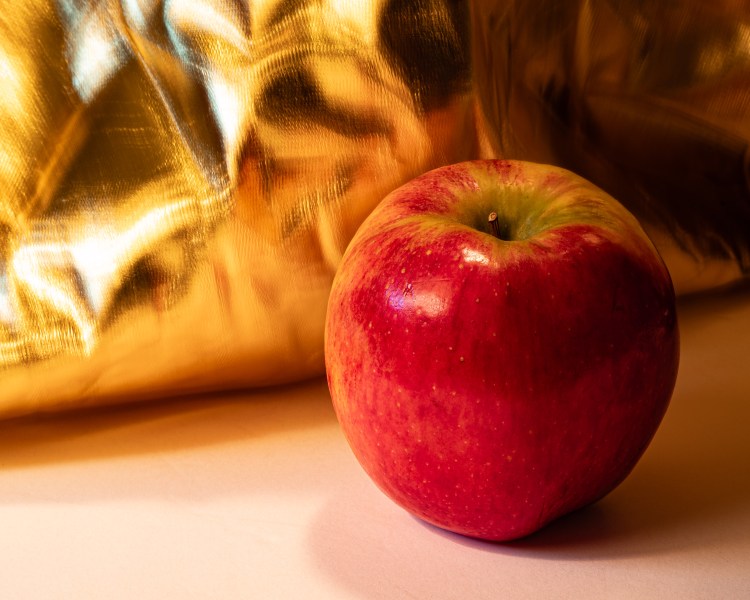
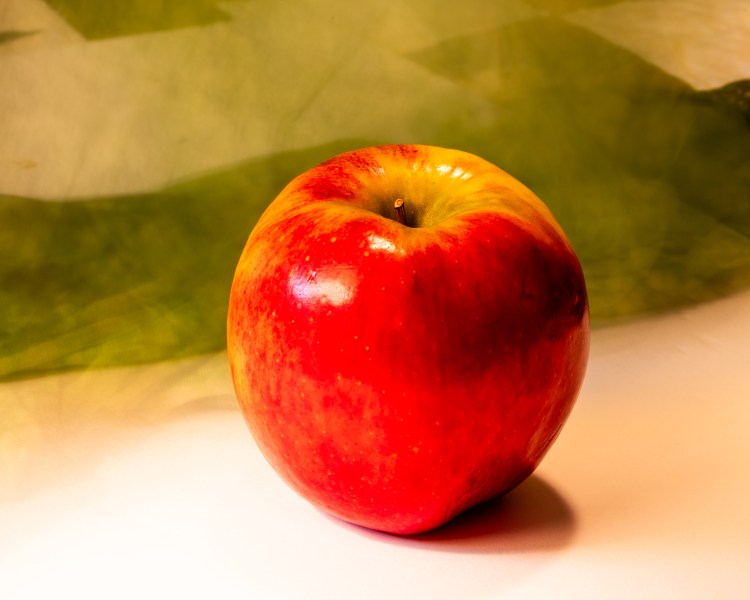
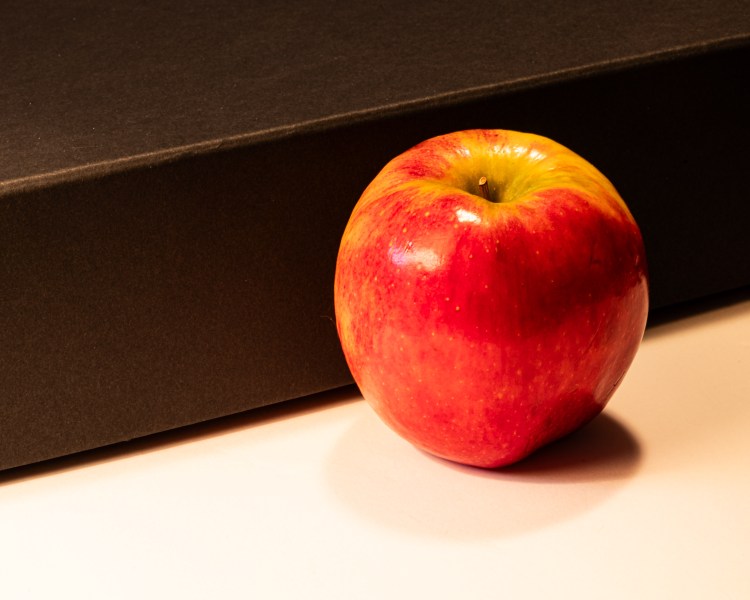
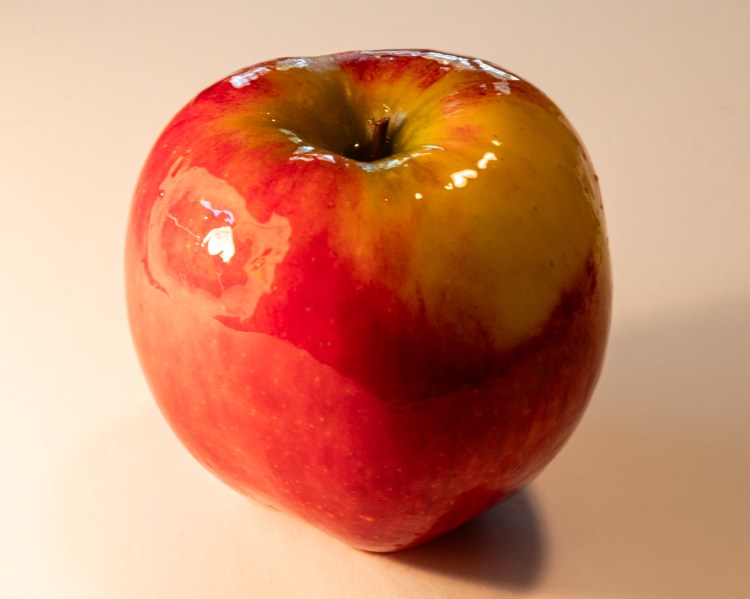
My photography group assignment for September was “Composition.” We were told to photograph a small object in at least 10 different ways, experimenting with angle, distance, etc., and then to choose the 2 to 4 we liked best, which would be presented to the group and critiqued at our next meeting.

We could define “small” in any way we wished. We had to keep the object in a consistent environment, but we could alter its appearance by doing things like spraying it with water, immersing it in water, or cutting it in half. I’m sure that last suggestion applied only to inanimate objects!

Aside from trying to decide how I’d alter the poor object, the hard part for me (and for many of the rest of us, I’ve heard) was settling on a subject to photograph. I wanted to choose something interesting or unique. But then it dawned on me that I was in the group to learn, not to try and impress anyone. And the best way for me to learn composition, I figured, was to keep it simple. I chose an apple as my model.

After selecting the prettiest apple in my fruit bin, I hauled out my camera, two lenses, a tripod, a shiny background, a scarf, a lamp, and a flashlight. I piled everything on my bed and proceeded to set up various scenes using the apple as the star of my production.

I set the apple on a white board. I placed a black box behind it. I nestled it in a colorful scarf. I experimented with various shutter speeds and apertures. I waved the scarf behind it. I sprayed the apple with water and coated it in olive oil. I spent at least 4 hours taking photos of the damned apple.

Then I spent another hour or so editing my photos. But after all of that, I was unsatisfied. I felt like I hadn’t done a very good job on the assignment, and I was embarrassed to show my photos to the group. Even worse, I hadn’t learned anything about composition.

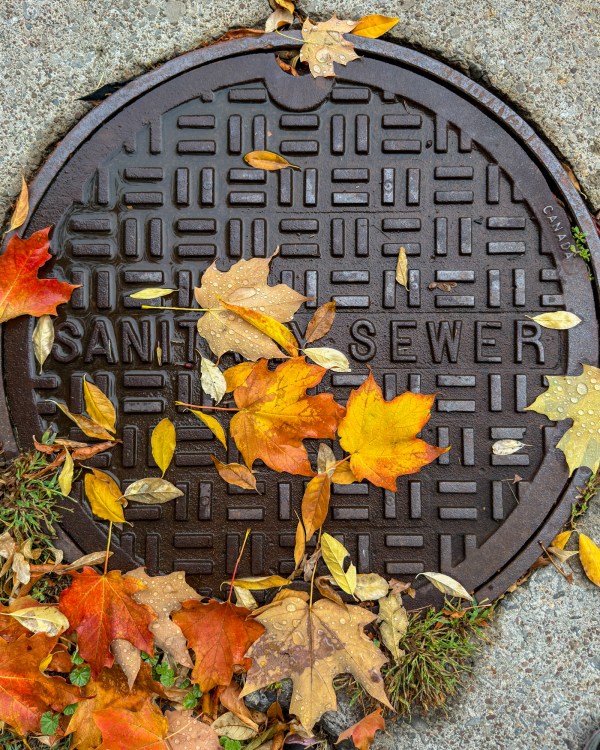
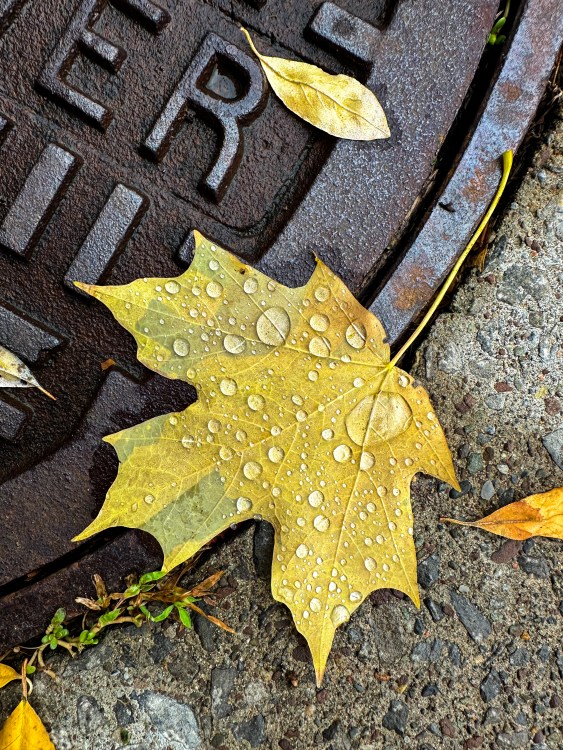
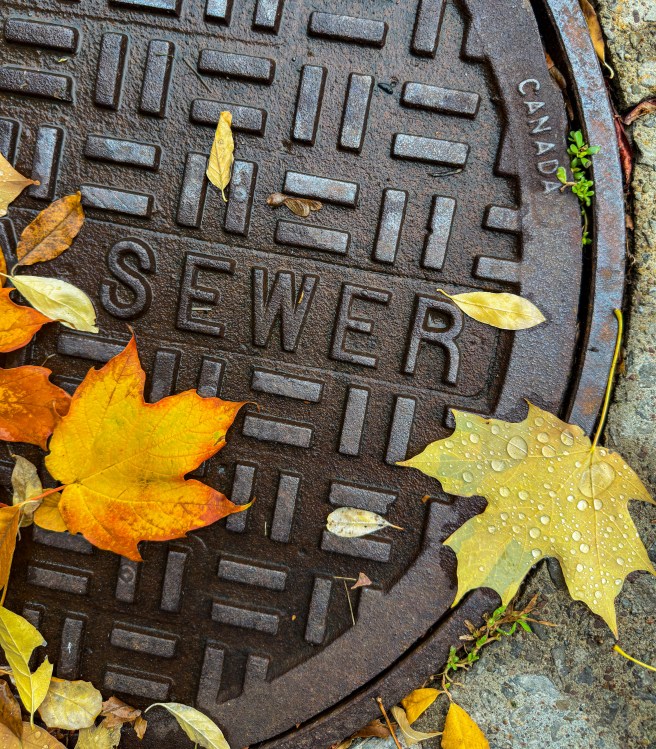
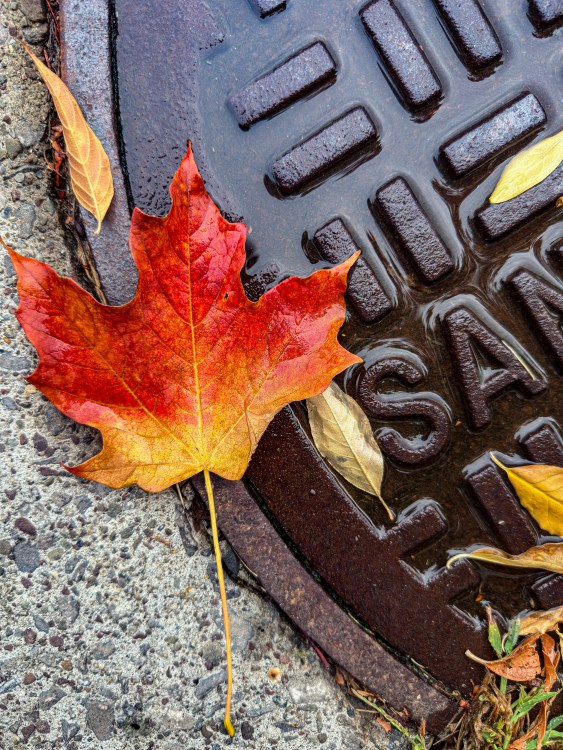
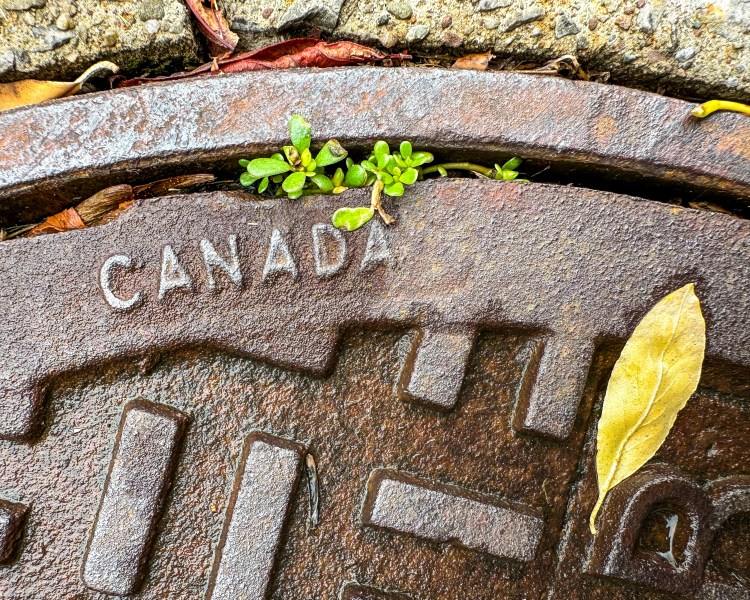
Then yesterday I went for a walk, and what did I see? Hundreds of small, rain-splashed autumn leaves glittering in the sun. Some had landed on top of a sewer cover. There was a strange beauty in all of that. Unfortunately, all I had with me was my iPhone, and there was someone walking behind me. Nervous about stopping, squatting down, and taking pictures with someone watching, I kept walking.

But after they passed me, I turned around. Sure, traffic was zooming by, and I’d be noticed by everyone in their cars as I crouched down, held that position for far too long, and then struggled to get up again (that did happen!), but so what? If a good picture is worth 1,000 words, it’s also worth a little embarrassment and creaky knees. I got to work.

After about 5 minutes, I had 30 pictures of leaves! And my knees survived! I couldn’t wait to get home and edit the pictures. I hadn’t used any fancy equipment. I didn’t have special lighting or backgrounds to play with. But instead, I decided to do what our mentor had said … notice something, stop, walk around it, and take pictures from different angles.

What do you think of the results? Which photos do you like best?

Did I learn something? Yes. I learned that beautiful objects can be found anywhere, even at the most unexpected times and in the most unexpected places … and that it pays to consider all the “angles.”
Coincidentally Speaking

I love coincidences – apparently unrelated events that become connected, otherwise known as synchronicity. Well, this morning a coincidence popped up, and it was perfectly in sync with my day.

Let me set the stage.

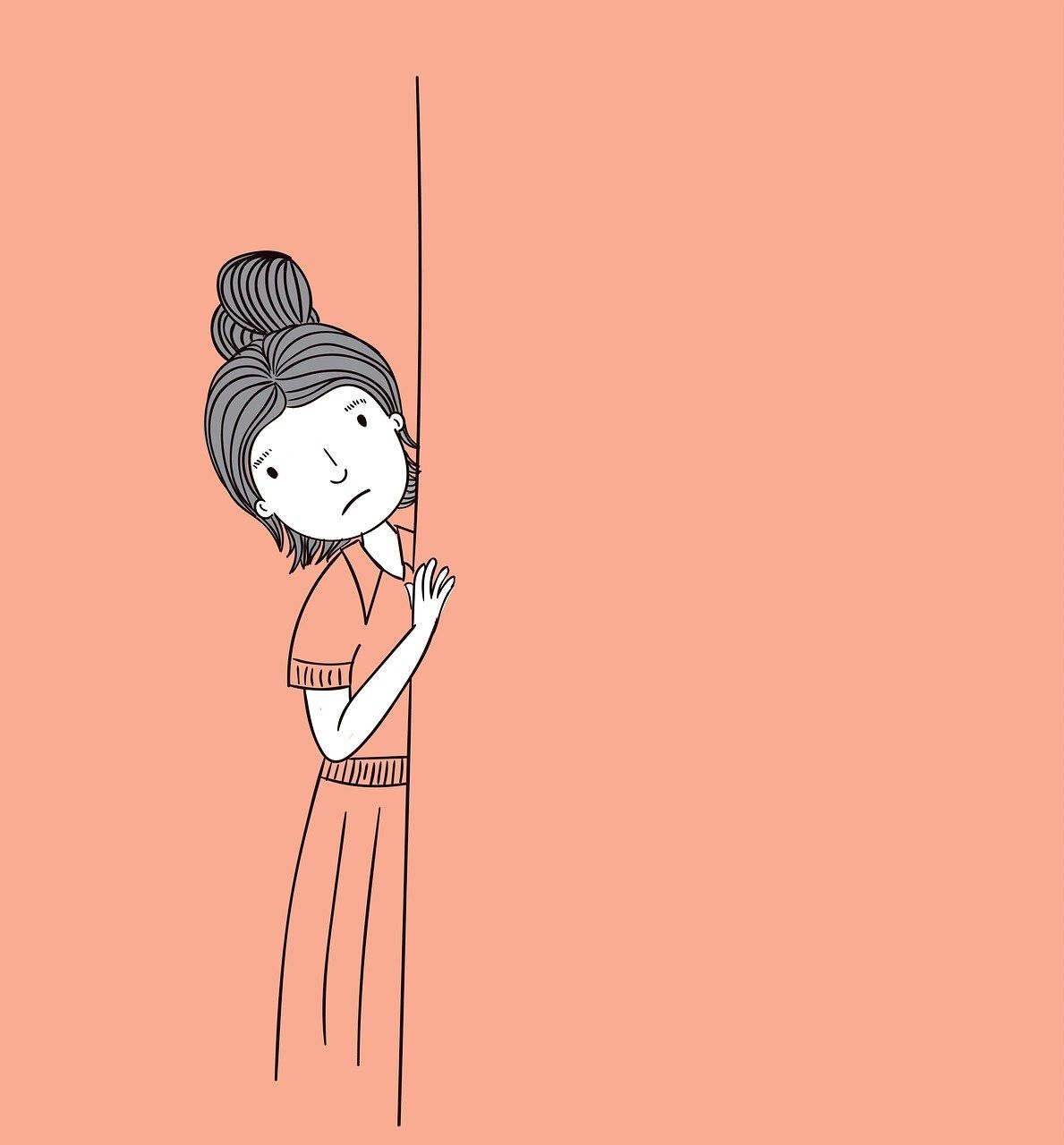
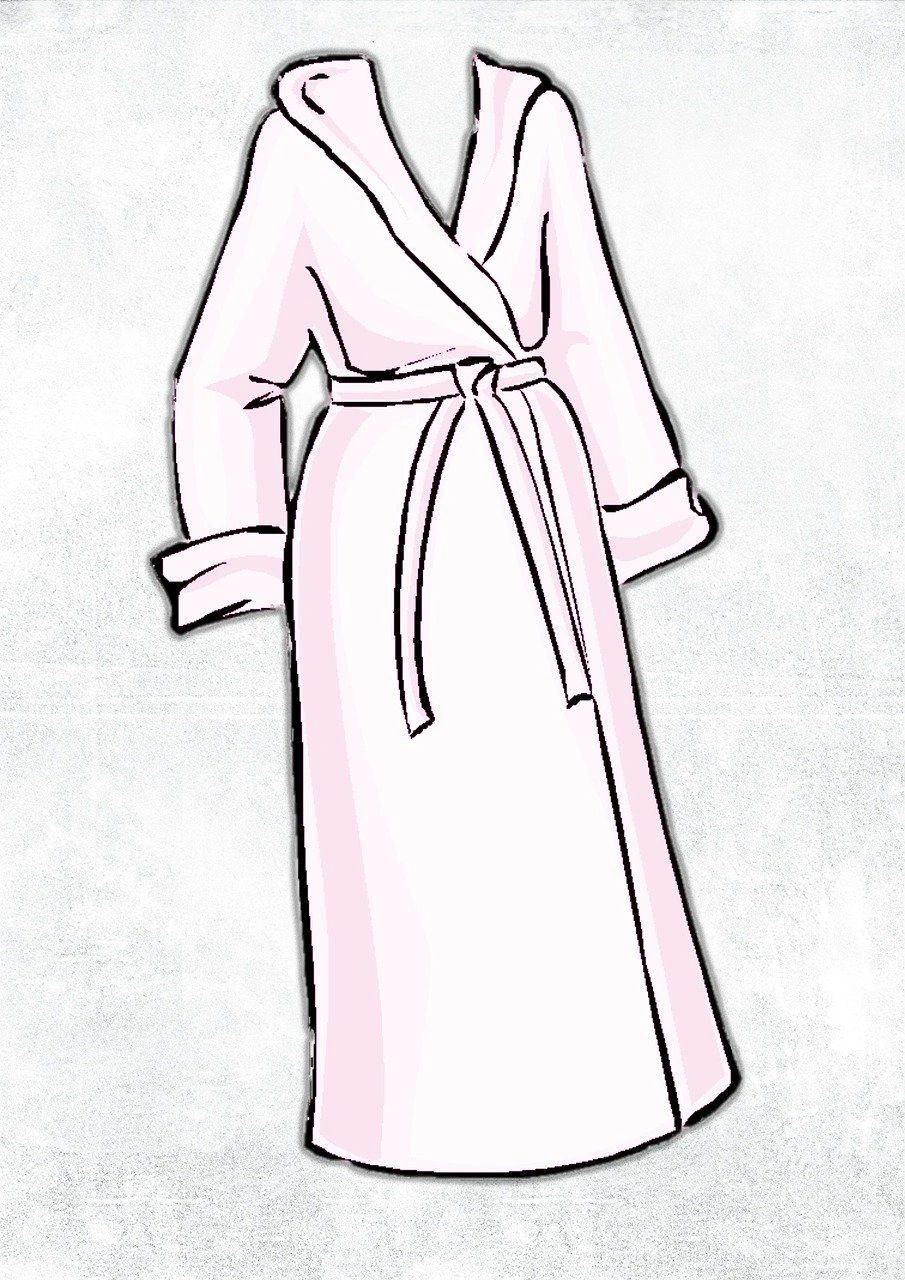
It’s 10:30 on a Sunday morning. I’m still in my fuzzy pink bathrobe. My hair’s a mess. I have raccoon eyes, probably, although I haven’t checked myself in the mirror yet. I’m hiding behind an open door.

Image by Piyapong Saydaung @ Pixabay

What could possibly explain my situation, and my unkempt appearance?

It’s simply this: I was up late last night. I couldn’t help it. I’d spent hours reading. Playing guitar. Watching TV.

Doing a crossword puzzle, browsing YouTube, researching a literary agent online.

Cutting my hair.

Combing through my possessions for doodads to enhance my vendor table at a book fair next weekend.

And cleaning out two closets that suddenly seemed to be jam-packed with clothes I couldn’t believe I’d actually spent good money on, and never wear anymore.

Just an average Saturday night.

Is it any surprise, then, to find me cowering behind my back door late Sunday morning, with one extended hand on my dog’s leash, the other on the doorknob, awaiting the moment we were both safely back inside the house? I wasn’t hung over, just hung UP on one horrifying thought: What if my neighbors see me?

I knew if that happened, and if they asked if I was okay, I probably shouldn’t dive into the litany of activities I’ve just revealed to you: the playing, watching, puzzling, researching, cutting, combing and cleaning I’d spent hours on the night before. Better to just utter a simple excuse before ducking back inside my house. But what could I say? The words “I’m an artist” suddenly sprang to mind. After all, artists are allowed to stay up late and sleep in the next day.

But is that true? I asked myself. AM I an artist? No, absolutely not. Not really. Well, maybe. I just wasn’t sure.

Image by ArtsyBee @ Pixabay

Do artists cower behind doors, dressed in fuzzy pink bathrobes?

Why yes, I suddenly remembered, they do! I’d seen Michael Douglas do just that in Wonder Boys, where he plays an English teacher trying to write a novel. His bathrobe was fuzzy! And pink! (I think it was his wife’s, but that’s beside the point.) Hmm. The idea of calling myself an artist was starting to seem more plausible.

I ate a big breakfast, still ensconced in my robe, after which I listened to the audiobook I’d begun recently: Miracle and Wonder, by Malcolm Gladwell – an extended interview with musician Paul Simon.

When I came to the part where Simon was asked about his motivation to experiment with music, I was stopped in my tracks by his response:

I really didn’t like being called an artist. Until I was in my 40s, I didn’t accept that. I just felt like, no, I’m not an artist. And when I was in my 40s, I took courses around the time of Graceland … I said, well, actually, I AM an artist. It doesn’t mean I’m a GOOD artist, it’s just a personality type. Some people make up stuff all the time, they can’t help it, they make it up. But, you know, it doesn’t mean you’re a … you could be a bad artist, you could be a great artist! But it’s a kind of a type of person. – Paul Simon

I laughed out loud when I heard that! There’s your answer, I told myself. Paul Simon just spoke to you! Paul Simon had imposter syndrome, and he overcame it. And you should, too. You ARE an artist!

I’m no longer going to hide behind a figurative door, fearing to call myself an artist. No, I’m going to wave my fuzzy pink flag proudly. My art might not be great, or even good, but I AM making stuff up (and enjoying the process).

By now you’re probably wondering what selection of songs, TV shows, and books could possibly have kept me up and interested until the wee hours of Sunday morning. Well, here they are, in no particular order:

TV: The final episode of the Netflix series, All the Light We Cannot See. It’s just beautiful, all the way through. Great acting within a story that’s simultaneously deep, dark, and uplifting, based on Anthony Doerr’s lyrical, Pulitzer prize-winning novel by the same name. The blind woman who plays the part of Marie beat out thousands of sight-impaired actors for the role, despite the fact that she’d had no previous acting experience or training. And it was her first audition! Now that’s an artist!

Hardcover bookThe List of Things that Never Change, by Rebecca Stead. It’s a wonderful book written for middle grade kids, about a girl with two dads who sees a shrink, wishes she had a sister, and never gets 10 out of 10 on a spelling test (and therefore never gets to eat lunch with her teacher on Fridays). That’s all I know about it so far, and it’s so good I had a hard time putting it down last night.

AudiobookMiracle and Wonder, by Malcolm Gladwell. I highly recommend it for anyone who’s interested in music, creativity, songwriting, or Paul Simon.

Songs: The songs I practiced on my guitar (26 altogether) before watching TV included ones written by Gordon Lightfoot, Paul Simon, Steve Goodman, Neil Young, Bob Dylan, The Beatles, Jill Sobule, and me. I spent a significant portion of the time listening to recordings of Paul Simon playing Homeward Bound and Still Crazy, trying to copy his fingerings (but not succeeding too well). Nonetheless, the act of listening to the chords and trying to break them down into individual notes is, for me, both fascinating and rewarding.

Crossword Puzzle: The Sunday New York Times. It was around 12:05 a.m., and technically Sunday morning, when I started it. I finished it today during breakfast.

YouTube: After searching “how to set up book festival vendor table,” I watched How to Create the Best Vendor Booth for a Pop-Up Shop by Monica Razak, and it inspired me to run around the house searching for props for displaying my books, crafts, business cards, etc. This somehow led to the cleaning out of closets. I’m not sure why. An artist works in mysterious ways.

Featured image (hearts): PIRO @ Pixabay

Lucky to Live in the ROC (Part 4)

Welcome back for another installment of “Lucky to Live in the ROC,” the ongoing series in which I write about upstate New York attractions in and around Rochester. In the last episode, I promised you an epic road trip in search of the perfect pizza, and some unexpected artwork, so here goes:

The Pizza

On a recent road trip through upstate New York, I stopped in Geneseo, a quaint college town thirty miles south of Rochester, and discovered “Mama Mia’s Pizza.” The pizza was so amazing – thin and crispy, with great-tasting sauce – that I returned a few weeks later with a friend for another slice. This time, I didn’t just get great pizza, I got a great cup of coffee, too.

When I ordered my coffee, the woman behind the counter said they’d make a fresh pot. “Okay,” I replied, wondering if I was causing them too much trouble as I began to eat my pizza at a table outside. Pretty soon, a young man came out. “I’m going to make you a cup of Costa Rican coffee.” “That’s fine,” I said.” About ten minutes later, I’d finished my pizza and was wondering if I’d ever get my coffee. Suddenly, the coffee man came out with a steaming cup.

“I ran home and got some beans,” he explained. “I bought them at the Rochester Public Market, they’re great.” And he’d come back to the shop and ground them just for me. Wow. It was the BEST cup of coffee I’ve had in a long time.

I didn’t take a picture of my pizza because it disappeared too quickly, but it looked something like this:

And here’s a sign I saw in a Geneseo shop window.

The Unexpected Artwork

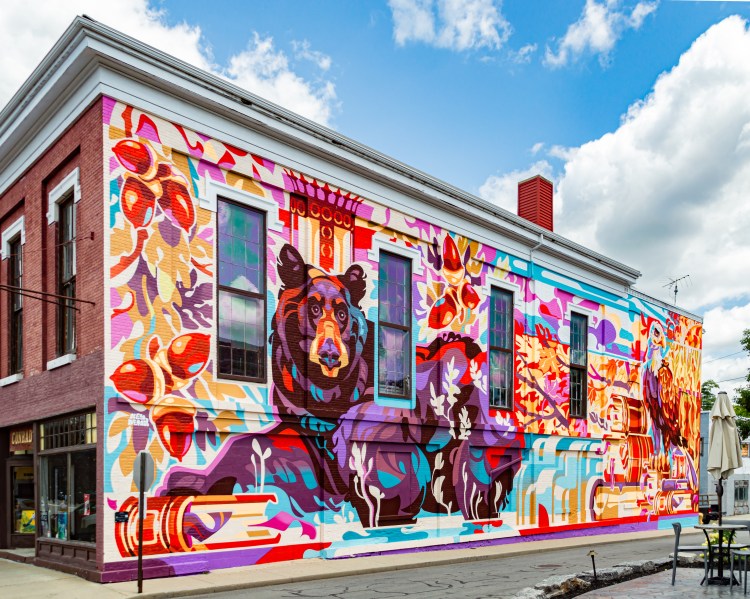
In 1914, Robert Frost wrote “Mending Wall,” a poem about a wall that divided his orchard from his neighbor’s forest. “Something there is that doesn’t love a wall,” he wrote. But in Livingston County, New York, the residents love their walls so much that, last July, they commissioned some artists to paint murals on them, and then they held the Livingston County Mural Festival to show them off.

The colorful walls are actually the sides of buildings, one for each of the nine villages in Livingston County. I hadn’t heard about the murals, but on our way home from Mama Mia’s Pizza, my friend pointed out of his window.

“Cool,” he said. “I’d like to photograph that.” We parked on Main Street and gaped at the mural for a while.

Soon, a woman approached us. I thought she might have been the mural’s artist, eager to talk about her work. But she was just a helpful citizen who wanted to tell us all about the festival.

Like the friendly coffee man, she momentarily ran off and returned bearing a gift: a small booklet detailing everything you ever wanted to know about the festival, including maps and the painters’ names. That day, we made it our mission to visit each and every one of the Murals of Livingston County.

I know that sounds like “The Bridges of Madison County,” but please do NOT mistake this essay for that book. If you’ve ever been forced to read “The Bridges of Madison County,” or if, like me, you were just curious to see how bad it was, I’m sorry to bring it up.

But hey, who am I to judge? I just binge-watched eleven episodes of “Virgin River,” where almost every scene ends with a warm embrace and this stunning dialogue:

“I love you.” “I love you, too.”

I can’t wait for Season Five! And no, I’m not being sarcastic!

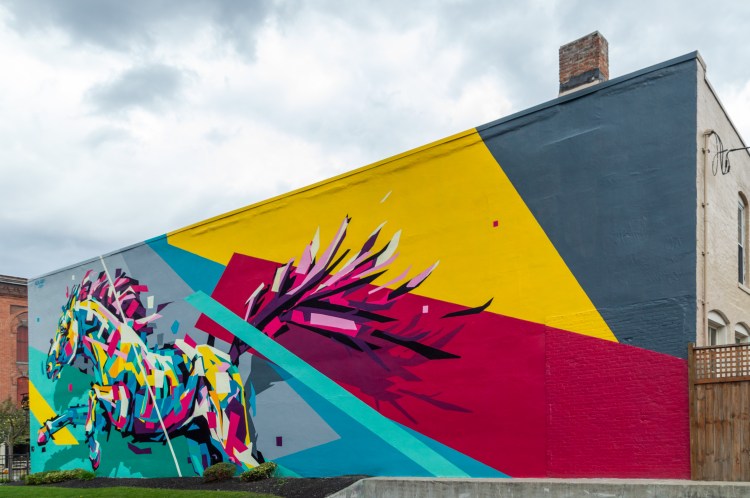
But I digress. Here are two more murals of Livingston County. I’ve actually been to four others to date (Avon, Caledonia, Leicester, and Lima), but I lost the photos! It’s the first time a memory chip has failed on me (besides the one in my brain, that is). It’s disheartening, but I can always go back and take more photos. I think the murals will be there for a while.

Next time, I’ll post recent photos of Mother Nature’s artwork: the colorful autumn leaves I’m seeing everywhere. Stay tuned!

Be sure to follow my blog so you don’t miss a thing! Just click below, and then look for the small blue button that says “Follow loristory.” Thanks!

Featured image by Wilfried Pohnke @ Pixabay.com.

The Curious Case of Life Imitating Art

The muse must have been looking over my shoulder yesterday because, unexpectedly, I stumbled upon a case of life imitating art. Or was art imitating life?

I’d spent most of the day walking my dog, talking with friends online, and reading Anna Quindlen’s novel, “Still Life with Breadcrumbs,” the story of a photographer whose career is in decline.

In late afternoon, I decided to take my car out for a spin, since the last time I’d started it up, it had been sluggish. I feared the battery was about to reach its moment of planned obsolescence. (That would be about par for 2020.) But I hoped that if I drove around for an hour or so, maybe I could revive it.

On a whim, I grabbed my camera before heading out (something I haven’t done in a while, since it’s been too hot during the day for photography). “You never know,” I thought, imagining for just a second a chance encounter with a dust devil, or maybe a space alien. The car sputtered to a reluctant start. Before it could die on me, I put it in gear and headed north.

My destination was Oracle, about half an hour up the road – an unincorporated town whose most famous resident to date has been Buffalo Bill Cody. En route, it occurred to me to plug in an audiobook that was in my phone.

Unfortunately, I’m not too good with modern audio systems in cars (or in phones, for that matter). In fact, I was surprised I’d managed to get the book copied into my phone at all. So as not to cause an accident, I turned off the main highway, Oracle Road, and onto Biosphere Road (which, inconsequentially, leads to Biosphere 2) in order to park, thumb through my owner’s manual, and figure out how to tell my car to read a book to me.

After a few hundred feet, I came to a turnaround. It looked like an ideal place for rattlesnakes and tarantulas to hang out, but I wasn’t planning to get out of the car and join their party, even if they were wearing masks. Heavy, dark storm clouds were gathering in the distance, and a few were above my head. I was anxious to queue up my book and get back on the road.

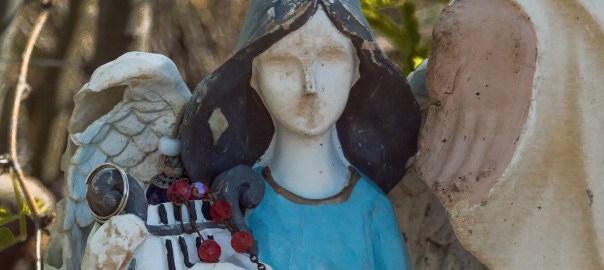
The clouds had other ideas. They suddenly moved out of the sun’s way, and a shaft of light landed on something smooth, tall, and bright along the trail: a scarred and dusty shrine in the middle of the desert.

It seemed to be a case of life imitating art. You see (spoiler alert), on page 37 in Still Life With Breadcrumbs, that book I’d been reading earlier that day, the protagonist goes for a hike in the woods and comes upon a shrine – a white wooden cross with a glittering child’s volleyball trophy lying on the ground next to it. She takes some photos.

I felt like life was trying to tell me something, so I shut off the engine, grabbed my camera, and got out of the car. Scoping out the ground for snakes or spiders, I cautiously approached the little memorial and took a few photos. As soon as I’d finished and gotten back in my car, I realized I might have made a mistake.

It was 107 degrees out, and there I was in the middle of the Arizona desert with a car whose battery was on its last legs. I wondered how long it would be before AAA could find me. I turned the key in the ignition. The engine choked for a few seconds, and then, reluctantly, it caught.

I sighed, turned the car around, and glanced back at the shrine, but by then the sun had ducked behind the clouds again; the scene was now in shadow. I’d gotten there just at the right moment.

All I could think of on the drive home was the phrase, “life imitates art.” So today I looked that up and learned a thing or two. The idea has been around since at least the time of Plato, who believed art was a poor imitation of life, and for that reason could be dangerous. Aristotle, on the other hand, welcomed art’s imitation of life. And Oscar Wilde’s take was that life imitates art more often than art imitates life. Even Dostoevsky got into the debate, describing it as more of a codependent relationship, where art imitates life, which then imitates art, causing life to owe its very existence to art.

As for me, I was totally flabbergasted by the way my life (finding the shrine) seemed to be imitating art (the book I’m reading). Or maybe art (the book) was imitating life (its pathos) which in turn was imitating art (the shrine). It’s something I thought was worth pondering, especially when I realized one more thread:

In “Still Life With Breadcrumbs,” the protagonist doesn’t notice a certain, possibly significant, detail on the cross until she gets home and enlarges the photo. That same thing happened to me – I didn’t notice the coins at the base of the statue until I got home. Can you spot them?

Shrine 5

I’ve searched online for other photos of this shrine but couldn’t find any, so I don’t know who it’s for. I wish I did. In any case, I think I’ll return soon and add some coins to their collection.


Yellow

YELLOW

In spring

yellow makes me feel like laughing

the tickle of a lemon breeze

ruffles my hair and

puckers my lips

In summer

it pours from the sun

like hot flat sheets of maple syrup

drenching my body

in liquid sugar

In autumn

yellow turns to orange

and licks my face like a ginger cat

purring

until I try to catch it

In winter

it’s a trickle of iced tea

dropping in to say

stick around

I’ll be back soon.

Acacia Flower

The Writer’s Brush

Have you ever been immersed in a book and suddenly been struck by the knowledge that the writing isn’t just good, it’s great?

Of course you have. But what exactly is it about the writing that gets to you? What hits you over the head and makes you say, “Wow”? Is it what the writer has to say, or how they say it?

To my mind, great writing requires both. It not only has to impart something worth saying, but it has to say it in a particularly artful way. I came across an example of this today while reading “One-Eyed Cat,” by Paula Fox.

This book is an example of how characters, setting, mood, plot, and theme all come together delicately yet quite powerfully. The author has something to say to young adult readers, and she says it with finesse. I couldn’t help but think “Wow” to myself several times while reading. Here’s an example of what I mean:

 “The stillness was deep as though the earth itself had drawn in its breath. The only thing moving was a wasp near the roof of the outhouse. Ned watched it as its circles grew smaller and smaller until, all at once, it disappeared. Probably its nest was there just under the roof. Maybe there were snakes in back of the outhouse where the tangled grass grew thick. He suddenly recalled how Janet had flung her whole self against Billy, how the snake had flown out of his hands. A thought was buzzing and circling inside his head, a thought that stung like a wasp could sting.”

With those few sentences, the author creates a silence, then fills it with small terrors. She has not only created a mood, she’s put us right inside of Ned’s head and made us feel the sting of the painful thought that Ned can’t just swat away. That sting is the tangible representation of the book’s central theme.

After that paragraph, I couldn’t stop turning the pages. I was in Ned’s head and I wanted to know how things would turn out. The theme was what hooked me, and the writing style made me a very willing catch.

cat-1460882_1280

And here’s another analogy: great writing is like great painting. The subject is important, but so is the execution. A splash of blue color on canvas is just that, unless it happens to be as majestically painted as Starry Night. A face could be quite boring unless it’s captured the mystery of the Mona Lisa or the terror of The Scream.

Great writing requires a solid subject and an artistic brush.

What examples of great writing have you read lately?

Life Imitates Art Garfunkel

It’s Tuesday, 11:30 p.m., Day 28 of the November Nano Poblano blog challenge, and I have to get to sleep soon.

I’m flying out in the morning, early. My alarm is set for Wednesday morning, 3:00 a.m.

I’m reminded of two songs:

“But the dawn is breaking, it’s early morn, the taxi’s waiting, he’s blowing his horn” — John Denver, Leaving On A Jet Plane

“The morning is just a few hours away” — Simon and Garfunkel, Wednesday Morning, 3 A.M.

Aristotle thought that art imitates life, and Oscar Wilde once said that life imitates art … but it seems that my life imitates Art Garfunkel.

Gee, I hope so. I’d love to sing like that some day.

In Carnegie Hall.

While standing next to Paul Simon.

But I’d stay friends with him until we were old.

Old friends.

Now, if I were flying to Denver, that would be like life imitating Art Garfunkel imitating John Denver. I’d like to see that.

Country Roads, bring me home across the 59th Street Bridge Over Troubled Water, to Scarborough Fair.

Coloring Club

Brick red. Maize. Pine green. Cornflower. Raw sienna. Sepia. Gold. Silver. Copper.

What am I talking about? The Crayola 64 crayon box, of course. To my mind, the set of 64 was the greatest collection of them all.

I’ll bet you can remember that good crayon smell. Do you remember how you always had to peel the paper on your favorite colors, and how heartbreaking it was when one of them broke? And how you never used white?

A brief history: The first crayon was invented in 1902. First there were 8, followed by 16, 24, and 48. And then there was the set of 64, in 1958, and it was so unbelievably perfect that it was unchanged until 1990. (Little known fact: the Crayola crayon with the gross and ridiculous name “flesh” was renamed “peach” in 1962.)

The reason I’m bringing this up is that I just got home from a meeting of the Tucson Coloring Club. It was like being a kid on my first day of kindergarten. I didn’t know anybody. I carried my supplies in a bag and set them down on an empty chair. I went to the lunch line, got my lunch, and ate it with someone I didn’t know. Then I joined the rest of my new friends at another table and began to color and talk. It was probably the most relaxed I’ve felt all week. I want to be five years old again.

The Tucson Coloring Club is just one of many local Meetup groups. I recently signed up for a few that sounded interesting, including a hiking group that’s probably about my speed (out-of-shape to intermediate) and another group that goes to dinners and plays together. I decided not to sign up for the Tucson Python Club or the Tucson Geek It Up. The coloring club seemed like a nice, easy way to get my feet wet. Besides, I already had one of those trendy adult coloring books lying around the house.

We met at one of my favorite cafés, Bentley’s, which is about 20 miles from home. I ordered coffee, quiche, and a salad because I was starving when I got there, and decided to eat at the counter next to the table, in case I spilled something. (I could just picture myself knocking over my coffee cup or splashing blue cheese dressing on somebody’s art project.) Unfortunately, that meant sitting with my back to the group for a while, but then someone else’s lunch arrived and she joined me. I felt like I fit in.

After eating, I rejoined the group at the big table and began to color. There were the usual questions about where I live and work, etc., but there was also ample time to just listen to others and to color quietly. Some people never talked at all, and that was okay, too. It was just such a relaxed and accepting group.

There was a 20-something ex-teacher who colored a complicated design in an art nouveau book. She told us that every time she finishes a page, she writes a letter on the back of it and sends it to her grandmother. She talked about her grandmother, who lives far away, doesn’t like to talk on the phone, and may be depressed. Their only way of communicating is through those pretty colored pages.

Then there was a 60-something man who used to work in the computer field. I think he’s retired now. His coloring project was a geometric design with big open spaces. He said he likes the big spaces because he doesn’t have to plan too much about which colors to choose. He was friendly, asked lots of questions, and (refreshingly) didn’t talk about himself very much.

And there was an occupational therapist who teaches others how to work with their hands, but who’s been diagnosed with MS and is losing her ability to work with her own hands. She discovered that she can hold on to gel pens pretty well (and I suspect it’s good therapy, too). She’s been trying to figure out ways to get out of the house now that she needs to use a motorized chair. She’s able to fold it up and put it into the trunk of her car, but when she gets places she needs help getting it out and unfolded. She’s going places anyway, and figuring it out as she goes along. “I don’t have any other choice,” she added with a smile. We discovered that, by sheer coincidence, she lives right around the corner from me. Looks like I may be carpooling with her if I stay in the group. She seems nice and, who knows, I may have found a new friend in my neighborhood.

Some of us talked about our favorite colors, how we choose colors, and whether we press lightly or hard when we color. One person opened up about why she moved away and then came back, touching on some family issues. Another talked about a friend whose daughter has been cutting herself. A man talked about how he was in counseling and has used art in therapy. For a bunch of strangers who spent less than two hours together, the topics we covered were pretty amazing.

It was just so nice to sit there and think about colors today. It literally brightened up my day.

*****

My new photo book about the Pacific Northwest, “Standing in the Surf,” is available in e-book and paperback formats here: