This post is about a part of Spain I’d never heard of … and it’s about my grandsons, too.
Yesterday, while listening to a local radio program about world reggae music, I was surprised to hear a reggae song described as Spanish, Celtic, and Galician. I’d never heard the terms “Spanish” and “Celtic” together in the same sentence. To me, Celtic meant Irish, Welsh, and Scottish. I couldn’t imagine a Spanish reggae song with a Celtic flair.
What’s more, I didn’t have the slightest idea what “Galician” meant. Curious, I Googled it and found a reference to a Galicia in eastern Europe. I thought I’d misheard the radio host and thought nothing more about it.
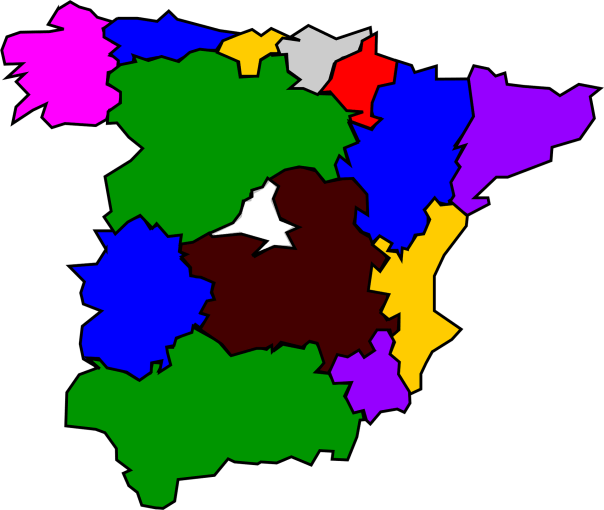
But then, later that evening, while reading a book about Spain (because I’m planning a trip there soon), I stumbled upon a map showing another Galicia – this one a region in the northwestern portion of the country … and the book said that Galicia’s language has Celtic roots.
Galicia is the bright pink region on this map, in the northwest corner of Spain.
Wow! I’d just learned something new about music, language, AND geography. I like learning new things. But today, in the car, when I asked my 10-year-old grandson Porter (who loves maps and history) if he’d ever heard of Galicia, the one in Spain, I learned even more.
Yes, he knew exactly where it was. He even expressed the opinion that the map of Spain would look much better if Galicia were part of Portugal!
He also already knew about Galicia’s Celtic ties, and when I wondered aloud how many languages were spoken in Spain, he mentioned not just Spanish, but Basque and Catalan, too.
After I told him I’d be visiting southern Spain soon, he said he thought there’d be a lot of history there because it was probably the oldest part of Spain. This led to a lively tutorial (by that I mean he tutored me) about Spain’s history, including key points like Charlemagne’s invasion and several Spanish conquests (Mexico, southwestern US, the Philippines, Cuba, and Equatorial Guinea). That’s right. My grandson knows something about the history of Equatorial Guinea, a small country in Africa.
Did I mention that he’s only 10 years old?
Meanwhile, his 6-year-old brother Elliot was quietly absorbing every word, and during a break in the conversation, he sweetly offered his own opinion:
“Grandma, when you come back from Spain, maybe you can tell us all about it … and if you get us anything while you’re there, you can give it to us then.”
Up until today, my main goals in traveling to Spain had been (1) brushing up on my Spanish conversational skills, (2) taking lots of awesome photos, and (3) steeping myself in Andalusian culture. But now, I have a much more important goal: finding a couple of really cool souvenirs for my grandsons.
That’s a question I recently asked some 5th grade boys, right before launching into my school presentation about poetry, which included a reading of my book, “Iguana in the Road.”
As a member of a local writer’s group, I’d been invited to participate in a literacy program for city youth. I was excited to be around students again, after having been retired from school psychology for 4 years.
I arrived early, hoping to set up my presentation before the students arrived. Unfortunately, I soon learned that there would be a substitute teacher that day.
Then I was informed by the Literacy Specialist that it was a “tough class.”
I knew I could handle that, but what ruffled me a bit was when my PowerPoint presentation wasn’t immediately recognized by the smart board in the classroom.
It was 8:00 a.m. on a Friday before a long weekend, and I’d been hoping my bright, colorful PowerPoint slides would wake the kids (and me) up, and keep us awake throughout the presentation.
I had a Plan B: I’d brought notes. But luckily, I didn’t have to use them! After about 5 minutes, a helpful staff member got the technology working, and my PowerPoint was up on the big screen. Yay! Now all I had to do was inspire a bunch of young boys to write poetry.
I began by holding up a cute stuffed iguana and asking, “What does an iguana have to do with poetry?” Admittedly, it wasn’t a fair question. They couldn’t possibly have known what I was leading up to. But one brave soul raised his hand.
“Eat,” he said.
“Eat?” I asked. He nodded.
“Okay … they both eat?” He nodded again. What could he have meant?
Maybe I misheard him, and what he really said was “neat” (as in “I like both”) or “feet” (as in the rhythmic pattern of poetry). In either case, maybe he should have been teaching the class instead of me.
I decided to move on quickly – and to keep the presentation lively. (A teacher friend of mine once told me that teaching is something like acting.) I believe my strategy worked, because the boys paid attention and were respectful and engaged throughout the entire hour.
I think having props like my cuddly stuffed iguana helped. I also had brought lots of books. I began by showing them a picture book about Gwendolyn Brooks, the first Black person to ever win a Pulitzer Prize. She won the prize for poetry, I informed them, and she wrote her first poem when she was seven years old. They seemed surprised by that.
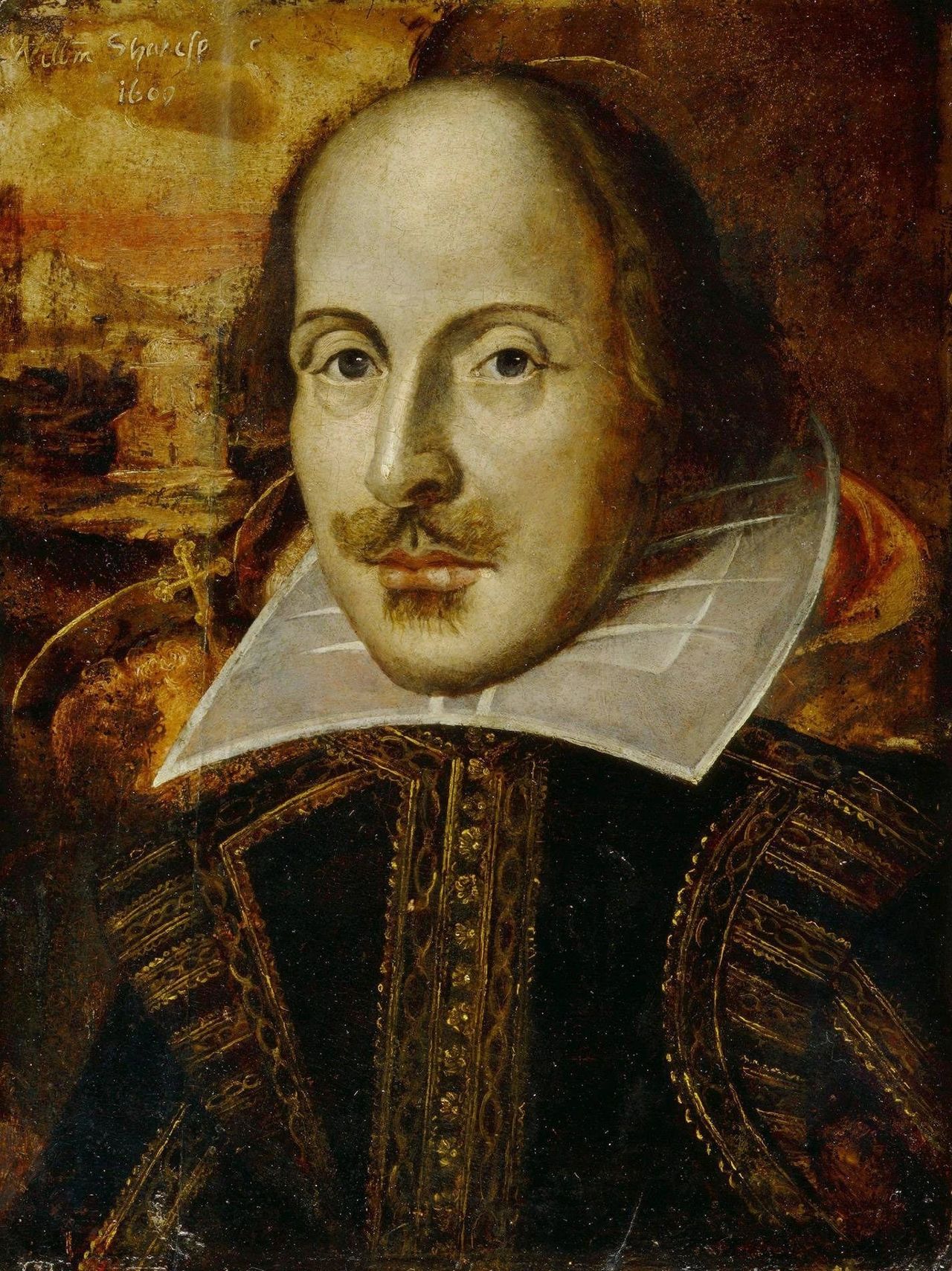
Next, I read short quotes about poetry from three famous poets: Amanda Gorman, William Shakespeare, and Kwame Alexander. They’d never heard of Amanda or Kwame, but one boy not only recognized the Bard, but knew his name.
William Shakespeare
I animatedly read a page from Kwame Alexander’s novel-in-verse, “The Crossover.” When I mentioned that the book is about twin brothers who play basketball, one boy raised his hand. “I’m a twin!” he said. When I said that the main character in the book is named Josh, he grinned. “I’m Josh!” he exclaimed. I was glad I’d chosen “The Crossover” to include in my talk. (P.S. I love that book!)
Kwame Alexander
I then listed the main ingredients in a poem (rhyme, rhythm, and repetition), read a poem as an example of rhyme, showed a photo of my dog (because kids like dogs, right?), and read a poem I’d written about my dog that used repetition.
I added other ingredients, such as comparison (simile and metaphor), and I read a poem my own daughter had written in 4th grade – one that used a metaphor. I wanted them to know as much about poetry as I could squeeze into an hour, without boring them to death.
I also stressed that a poem does not need to be long. As an example, I put Muhammad Ali’s famous poem (“Me. Whee!”) up on the board.
Then I dramatically announced that there were NO RULES! in poetry. I wanted them to relax and feel free to write whatever was in their hearts.
After that, I invited them to think of a topic and brainstorm a few words that could eventually become a poem. Classroom helpers passed out paper and pencils that had been provided by a grant from a local organization.
Several students asked for help with spelling. As I spelled out a word for one boy, he wrote it from right to left, each letter reversed. Some kids didn’t write at all. One child kept his head down on his desk most of the time. I knew from experience that could mean he hadn’t slept the night before, was hungry, or maybe was just trying to keep his emotions together. Whether they wrote or not wasn’t important to me. I was just glad they were listening, because I was hoping to plant some poetry seeds that day.
In the 5 minutes they had to think of topics and write, the majority of kids did write. I’m not sure I could have done that! Their rough drafts ranged from just a few words to whole paragraphs. Several volunteered to stand and read their works-in-progress to the class.
They wrote about football (one poem was a play-by-play description of a game), and about their pets. One of my favorite creations was this one:
“Chocolate, dog, no, no, no.”
Good use of repetition! And it says so much in just five words. After reading his poem aloud, the author explained what he meant (that dogs shouldn’t eat chocolate). This is a clear, concise, rhythmic poem, written in just a few minutes by someone who might never have written a poem before in his life. Bravo!
I concluded my presentation with a reading of “Iguana in the Road,” and moved on to my next assignment, a bilingual 5th grade class down the hall. (The school I visited is the largest bilingual elementary school in my city.)
Right away, I noticed a difference. The students seemed older, taller, quieter. They didn’t raise their hands or respond to my questions … not right away, at least.
But by the end of the presentation? Wow. Not only were they participating, but they were actively encouraging each other to participate, chanting their friends’ names to get them to stand on the “stage” (the front of the room) and to share their poems.
While they wrote, I offered assistance. As with the former class, many asked for help with spelling. One girl asked if it was okay to write in Spanish, or if she had to write in English. I told her it was fine to write in Spanish, and then I mentioned that to the rest of the class. As a result, several kids wrote poems in Spanish.
Since many were reluctant to read aloud, I offered to read their poems for them, including the ones in Spanish. At least ten children handed me poems to read, about half of them in Spanish. I think they were pleasantly surprised that I could read and understand them!
Thanks to the community grant, each child in the participating elementary schools received a free book that day! I was so grateful for the privilege of being part of this program and being among so many creative, talented, and helpful people.
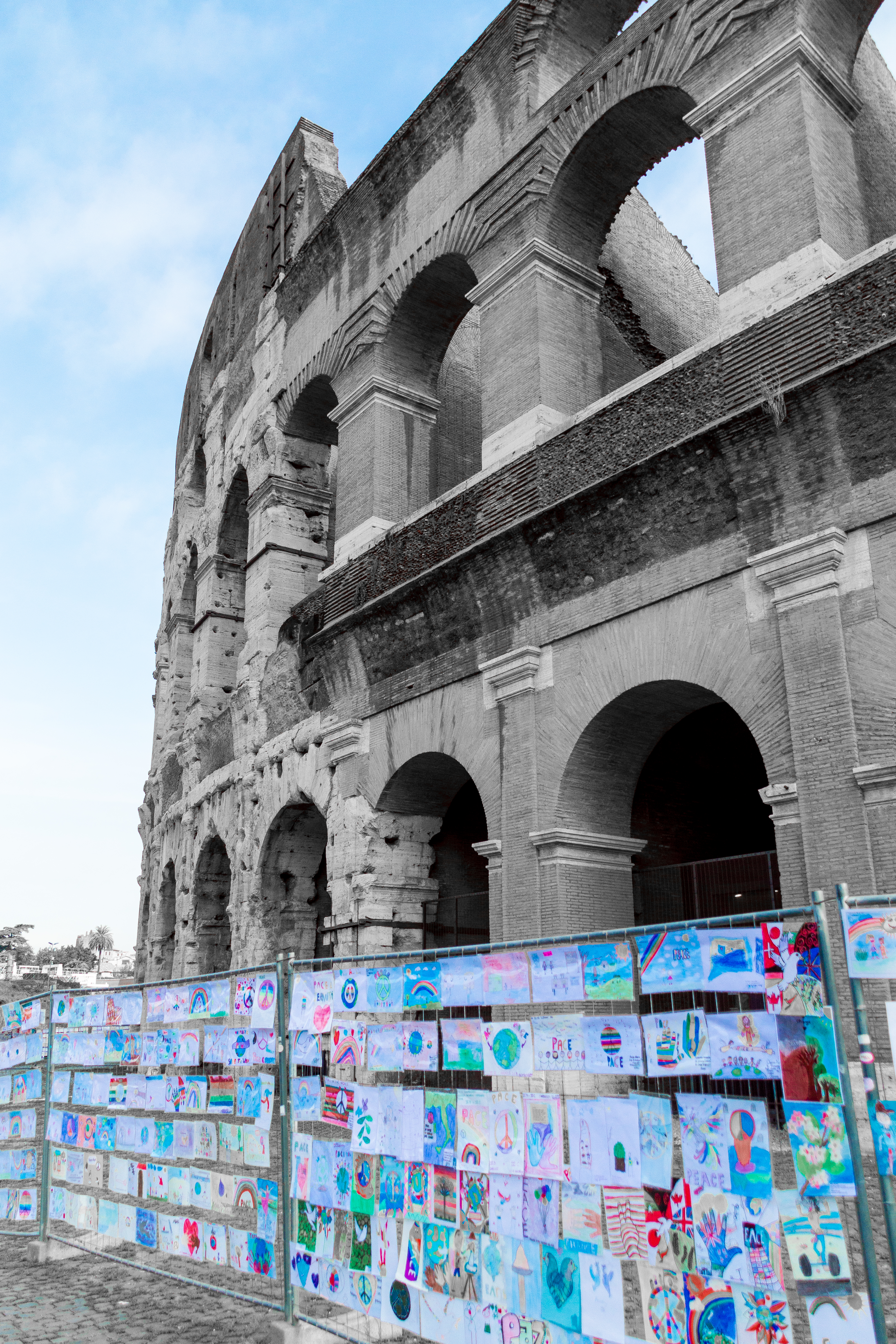
The Roman Colosseum, built between 72 A.D. and 80 A.D., is a symbol of brutality.
It is widely believed to have been built by tens of thousands of slaves. During some of the spectacles, it is said that 10,000 animals were slaughtered in a single day. Gladiators fought to their deaths and criminals were executed, all for the sheer entertainment of crowds of 50,000 or more. It is not my favorite place.
In fact, I never was very interested in Roman history, or in seeing the Colosseum. But when I was in Rome for two days in September with someone who did want to visit the Colosseum, I said, “sure, why not,” and went along.
It’s big. It’s old. And it’s kind of shocking to be strolling along on an ordinary cobblestone street, turn a corner, and there it is, looming over everything. Kind of spooky, actually.
But for me, the most compelling part about the Colosseum was the fence around it — a fence that was covered with children’s colorful drawings calling for peace. I loved the contrast.
Maybe there’s hope for this world yet.
This is post #3 for NanoPoblano2019. Click the link to read some other posts from a wonderful bunch of dedicated bloggers known as “cheer peppers.”
It rarely snows in Tucson, Arizona, but when it does, it’s a pretty big deal.
There was a dusting of snow to our north last night, and probably five inches of the stuff 25 miles up the road, in Oracle State Park, which is where I went today to take photos. The place was swarming with “snow peepers,” and some of them were building snowmen.
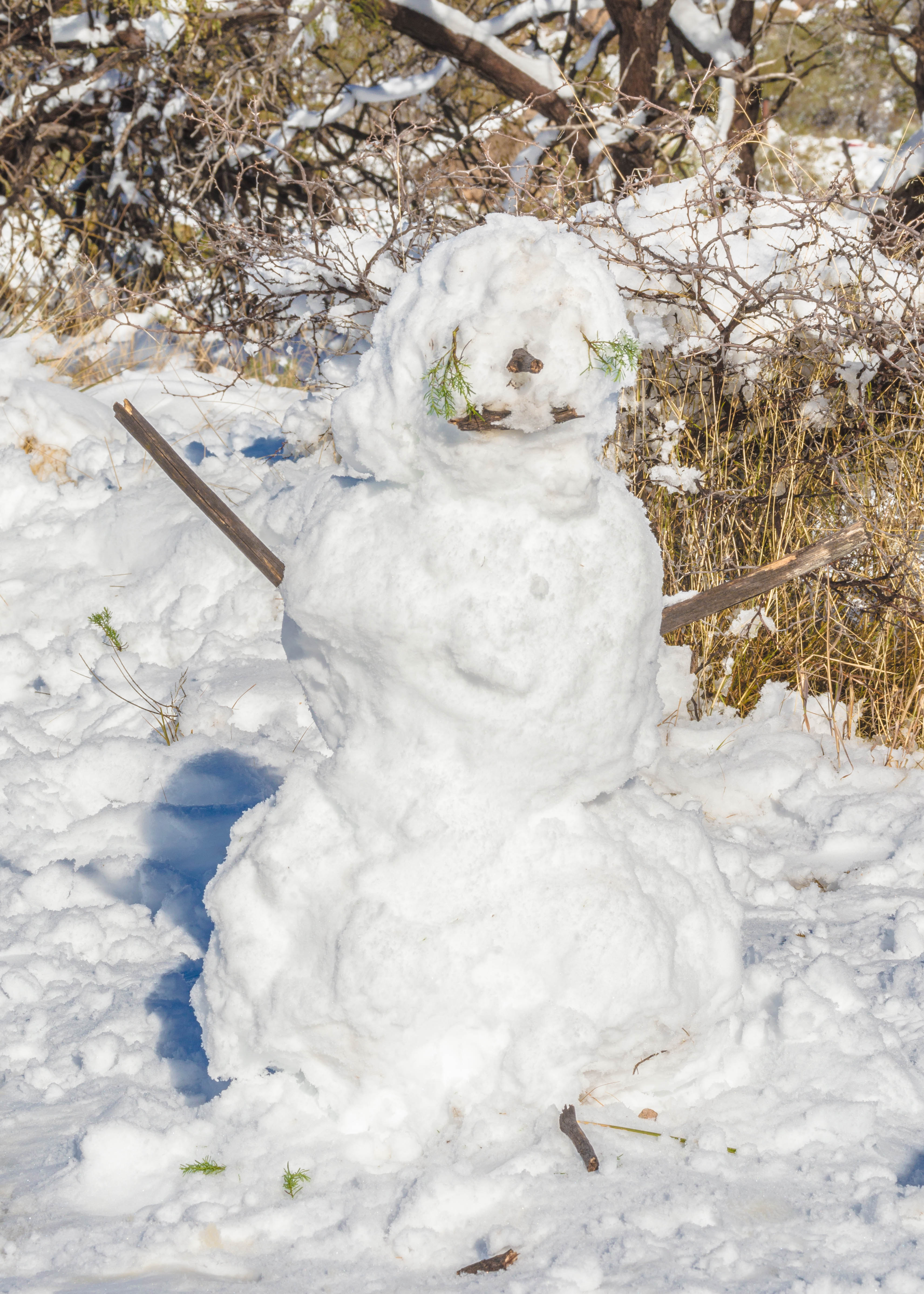
Here’s one of my snowmen photos. But this snowman isn’t really a man, is it? Because he (it?) has three ears (horns?) and wings (gigantic shoulder muscles?). Obviously, it was built by a bunch of men with issues. I won’t say what their issues are, but what’s that guy in the red jacket pointing at?
I do think this snowman is kind of lovable. Just look at that expression.
Here’s another snowman. This one is more typical of the ones I saw in Oracle today:
A 3-foot tall snow person with eyes made from a plant called “desert broom.”
Obviously, we southwest Arizona residents aren’t too good at building snowmen. But then, can you blame us? It only snows one day a year here! We need more practice.
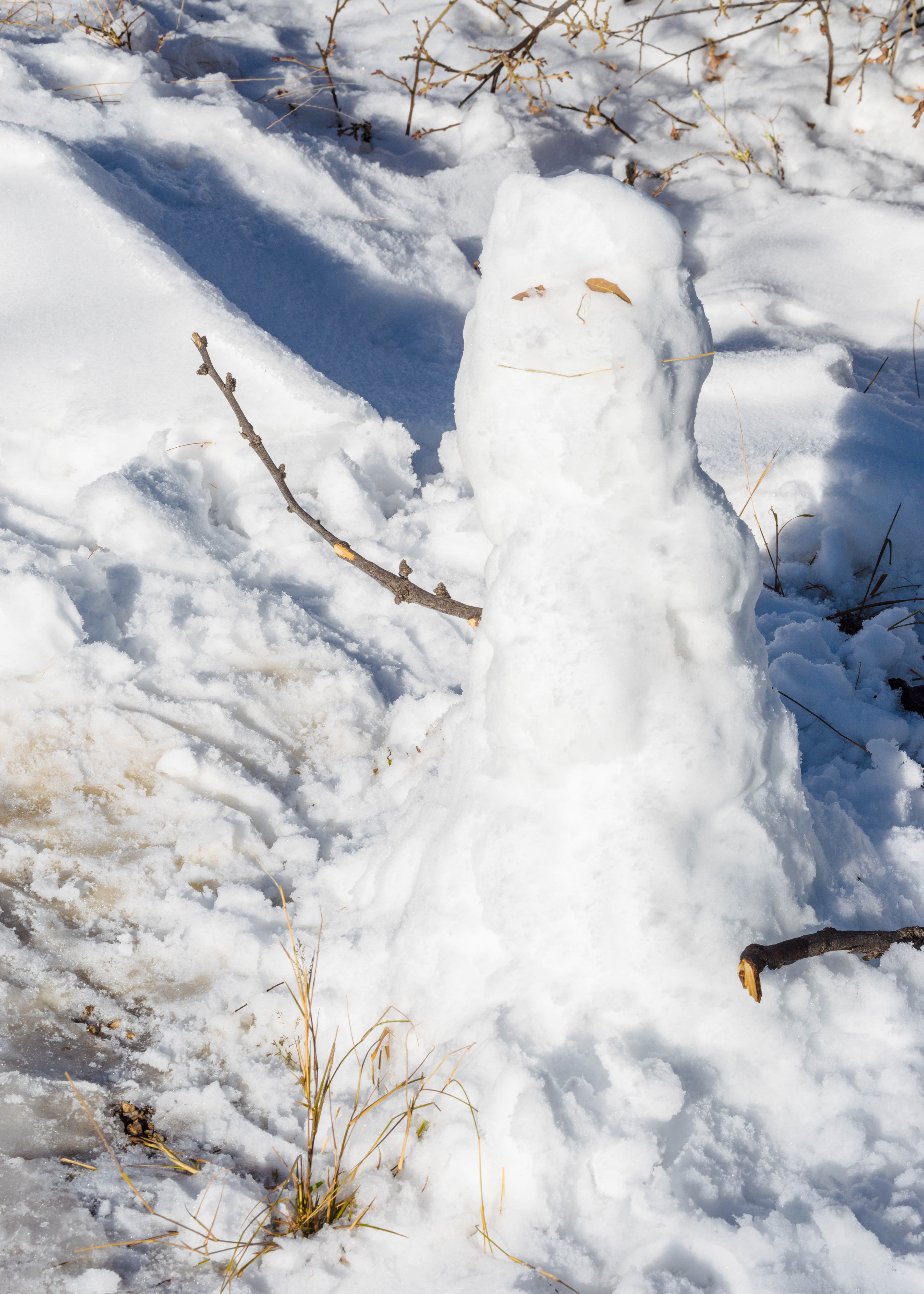
On my way out of the park, I spotted this 2-foot tall model pointing the way:
Actually, I think its arm fell off.
I think this minimalist sculpture was the best little snowman of all.
If you like snowmen, you’ll probably enjoy listening to my song about them, called “Gonna Build a Snowman.” It’s guaranteed to get you in touch with your inner child, and you can listen now, for free, here:
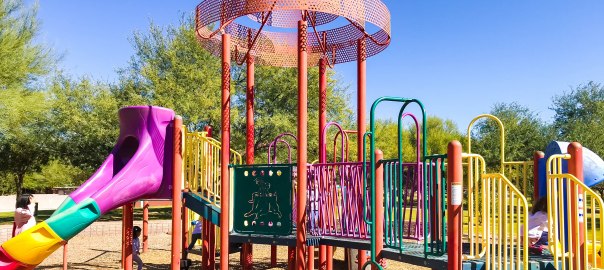
Yesterday, I walked to a little park near my apartment. It was a beautiful day. People of all ages, shapes, and sizes were out walking and riding bikes. A gray-haired woman sat on a bench in the sun next to a young woman with Down syndrome. A bald man on a recumbent bike sat quietly next to a statue, a memorial to children in the community who have died. Children played on a rainbow-colored slide. I noticed that it was also a rainbow-colored variety of children; their hair was black, brown, and yellow. It got me thinking about America.
It’s hard NOT to think about America these days (especially if, like me, you happen to be an American). We’re in the news every day, and most of it’s downright embarrassing. But at the park, I started thinking about what I believe truly makes America great. To me, it’s our diversity.
Maybe this Thanksgiving, Americans should make more of an effort to give thanks for our diversity. And maybe we should celebrate it this Fourth of July, too.
Tonight, I’ve written some lyrics about diversity in America. You might want to sing them to the tune of “America the Beautiful” while sitting down for your Thanksgiving dinner this year.
DIVERSITY
Oh beautiful for this our home
For mountains, rivers, trees
For buffalo so plentiful
Fish swimming in the seas
For Native people living here
Respectful of the land
The beans and corn and squash adorned
That perfect feast so grand
Oh brave the many immigrants
Who faced the ocean storms
With hopes of finding better lives
Wishing to be transformed
And braver still the stolen ones
Robbed of their liberty
Our country’s been a melting pot
Though not completely free.
We stand for nothing if not this:
We are diversity
A land of many colors proud
That is our legacy
America, America
Our strength: our many shades
A garden where all flowers grow
Where every grain can wave!
I was raised Catholic, but don’t jump to any conclusions. Yes, my experience was frightening, but not in the way one might assume. It was a nun who scared the bejeezus out of me.
I was 11 years old and attended public school, but as a member of the local Catholic parish, I was required to attend “religious instruction” every Monday afternoon. (To this day, I’m not too fond of Mondays.)
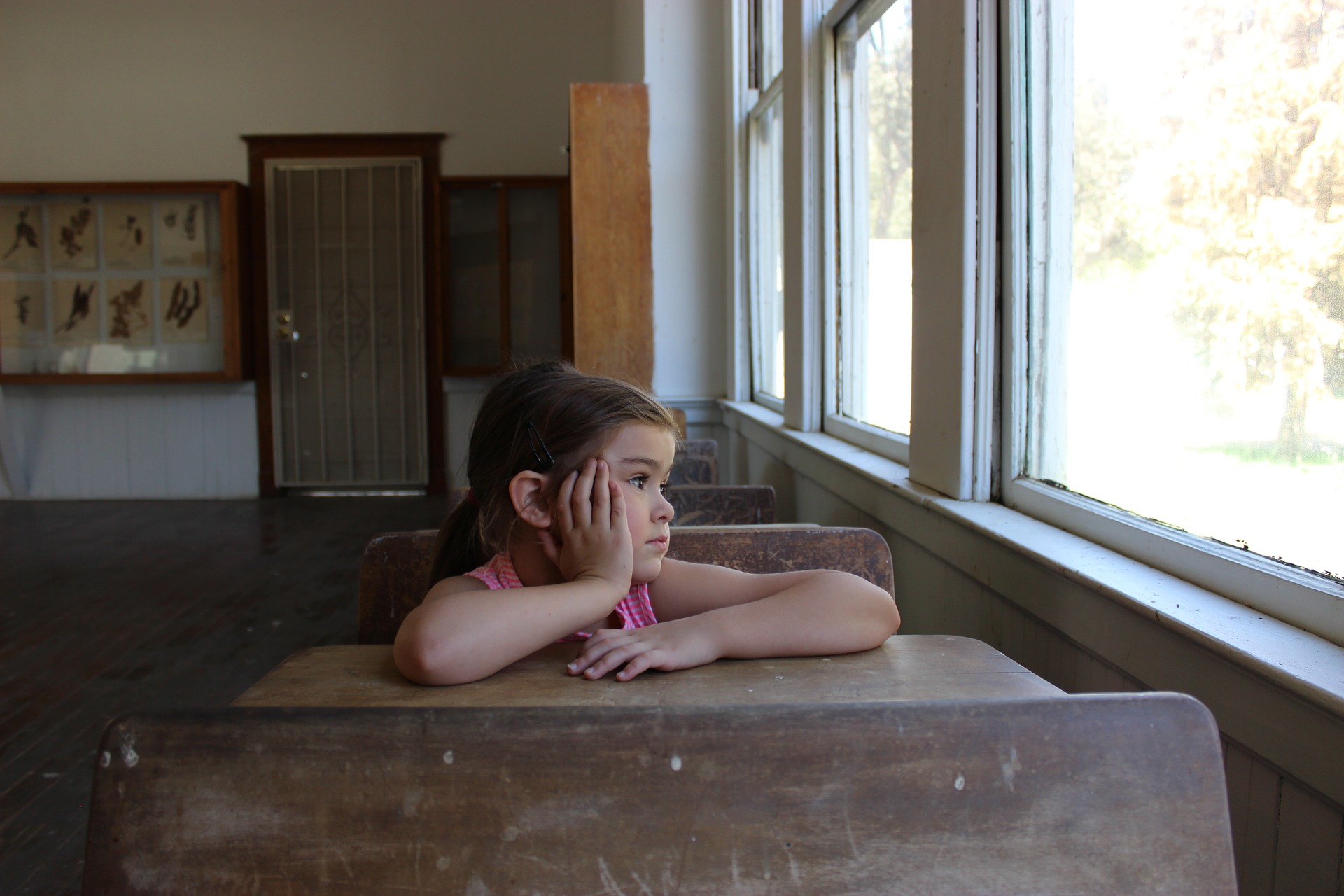
The “instruction” in those days consisted of nuns forcing us to memorize answers to the questions in the Catechism (something we were too young to understand) while we sat for what seemed like hours confined to wooden desks (the kind that were attached to each other, with little inkwells and fancy wrought-iron scrollwork on the sides).
I was a good little Catholic. Most of the time I paid attention to what the nuns were saying. Some of the time I stared out the window, and occasionally I just wondered how the Catholic school kids could stand those weird little desks.
I wish I had spent more time staring out the window and less time listening to the nuns, because one thing a nun said had a traumatic effect on me. She was talking about sin, and the right way to go about Confession.
At Confession, we were supposed to walk into a tiny wooden space about the size of a closet, close the curtain behind us, kneel on a hard board, and wait until a faceless shadow appeared behind a sliding door. Pretty scary so far, right? Then we had to tell the faceless shadow (the priest) all of the “sins” we’d committed since our last Confession. Sin had been described to us as black marks on our pure white souls, marks that could only be erased by going to Confession.
We were taught that if we died with sins on our soul, we had to suffer before we could get into heaven. And God forbid we should die with a “mortal” sin on our soul. (Mortal sins were serious crimes, like murder, or coveting our neighbor’s wife, or swearing, and other shit like that.) If we’d done any one of those things and then had the misfortune to die without getting to Confession first, we were doomed to a fiery Hell. At least that’s what we were taught back then. We were taught those things beginning when we were only seven years old, the “age of reason” according to the Church.
It was bad enough having to go to Confession, and to be introduced to concepts of death and suffering at such a tender age, but forcing us to memorize and recite answers to God-questions like brain-dead parrots was unforgivable.
But the worst part, for me, was what one particular nun told us during religious “instruction” when I was 11 years old. She said that if we forgot to tell a sin during our Confession, it totally negated the whole Confession. We would get back ALL of the sins we’d confessed that day. They’d stick to our souls like glue until our next Confession. And then if we still forgot to confess the sin, we’d get all of THOSE sins back, too. In other words, if we made one tiny mistake during a Confession, it was almost guaranteed that we’d be going to Hell forever.
I was terrified. I convinced myself that I’d probably forgotten to tell one of my sins once, but because I’d forgotten it, there was no way I’d ever be able to confess it, and so I was going to Hell for sure.
Hell. Permanent, everlasting suffering of the worst kind. Eleven years old.
I didn’t know what to do. I held on to my fears and was afraid to share them with anyone. I started to worry about every little thing I did or did not do being a sin. For example, when my mother made a minor suggestion, not doing what she had suggested was a sin. When my teacher read chapters of “Tom Sawyer” aloud in class, I tried to shut out the words and think about something else because one of the characters said a swear word, and listening to it would be a sin.
I was extremely stressed, to say the least. One day I broke down in front of my parents. I just wasn’t able to hold it in anymore. Luckily, they realized I needed help. My mother took me to talk to the parish priest, Father O’Neill. I will never forget him.
He was big and round, with round glasses, black hair, and a kind face. I went into the room with Father O’Neill and told him what was troubling me. His reaction was to say this:
“None of this will matter in ten years.”
and this:
“At your next Confession, come to me. Say you’re the girl who is ‘scrupulous’. I’ll make sure that all your sins are forgiven.”
Trusting that he had some kind of magical pipeline to God, I did what he said, and immediately was cured of my fears. About two years later, perhaps I actually HAD reached the age of reason, and I decided that the Catholic church was not for me. I stopped going to church and didn’t feel an ounce of guilt.
Some people say that this obsessive worry about religion is a form of OCD or anxiety, while others feel it’s just a natural reaction to a traumatic event. In my case, I’m convinced it was a natural reaction to a series of frightening ideas presented to an impressionable child by a well-meaning but misguided adult.
I’m thankful to my parents for getting me help, and to Father O’Neill for figuring out a simple solution that worked for me. I know now that I was mistaken to believe that the only way to salvation was through him, but it was the band-aid that helped me heal.
Yesterday, I attended the 2018 Arizona SCBWI (Society of Children’s Book Writers and Illustrators) conference.
I learned a ton of information about writing everything from picture books to YA, both fiction and non-fiction, and I came away with so many fresh ideas that I think my brain is going to explode very soon. But wait — that just gave me an idea for a picture book called, “My Brain Feels Like It’s Exploding.”
The book sample that I had submitted to the conference was not one of the few chosen for a face-to-face critique by an agent, but I did receive a constructive and thoughtfully-written critique from a knowledgeable and experienced children’s book editor. For that I am forever grateful. So maybe I should write the definitive YA self-help book on “How to Handle Criticism.”
My First Page submission was not one of the 15 or so selected to be discussed by the faculty panel, but I gleaned important insights from the panel’s comments about others’ writing. Now that I have those insights, I’m actually glad mine wasn’t chosen to be showcased. I probably would have jumped up, knocked over my coffee, and tipped everyone off that the anonymous, flawed first draft up on the two gigantic screens was mine. How embarrassing that would have been! And now I have an idea for a Middle Grade science book: “Why People Blush.”
I was not sought out by agents wanting to sell my books, as I had secretly dreamed. One agent did ask me for my “elevator pitch” (after I’d delicately broached the subject), but I stumbled through it, and I don’t think I impressed her. Besides, she specializes in a totally different genre.
I didn’t even win a door prize.
But I LOVED the conference. It was stimulating, informative, inspiring, and friendly. I met some really nice writers, agents, editors, and illustrators, and I’m eagerly looking forward to being in touch with them and seeing them at the next writing conferences and events.
Within hours of the conference closing, I was back at it, revising not one but two books that I’m currently working on. And I plan to keep writing and revising and attending writer’s conferences forever. And thinking up goofy book ideas.